

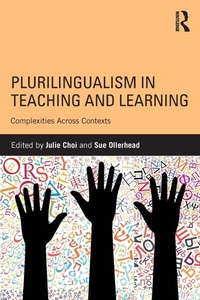
Plurilingualism in Teaching and Learning
Complexities Across Contexts
1st Edition
Published on 20. December 2017
Book
Paperback/Softback
244 pages
978-1-138-22849-8 (ISBN)
Description
Assembling a rich and diverse range of research studies on the role of plurilingualism across a wide variety of teaching and learning settings, this book supports teacher reflection and action in practical ways and illustrates how researchers tease out and analyze the complex realities of their educational environments. With a focus on education policies, teaching practices, training, and resourcing, this volume addresses a range of mainstream and specialized contexts and examines the position of learners and teachers as users of plurilingual repertoires. Providing a close look into the possibilities and constraints of plurilingual education, this book helps researchers and educators clarify and strengthen their understandings of the links between language and literacy and offers them new ways to think more rigorously and critically about the language ideologies that shape their own beliefs and approaches in language teaching and learning.
Reviews / Votes
"[W]e can gain insights from the multifarious ways in which the authors of the articles collected in this volume have critically engaged with [the] complex issues in each of their diverse contexts. What unifies them is the commitment to a candid and critical discussion of how to serve students' best interests amidst all these new competing policy discourses and institutional regimes."--Angel M. Y. Lin, The University of Hong Kong
"Plurilingualism in teaching and learning's greatest value lies in the range of voices and perspectives it presents, of different people enriching education through language diversity. [...] I highly commend this volume to you as a guide for your investigations into language diversity and how it best fits within your practice. "
--Elizabeth Gunn, Fine Print, the journal of the Victorian Adult Literacy and Basic Education Council
More details
Language
English
Place of publication
London
United Kingdom
Publishing group
Taylor & Francis Ltd
Target group
College/higher education
Illustrations
14 s/w Photographien bzw. Rasterbilder, 6 s/w Zeichnungen, 5 s/w Tabellen
5 Tables, black and white; 6 Line drawings, black and white; 14 Halftones, black and white
Dimensions
Height: 229 mm
Width: 152 mm
Thickness: 14 mm
Weight
385 gr
ISBN-13
978-1-138-22849-8 (9781138228498)
Copyright in bibliographic data and cover images is held by Nielsen Book Services Limited or by the publishers or by their respective licensors: all rights reserved.
Schweitzer Classification
Other editions
Additional editions
E-Book
01/2018
1st Edition
Routledge
€68.49
Available for download
E-Book
01/2018
Routledge
€68.49
Available for download
Book
12/2017
1st Edition
Routledge
€206.50
Shipment within 10-20 days
Persons
Julie Choi is a Lecturer in Education (Additional Languages) in the Melbourne Graduate School of Education at the University of Melbourne, Australia.
Sue Ollerhead is a Lecturer in Literacies and English as an Additional Language in the School of Education at the University of New South Wales, Sydney, Australia.
Sue Ollerhead is a Lecturer in Literacies and English as an Additional Language in the School of Education at the University of New South Wales, Sydney, Australia.
Content
1. Introduction Part I Plurilingual language-in-education policies 2. Provision, policy and reasoning: The pluralisation of the language education endeavor 3. Mother-tongue based multilingual education in the Philippines: Perceptions, problems and possibilities 4. Bypassing unrepresentative policies: What do Indigenous Australians say about language education? Part II Plurilingual student repertoires 5. The translingual advantage: Metrolingual student repertoires 6. An expanded view of translanguaging: Leveraging the dynamic interactions between a young multilingual writer and machine translation software 7. Keeping the plurilingual insight: Visualising the literacies of out-of-school children in northern Ghana Part III Plurilingual classroom practices and teacher perspectives 8. Translingual innovation within contact zones: Lessons from Australian and South African schools 9. Plurilingualism and agency in language education: The role of dramatic action-oriented tasks 10. The plurilingual life: A tale of high school students in two cities Part IV Plurilingualism in higher education contexts 11. Transforming lexicon, transforming industry: University lecturers as language planners in Timor-Leste 12. Challenging the quiet violence of a powerful language: Translanguaging towards transformative teaching in South African universities 13. From linguistic preparation to developing a translingual mindset: possible implications of plurilingualism for researcher education