

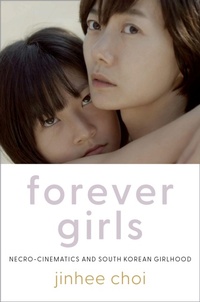
Forever Girls
Necro-Cinematics and South Korean Girlhood
Published on 26. May 2025
Book
Paperback/Softback
224 pages
978-0-19-768579-2 (ISBN)
Description
Forever Girls explores girlhood manifest in contemporary South Korean cinema within the conflicting socio-political forces that shaped the nation: coloniality, postcolonial and postwar traumas, modernity, and democracy. Author Jinhee Choi reorients the direction of current scholarship on contemporary South Korean cinema from patriarchy, masculinity and violence, to instead consider girls as a social imaginary.
Drawing on the depiction of girlhood from the 1970s as a reference image, including that of low-wage working-class girls, Choi explores the extent to which the form of girlhood represented in the millennial South Korean cinema still resonates with such an image. From the popular teen pictures and male auteurs' work of the 1970s; to a contemporary film cycle on military sexual slavery ("wianbu"); to Bong Joon-ho's girl trilogy; and to South Korean independent cinema of 2010s directed by women, Choi focuses on girls' sexuality, labor, and leisure, and demonstrates how girls in contemporary South Korean cinema are increasingly represented to have agency (albeit still limited); they are subjects who remember the past, experience the present, and envision the future, and whose interiority lies beyond their status as victims of sexual violence and national trauma. Choi further critically engages with the girlhood associated with unproductivity and dismissed as mere irreality. In contrast, she foregrounds how cinema could adequately mourn girls' deaths and grant them shelter and idleness as part of what is desperately needed: the very girlhood that has long been denied.
Drawing on the depiction of girlhood from the 1970s as a reference image, including that of low-wage working-class girls, Choi explores the extent to which the form of girlhood represented in the millennial South Korean cinema still resonates with such an image. From the popular teen pictures and male auteurs' work of the 1970s; to a contemporary film cycle on military sexual slavery ("wianbu"); to Bong Joon-ho's girl trilogy; and to South Korean independent cinema of 2010s directed by women, Choi focuses on girls' sexuality, labor, and leisure, and demonstrates how girls in contemporary South Korean cinema are increasingly represented to have agency (albeit still limited); they are subjects who remember the past, experience the present, and envision the future, and whose interiority lies beyond their status as victims of sexual violence and national trauma. Choi further critically engages with the girlhood associated with unproductivity and dismissed as mere irreality. In contrast, she foregrounds how cinema could adequately mourn girls' deaths and grant them shelter and idleness as part of what is desperately needed: the very girlhood that has long been denied.
More details
Language
English
Place of publication
New York
United States
Target group
College/higher education
Product notice
Paperback (trade)
Unsewn / adhesive bound
Illustrations
30 halftone illustrations
Dimensions
Height: 230 mm
Width: 152 mm
Thickness: 12 mm
Weight
334 gr
ISBN-13
978-0-19-768579-2 (9780197685792)
Copyright in bibliographic data and cover images is held by Nielsen Book Services Limited or by the publishers or by their respective licensors: all rights reserved.
Schweitzer Classification
Other editions
Additional editions

Book
03/2025
Oxford University Press Inc
€106.64
Shipment within 15-20 days

E-Book
02/2025
OUP eBook
€28.49
Available for download

E-Book
02/2025
OUP eBook
€28.49
Available for download
Person
Jinhee Choi is a Professor of Film Studies at King's College London, UK. She's the author of South Korean Film Renaissance: Local Hitmakers, Global Provocateur (2010) and has edited Reorienting Ozu: A Master and His Influence (2018) and co-edited Cine-Ethics: Ethical Dimensions of Film Theory, Practice and Spectatorship (2014). She has published widely on East Asian popular cinemas, film and urban space, food and film, and philosophy of film in numerous journals and edited volumes.
Content
Acknowledgements
Introduction
Chapter 1: Reference Girl: 1970s Girls
Chapter 2: Girls who Disappear; Girls who Remember: From the Writing to Speaking Subject
Chapter 3: Death of a Girl: Necro-cinematics and Bong Joon-ho's Girl Trilogy
Chapter 4: Directing Girls: Korean Independent Women Directors and Girlhood
Chapter 5: Idle Girls: Sunny (2011), Miss Granny (2014) and Queen of Walking (2015)
Afterword
Filmography
Bibliography
Index
Introduction
Chapter 1: Reference Girl: 1970s Girls
Chapter 2: Girls who Disappear; Girls who Remember: From the Writing to Speaking Subject
Chapter 3: Death of a Girl: Necro-cinematics and Bong Joon-ho's Girl Trilogy
Chapter 4: Directing Girls: Korean Independent Women Directors and Girlhood
Chapter 5: Idle Girls: Sunny (2011), Miss Granny (2014) and Queen of Walking (2015)
Afterword
Filmography
Bibliography
Index