

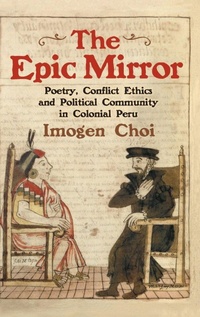
The Epic Mirror
Poetry, Conflict Ethics and Political Community in Colonial Peru
Published on 18. February 2022
Book
Hardback
240 pages
978-1-85566-347-3 (ISBN)
Description
How did Spanish-American writers and veterans in the late sixteenth and early seventeenth century use epic poetry to search for ethical solutions to the violent conflicts of their age?
Winner of the 2017-18 AHGBI-Spanish Embassy Publication Prize
The Epic Mirror studies how Spanish-American writers and veterans in the late sixteenth and early seventeenth century used epic poetry to search for ethical solutions to the violent conflicts of their age. The wars about which they wrote took place at the frontiers of the Spanish empire, where new political communities were emerging: fiercely independent Amerindian republics, rebellious Spanish settlers, maroon kingdoms of fugitive African slaves. This colonial reality generated a distinctive vision of just warfare and political community.
Working across the fields of Hispanic literature, the history of political thought, and studies of empire, colonialism and globalisation, Choi reinterprets three major works of colonial Latin American literature: Alonso de Ercilla's La Araucana (1569-90), Pedro de Ona's Arauco domado (1596), and Juan de Miramontes Zuazola's Armas antarticas (1608-9). She argues that these works provide a rare insight into the development of political thought in Viceregal Peru. Through the imaginative mirrors of epic, the reader is forced to ask the same questions of the unfinished conquests of the Americas as of those in Africa, Asia or Europe: when conflicting forces are divided by irreconcilable world views, even if the war is won, how is it possible to achieve peace?
Winner of the 2017-18 AHGBI-Spanish Embassy Publication Prize
The Epic Mirror studies how Spanish-American writers and veterans in the late sixteenth and early seventeenth century used epic poetry to search for ethical solutions to the violent conflicts of their age. The wars about which they wrote took place at the frontiers of the Spanish empire, where new political communities were emerging: fiercely independent Amerindian republics, rebellious Spanish settlers, maroon kingdoms of fugitive African slaves. This colonial reality generated a distinctive vision of just warfare and political community.
Working across the fields of Hispanic literature, the history of political thought, and studies of empire, colonialism and globalisation, Choi reinterprets three major works of colonial Latin American literature: Alonso de Ercilla's La Araucana (1569-90), Pedro de Ona's Arauco domado (1596), and Juan de Miramontes Zuazola's Armas antarticas (1608-9). She argues that these works provide a rare insight into the development of political thought in Viceregal Peru. Through the imaginative mirrors of epic, the reader is forced to ask the same questions of the unfinished conquests of the Americas as of those in Africa, Asia or Europe: when conflicting forces are divided by irreconcilable world views, even if the war is won, how is it possible to achieve peace?
Reviews / Votes
The Epic Mirror es un estudio muy relevante para la discusion sobre poesia epica americanista y la poesia epica en general. Es una investigacion que no solo es novedosa por las lecturas que nos presenta de la poesia epica, sino tambien por la manera en que relaciona sus aspectos formales con la discusion politica, etica y moral que se entreve en sus octavas. En cuanto a la discusion especifica sobre la poesia epica colonial peruana, este libro es un acierto en tanto que sostiene una lectura articulada sobre el desarrollo de este tipo de poesia, la evolucion de las ideas politicas y la importancia de la ciudad de Lima como centro interconectado del Imperio hispanico.The Epic Mirror is a very important intervention into debates about American epic poetry and epic in general. Its novelty resides not only in the readings of the poems, but also the way in which formal aspects are related to the political, ethical and moral dimension we glimpse in their verses... the book successfully achieves a coherent reading of the development of [epic in Colonial Peru], the evolution of political ideas and the importance of the city of Lima as an interconnected centre of the Hispanic empire. -- Maria Gracia Rios Taboada, Pontificia Universidad Catolica del Peru * BULLETIN OF THE COMEDIANTES * The Epic Mirror alimenta de una manera rigurosa, inteligente y novadora dos campos de investigacion a los que su autora, Imogen Choi, contribuyo de forma notable a lo largo de la pasada decada: no solo participa en la fecunda tradicion critica que lee la epica como un genero politico, sino que tambien alimenta el esfuerzo actual de reconstitucion del "paisaje literario colonial" (35), prosiguiendo con la tarea emprendida en The Rise of Spanish American Poetry (2019) y colocando "los confines del imperio [. . .] en el centro del escenario" (1).
The Epic Mirror feeds in a rigorous, intelligent and innovative way into two fields of research to which the author, Imogen Choi, has contributed significantly over the past decade: not only the rich critical tradition of reading epic as a political genre, but also recent efforts to reconstitute the 'colonial literary landscape' (35), continuing with the task begun in The Rise of Spanish American Poetry (2019) and placing 'the confines of the Spanish empire... centre stage' (1). -- Aude Plagnard, Universite de Montpellier Paul-Valery * CALIOPE * Amongst a growing field of scholars currently re-assessing the inventiveness and experimentation of Iberian epic poetry, The epic mirror confirms Imogen Choi as one of the most discerning and original readers of long narrative poems from the sixteenth and seventeenth centuries. Her insights into how novel political ideas are developed (often obliquely or through an allegorical lens) in epic poetry go a long way to explain the enduring appeal of this genre in Spain and colonial Spanish America. -- Emiro Martinez-Osorio, York University, Canada * Colonial Latin American Review * Imogen Choi's thorough and elegantly written The Epic Mirror: Poetry, Conflict Ethics and Political Community in Colonial Peru (London: Tamesis, 2022) highlights how a trio of lengthy epic poems-Alonso de Ercilla's La Araucana, Pedro de Ona's Arauco domado, and Juan Miramontes Zuazola's Armas antarticas-intertwine. Offering a new framework to read these poems and to encourage more research, Choi argues that they are the product of early colonial wars and conflicts, which dramatized contemporary debates on juridical theories of natural law, humanist perceptions on the ethics of war, and political treatises on how conquest and colonization affected communities. -- Victoria Rios Castano, Coventry University * THE YEAR'S WORK IN MODERN LANGUAGE STUDIES * Choi's analysis presents ample information on what the Hispanic epic poetry of the sixteenth and seventeenth centuries, in particular, who wrote these texts and who their readers were. Her conclusions on the links between ethics and politics in relation to literature reveal the cultural value of the works of Ercilla, Ona and Miramontes and help to understand the cultural complexity of the historical period examined. -- Raul Marrero-Fente, University of Minnesota * BULLETIN OF SPANISH STUDIES * With its strong conceptual apparatus, its rigorous use of historical information and its piercing capacity for analysis, this book marks an advancement in many areas which the best criticism on colonial epic has only begun to discover in the last few years. Most significant is the fundamental argument of the book: how imitative models can be used as mirrors of good government... In this sense, the book opens up new paths for interpreting colonial epic. -- Javier Navascues, Universidad Navarra * RILCE: REVISTA DE FILOLOGIA HISPANICA * Without a doubt, what is set out in this monograph can and should be developed beyond the three poems it considers and should lead to new ways to analyse the treatment of colonial conflict in contemporary literature, as the author herself proposes. This is a path explored by the author with great incisiveness, discussing aspects and passages of the works with great historical rigour, and making of this monograph an important contribution to the study of Hispanic epic. -- Lara Vila, Universidad Girona * STUDIA AUREA *
More details
Series
Language
English
Place of publication
Woodbridge
United Kingdom
Publishing group
Boydell & Brewer Ltd
Target group
Professional and scholarly
Product notice
Cloth over boards
Dimensions
Height: 240 mm
Width: 161 mm
Thickness: 18 mm
Weight
529 gr
ISBN-13
978-1-85566-347-3 (9781855663473)
Copyright in bibliographic data and cover images is held by Nielsen Book Services Limited or by the publishers or by their respective licensors: all rights reserved.
Schweitzer Classification
Other editions
Additional editions
E-Book
02/2022
1st Edition
Boydell & Brewer Ltd
€48.99
Available for download
E-Book
02/2022
1st Edition
De Gruyter
€48.99
Available for download
Person
IMOGEN CHOI is Associate Professor of Spanish at the University of Oxford.
Content
Introduction
1. Political Community and Just War in the City of Lima
2. Republicanism, Rebellion and Empire in Alonso de Ercilla's La Araucana
3. The Golden Mean of Colonial Governance in Pedro de Ona's Arauco domado
4. Defence, Desire and Community in Juan de Miramontes Zuazola's Armas antarticas
Conclusion
1. Political Community and Just War in the City of Lima
2. Republicanism, Rebellion and Empire in Alonso de Ercilla's La Araucana
3. The Golden Mean of Colonial Governance in Pedro de Ona's Arauco domado
4. Defence, Desire and Community in Juan de Miramontes Zuazola's Armas antarticas
Conclusion