

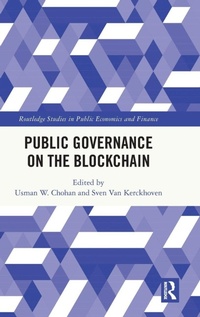
Public Governance on the Blockchain
1st Edition
Will be published approx. on 12. March 2026
Book
Hardback
196 pages
978-1-041-00586-5 (ISBN)
Description
The emergence of blockchain technologies has unlocked a myriad of possibilities for reshaping governance systems, from the grassroots level of micro-governance to the broader scope of national and transnational governance. In an era marked by persistent governance challenges, there is a profound desire for governance that is optimal, inclusive, participatory, and efficient across various scales of analysis, all of which might be improved by the adoption of distributed ledger technology. However, the adoption of blockchain for governance purposes, particularly in public governance, lags behind other applications such as cryptocurrencies and decentralized finance. What impedes this adoption? Are existing governance systems deemed sufficient by key stakeholders? Is inertia or cost hindering the transformation through blockchain innovations? Or has the potential of blockchain in public governance been overstated?
This book aims to address these questions comprehensively by leveraging the expertise of interdisciplinary scholars who undertake a holistic examination of the role, potential, and limitations of blockchain technologies in public governance. Through conceptual frameworks, real-world case studies, and forward-looking insights, the book navigates towards more optimal outcomes, soliciting stakeholder inputs and refining concepts along the way. By presenting diverse perspectives from various disciplinary angles, including public administration, public policy, computer science, economics, philosophy, and innovation governance, the book offers valuable insights for a wide-ranging audience of scholars and practitioners alike.
This book aims to address these questions comprehensively by leveraging the expertise of interdisciplinary scholars who undertake a holistic examination of the role, potential, and limitations of blockchain technologies in public governance. Through conceptual frameworks, real-world case studies, and forward-looking insights, the book navigates towards more optimal outcomes, soliciting stakeholder inputs and refining concepts along the way. By presenting diverse perspectives from various disciplinary angles, including public administration, public policy, computer science, economics, philosophy, and innovation governance, the book offers valuable insights for a wide-ranging audience of scholars and practitioners alike.
More details
Series
Language
English
Place of publication
London
United Kingdom
Publishing group
Taylor & Francis Ltd
Target group
College/higher education
Postgraduate
Illustrations
5 s/w Zeichnungen, 13 s/w Tabellen, 5 s/w Abbildungen
13 Tables, black and white; 5 Line drawings, black and white; 5 Illustrations, black and white
Dimensions
Height: 240 mm
Width: 161 mm
Thickness: 16 mm
Weight
473 gr
ISBN-13
978-1-041-00586-5 (9781041005865)
Copyright in bibliographic data and cover images is held by Nielsen Book Services Limited or by the publishers or by their respective licensors: all rights reserved.
Schweitzer Classification
Other editions
Additional editions

Usman W. Chohan | Sven Van Kerckhoven
Public Governance on the Blockchain
E-Book
03/2026
1st Edition
Routledge
€60.49
Available for download

Usman W. Chohan | Sven Van Kerckhoven
Public Governance on the Blockchain
E-Book
03/2026
1st Edition
Routledge
€60.49
Available for download
Persons
Usman W. Chohan, PhD, is an international economist and academic who serves as Advisor on Economic Affairs and National Development at the Centre for Aerospace & Security Studies (CASS), one of Pakistan's premier research-based think tanks, where he was a founding director.
Sven Van Kerckhoven, PhD, is Associate Professor of Political Economics at the Brussels School of Governance (Vrije Universiteit Brussel), where he also serves as Vice-Dean for Education. He also is a professorial fellow at the United Nations University Institute on Comparative Regional Integration Studies.
Sven Van Kerckhoven, PhD, is Associate Professor of Political Economics at the Brussels School of Governance (Vrije Universiteit Brussel), where he also serves as Vice-Dean for Education. He also is a professorial fellow at the United Nations University Institute on Comparative Regional Integration Studies.
Content
1. Introduction Usman W. Chohan & Sven Van Kerckhoven 2. The Emergence and Potential of Blockchain-based Technology for Public Governance Sven Van Kerkchoven 3. Tornado Cash, Flashbots, and Regulatory Equivalence: Alternatives to Regulatory Compliance or Avoidance in Blockchain Systems Primavera De Filippi, Morshed Mannan and Kelsie Nabben 4. Unpacking the Complexities of Blockchain Adoption in Public Administration Isis Gutierrez-Martinez, Francois Duhamel, Francisco Gabriel Rodriguez-Gonzalez and Luis Luna-Reyes 5. The Double Spending Problem and Cryptocurrencies
Usman W. Chohan 6. A History of Dogecoin Usman. W. Chohan 7. What's blocking blockchain adoption in public governance? The case of blockchain-based voting Donncha Kavanagh and Paul Dylan-Ennis 8. Chain of Command: How Blockchain May Reshape Migration Governance Max Nagel 9. Governance of blockchains in securities trading: Can a public, permissionless system become the new standard? Randy Priem 10. Public procurement on the Blockchain Sven Van Kerckhoven 11. Blockchain and Environmental Sustainability: Case of IBM's Blockchain Water Management Usman W. Chohan 12. Conclusion Sven Van Kerckhoven and Usman W. Chohan
Usman W. Chohan 6. A History of Dogecoin Usman. W. Chohan 7. What's blocking blockchain adoption in public governance? The case of blockchain-based voting Donncha Kavanagh and Paul Dylan-Ennis 8. Chain of Command: How Blockchain May Reshape Migration Governance Max Nagel 9. Governance of blockchains in securities trading: Can a public, permissionless system become the new standard? Randy Priem 10. Public procurement on the Blockchain Sven Van Kerckhoven 11. Blockchain and Environmental Sustainability: Case of IBM's Blockchain Water Management Usman W. Chohan 12. Conclusion Sven Van Kerckhoven and Usman W. Chohan