

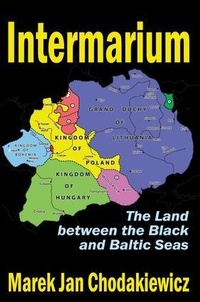
Intermarium
The Land Between the Black and Baltic Seas
1st Edition
Published on 30. October 2012
Book
Hardback
576 pages
978-1-4128-4774-2 (ISBN)
Description
History and collective memories influence a nation, its culture, and institutions; hence, its domestic politics and foreign policy. That is the case in the Intermarium, the land between the Baltic and Black Seas in Eastern Europe. The area is the last unabashed rampart of Western Civilization in the East, and a point of convergence of disparate cultures.
Marek Jan Chodakiewicz focuses on the Intermarium for several reasons. Most importantly because, as the inheritor of the freedom and rights stemming from the legacy of the Polish-Lithuanian/Ruthenian Commonwealth, it is culturally and ideologically compatible with American national interests. It is also a gateway to both East and West. Since the Intermarium is the most stable part of the post-Soviet area, Chodakiewicz argues that the United States should focus on solidifying its influence there. The ongoing political and economic success of the Intermarium states under American sponsorship undermines the totalitarian enemies of freedom all over the world. As such, the area can act as a springboard to addressing the rest of the successor states, including those in the Caucasus, Central Asia, and the Russian Federation.
Intermarium has operated successfully for several centuries. It is the most inclusive political concept within the framework of the Commonwealth. By reintroducing the concept of the Intermarium into intellectual discourse the author highlights the autonomous and independent nature of the area. This is a brilliant and innovative addition to European Studies and World Culture.
Marek Jan Chodakiewicz focuses on the Intermarium for several reasons. Most importantly because, as the inheritor of the freedom and rights stemming from the legacy of the Polish-Lithuanian/Ruthenian Commonwealth, it is culturally and ideologically compatible with American national interests. It is also a gateway to both East and West. Since the Intermarium is the most stable part of the post-Soviet area, Chodakiewicz argues that the United States should focus on solidifying its influence there. The ongoing political and economic success of the Intermarium states under American sponsorship undermines the totalitarian enemies of freedom all over the world. As such, the area can act as a springboard to addressing the rest of the successor states, including those in the Caucasus, Central Asia, and the Russian Federation.
Intermarium has operated successfully for several centuries. It is the most inclusive political concept within the framework of the Commonwealth. By reintroducing the concept of the Intermarium into intellectual discourse the author highlights the autonomous and independent nature of the area. This is a brilliant and innovative addition to European Studies and World Culture.
Reviews / Votes
"The Intermarium is one of the most culturally and politically significant regions of Europe. Yet historians and journalists too often limit themselves to a consideration of interests of the powers that have ravaged it. In this fascinating and deeply researched book, Marek Jan Chodakiewicz restores the region's separate identity. He shows the interplay of its peoples and their often tragic destinies, but also the traditional love of freedom that makes the Intermarium a vital source of support for the ideals of the West." --David Satter, Hudson Institute; Foreign Policy Institute of Johns Hopkins University School of Advanced International Studies "Dr. Chodakiewciz's unprecedented, long-overdue impeccably researched and extraordinarily well-argued study directly challenges the common view of the Intermarium as mere borderland between the "West" and Russia. Professor Chodaikiewicz's clarity of thought, highly readable prose, impressive command of 1,000 years of the area's history, and his unique perspectives gleaned from expert analysis of a multitude of foreign archival material rarely seen in English compel all those in academia, the US government, and the US foreign policy establishment to overturn the Moscow-centric approach to the Interrimarium that has governed US foreign policy for the last 70 years." --Dr. Robert W. Stephan (CIA Ret), Adjunct Professor Institute of World Politics and author, Stalin's Secret War, Soviet Counterintelligence against the Nazis 1941-1945More details
Language
English
Place of publication
New York
United States
Publishing group
Taylor & Francis Inc
Product notice
With printed dust jacket
Dimensions
Height: 241 mm
Width: 161 mm
Thickness: 45 mm
Weight
1019 gr
ISBN-13
978-1-4128-4774-2 (9781412847742)
Copyright in bibliographic data and cover images is held by Nielsen Book Services Limited or by the publishers or by their respective licensors: all rights reserved.
Schweitzer Classification
Other editions
Additional editions
E-Book
09/2017
Routledge
€68.49
Available for download
E-Book
09/2017
Routledge
€68.49
Available for download
Book
07/2016
1st Edition
Routledge
€76.50
Shipment within 10-15 days
Person
Marek Jan Chodakiewicz is professor of history and holds the Kosciuszko Chair of Polish Studies at the Institute of World Politics. His writings have appeared in World Affairs , World Politics Review , and The American Spectator . In addition, he is the author or editor of numerous books, including Between Nazis and Soviets: Occupation Politics in Poland, 1939-1947 ; After the Holocaust: Polish-Jewish Conflict in the Wake of World War Two ; and Poland's Transformation: A Work in Progress .
Content
Contents Introduction Background Sources and Method Part I. Intermarium: A Brief History 1. The Origins 2. Medieval Ruthenia and the Mongols 3. The Balts, the Germans, and the Poles 4. The Commonwealth 5. The Partitions 6. World War I and the Revolution 7. Interwar 8. World War II and Liberation Part II. The Armageddon and Its Aftermath (1939-1992) 9. An Overview 10. The First Soviet Occupation (1939-1941) 11. The Nazi Occupation (1941-1944) 12. The Second Soviet Occupation (1944-1992) 13. Transformation 14. The Liberation Part III. Post-Soviet Continuities and Discontinuities:Domestic and Foreign Challenges 15. An Overview 16. Contemporary Politics 17. The Baltics 18. Southern and Central Intermarium 19. Lifting the Velvet Curtain: Geopolitics andForeign Policy in the Intermarium 20. The Majorities and the Minorities Part IV. Chain of Memory 21. An Overview 22. Landscapes and Impressions 23. False Consciousness 24. A Sample of Individual Recollections 25. National Stereotypes 26. Koniuchy: A Case Study Conclusion Appendix I: The Death Toll in the Intermarium during the Twentieth Century Appendix II: Maps Bibliography Index