

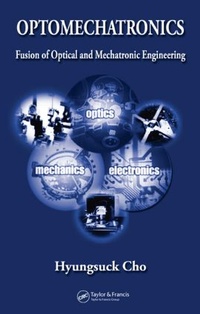
Optomechatronics
Fusion of Optical and Mechatronic Engineering
1st Edition
Published on 29. November 2005
Book
Hardback
616 pages
978-0-8493-1969-3 (ISBN)
Description
Representing an evolutionary leap, the integration of optical technologies into mechatronic systems adds a new dimension to an already multifaceted field. Optical elements enhance the functionality of mechatronics and in many cases introduce entirely new capabilities. Likewise, mechatronic elements bring the same synergistic effects to optical systems. However, most books focus on traditional mechatronics while only briefly discussing, or omitting completely, the characteristics of optomechatronic technology. Bringing together the fundamentals and underlying concepts, Optomechatronics provides a detailed introduction to this growing field.
With emphasis on the importance of interdisciplinary, multiple-technology fusion, this book threads together the background, definition, and characteristics of the field with an integrated view of various disciplines, a system-oriented approach, and a combined view of the macro/micro worlds. It begins with an analysis of a variety of practical optomechatronic systems to identify the underlying concepts and features of each area composing the field. These systems include optics, machine vision, feedback control, and micro-opto-mechanical systems (MOEMS). From this platform, the author demonstrates how to fuse the optical, mechanical, electronic, and microprocessor elements to realize desired functionalities. Finally, the book examines whole optomechatronic systems comprising the components described in the previous section.
Whether you are new to the field or have experience in a different engineering discipline, Optomechatronics supplies the necessary tools to harness the benefits that optical technologies bring to this important emerging area.
With emphasis on the importance of interdisciplinary, multiple-technology fusion, this book threads together the background, definition, and characteristics of the field with an integrated view of various disciplines, a system-oriented approach, and a combined view of the macro/micro worlds. It begins with an analysis of a variety of practical optomechatronic systems to identify the underlying concepts and features of each area composing the field. These systems include optics, machine vision, feedback control, and micro-opto-mechanical systems (MOEMS). From this platform, the author demonstrates how to fuse the optical, mechanical, electronic, and microprocessor elements to realize desired functionalities. Finally, the book examines whole optomechatronic systems comprising the components described in the previous section.
Whether you are new to the field or have experience in a different engineering discipline, Optomechatronics supplies the necessary tools to harness the benefits that optical technologies bring to this important emerging area.
More details
Series
Language
English
Place of publication
Bosa Roca
United States
Publishing group
Taylor & Francis Inc
Target group
Professional and scholarly
Professional
Illustrations
43 s/w Tabellen, 432 s/w Abbildungen
43 Tables, black and white; 432 Illustrations, black and white
Dimensions
Height: 234 mm
Width: 156 mm
Weight
982 gr
ISBN-13
978-0-8493-1969-3 (9780849319693)
Copyright in bibliographic data and cover images is held by Nielsen Book Services Limited or by the publishers or by their respective licensors: all rights reserved.
Schweitzer Classification
Other editions
Additional editions
E-Book
11/2005
CRC Press
€271.99
Available for download
E-Book
11/2005
CRC Press
€271.99
Available for download
Content
Introduction: Understanding of Optomechatronic Technology. Fundamentals of Optics. Machine Vision: Visual Sensing and Image Processing. Mechatronic Elements for Optomechatronic Interface. Optomechatronic Integration. Basic Optomechatronic Functional Units. Optomechatronic Systems in Practice. Appendix A1: Some Considerations of Kinematics and Homogeneous Transformation. Appendix A2: Structural Beam Deflection. Appendix A3: Routh Stability Criterion. Index.