

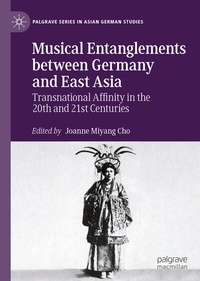
Musical Entanglements between Germany and East Asia
Transnational Affinity in the 20th and 21st Centuries
Published on 10. October 2021
Book
Hardback
XIX, 303 pages
978-3-030-78208-5 (ISBN)
Description
This edited volume explores musical encounters and entanglements between Germany and East Asian nations from 1900 to the present. In so doing, it speaks to their dynamic and multi-faceted musical relations in multiple ways. Despite East Asia and Germany being located at opposite ends of the globe, German music has found remarkably fertile soil in East Asia. East Asians have enthusiastically adopted it, while at the same time adding their own musical interpretations. These musical encounters have produced compositions that reflect this mutual influence, stimulating and enriching each other through their entanglement. After more than a century of entanglement, Germany and East Asia have become kindred musical spirits.
More details
Series
Edition
2021 ed.
Language
English
Place of publication
Cham
Switzerland
Publishing group
Springer International Publishing
Target group
Professional and scholarly
Illustrations
6 s/w Abbildungen
XIX, 303 p. 6 illus.
Dimensions
Height: 216 mm
Width: 153 mm
Thickness: 23 mm
Weight
533 gr
ISBN-13
978-3-030-78208-5 (9783030782085)
DOI
10.1007/978-3-030-78209-2
Schweitzer Classification
Other editions
Additional editions
Joanne Miyang Cho
Musical Entanglements between Germany and East Asia
Transnational Affinity in the 20th and 21st Centuries
Book
10/2022
Palgrave Macmillan
€160.49
Shipment within 7-9 days
Joanne Miyang Cho
Musical Entanglements between Germany and East Asia
Transnational Affinity in the 20th and 21st Centuries
E-Book
10/2021
1st Edition
Palgrave Macmillan
€149.79
Available for download
Person
Joanne Miyang Cho is Professor of History at William Paterson University of New Jersey, USA.
Content
Chapter 1: The Idea of Entanglement, Historiography, and Organization.- Part 1: German-Japanese/Korean Entanglements, 1900-1945: Wagner, Bandmasters, and Japanese Students.- Chapter 2: The Reception of Wagner in Japan at the Turn of the Twentieth Century: A Non-Musical Dimension of Cross-Border Music Transfer.- Chapter 3: Music for Modern Korea: Bandmasters Franz Eckert and Baek U-yong.- Chapter 4: Japanese Musicians in Germany and Austria, 1880-1945.- Part 2: Sino-German Entanglements, 1900-1949: Operas, Beethoven, and Jewish Cantors.- Chapter 5: The "Oriental" Utopia: Postwar Orientalism and Ferruccio Busoni's Opera
Turandot.-
Chapter 6: Reimagining China in Interwar German Opera: Eugen d'Albert's
Mister Wu
and Ernst Toch's
Der Fächer.-
Chapter 7: Demarcation and Cooperation: Nazi-persecuted Jewish Cantors in Shanghai Exile, 1938-1949.- Chapter 8: What Beethoven Meant in China, 1900-1949: Music, Ideology and Power.- Part 3: German-East Asian Entanglements since 1945: Ferienkurse, Mozart, and East Asian Composers.- Chapter 9: Mozart in the Context of Globalization: The Musician as Agent of Cultural Hybridity.- Chapter 10: When "Japanese" Music Became "Modern" Music: The Internationale Ferienkurse für Neue Musik as Intercultural Agency.- Chapter 11: The Music of the Korean-German Composer Yun Isang in the Cold War Era: Interculturality and Engagement Art.- Chapter 12: Korean Contemporary Music and Germany: An Examination of Four Korean Composers