

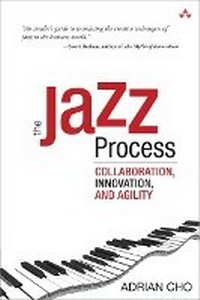
Jazz Process, The
Collaboration, Innovation, and Agility
Published on 17. June 2010
Book
Paperback/Softback
320 pages
978-0-321-63645-4 (ISBN)
Description
"An insider's guide to translating the creative techniques of jazz to the business world."
Scott Berkun, author of The Myths of Innovation
What Can Your Team Learn From Jazz Musicians?
Experienced jazz musicians apply specific principles to collaborate, execute, and manage change in real time--delivering extraordinary innovation in the face of non-stop pressure and risk. Now, jazz musician and collaboration expert Adrian Cho shows how you can use the same principles to dramatically improve any team's performance.
Cho systematically introduces the Jazz Process and demonstrates how it can help cross-functional teams improve teamwork, innovation, and execution. You'll learn new ways to encourage and integrate strong individual contributions from passionate and committed practitioners, and give them maximum autonomy while making sure your project's "music" never degenerates into chaotic "noise."
Through multiple case studies, Cho shows you how high-performance teams achieve their success.
* Master five core principles of working in teams: use just enough rules, employ top talent, put the team first, build trust and respect, and commit with passion
* Establish a realistic framework for effective, continuous execution
* Collaborate more effectively with team members, consumers, customers, partners, and suppliers
* Master the essentials of team execution: listening for change, leading on demand, acting transparently, and making every contribution count
* Reduce the "friction" associated with collaboration--and increase the synergy
* Use form, tempo, pulse, and groove to maintain constructive momentum
* Learn about the importance of healthy projects and teams
* Innovate by exchanging ideas and taking the right measured risks
* For every practitioner, leader, and manager interested in getting better results
Scott Berkun, author of The Myths of Innovation
What Can Your Team Learn From Jazz Musicians?
Experienced jazz musicians apply specific principles to collaborate, execute, and manage change in real time--delivering extraordinary innovation in the face of non-stop pressure and risk. Now, jazz musician and collaboration expert Adrian Cho shows how you can use the same principles to dramatically improve any team's performance.
Cho systematically introduces the Jazz Process and demonstrates how it can help cross-functional teams improve teamwork, innovation, and execution. You'll learn new ways to encourage and integrate strong individual contributions from passionate and committed practitioners, and give them maximum autonomy while making sure your project's "music" never degenerates into chaotic "noise."
Through multiple case studies, Cho shows you how high-performance teams achieve their success.
* Master five core principles of working in teams: use just enough rules, employ top talent, put the team first, build trust and respect, and commit with passion
* Establish a realistic framework for effective, continuous execution
* Collaborate more effectively with team members, consumers, customers, partners, and suppliers
* Master the essentials of team execution: listening for change, leading on demand, acting transparently, and making every contribution count
* Reduce the "friction" associated with collaboration--and increase the synergy
* Use form, tempo, pulse, and groove to maintain constructive momentum
* Learn about the importance of healthy projects and teams
* Innovate by exchanging ideas and taking the right measured risks
* For every practitioner, leader, and manager interested in getting better results
Reviews / Votes
"An insider's guide to translating the creative techniques of jazz to the business world."--Scott Berkun, author of The Myths of Innovation
"Jazz demands cooperation, enterprise, creativity, measured risk, and so much more--and so does business. Adrian's book is an entertaining guide for importing the jazz process into the world of business."
--Jack Chambers, linguistics professor at the University of Toronto and jazz biographer, author of Milestones: The Music and Times of Miles Davis
"This book has an important message: Effective collaborations are like jazz improvisations. Jazz succeeds because the group shares just the right kind of rules and structures; business teams also need to improvise within the right kind of structure. Cho has years of experience playing jazz and working in business teams, and in this book he applies this experience to analyze the ways that effective business teams balance structure and freedom."
--Dr. R. Keith Sawyer, associate professor of psychology and education at Washington University and author of Group Genius: The Creative Power of Collaboration and many other books on creativity and innovation
"In The Jazz Process, Adrian Cho weaves some unusual and interesting four-part harmony between jazz, business, sport, and information technology around an important theme...teamwork."
--Dr. Saul L. Miller, psychologist and author of Why Teams Win: 9 Keys to Success in Business, Sport, and Beyond and Performing Under Pressure: Gaining the Mental Edge in Business and Sport
"Adrian Cho's insight into high-performance teams is drawn from his personal experiences in music, business, and software engineering. Within the Eclipse community we have seen many of these ideas in action, and they work. I highly recommend The Jazz Process to anyone seeking to learn how to build agile, effective teams--regardless of your field of endeavor."
--Mike Milinkovich, Executive Director, Eclipse Foundation
More details
Other editions
Additional editions
E-Book
06/2010
1st Edition
Addison Wesley
€12.91
Available for download
Person
Adrian Cho is exceptionally well-qualified to draw parallels between the worlds of jazz, business, and software. As a bassist and conductor, he leads the critically acclaimed symphonic jazz ensemble, Impressions in Jazz Orchestra. At IBM, he manages development of IBM (R) Rational (R) Team Concert (TM), the first product built on IBM's Jazz (R) team collaboration platform, as well as Rational's Collaborative Application Lifecycle Management project. As a manager of intellectual property, Adrian plays a key role in IBM's Eclipse open source and Jazz Open Commercial Software Development efforts and serves as an invited expert on the Eclipse Foundation IP Advisory Committee.
Content
List of Figures xv
Foreword xvi
Preface xx
Acknowledgments xxiii
About the Author xxv
Introduction 1
PART I: WORKING
Chapter 1 Use Just Enough Rules 21
The Need for Rules 21
Employing Just Enough Rules 23
Breaking the Rules 26
Defining a Process 28
Documenting a Process 30
Evolving and Improving a Process 32
Chapter 2 Employ Top Talent 35
The Human Element 35
Individuality 37
The Importance of Awareness 40
Enabling Organizational Agility 44
Managing Human Resources 45
Chapter 3 Put the Team First 47
Putting the Team First 47
Absorbing Mistakes as a Team 49
Avoiding Groupthink 51
Team Awareness 52
Acknowledging Everyone's Efforts 53
Avoiding Team Elitism 54
Chapter 4 Build Trust and Respect 57
Trust and Respect 57
Benefits of Trust and Respect 58
Developing Trust and Respect 60
Acknowledging Efforts and Results 63
When Trust and Respect Are Lost 65
Chapter 5 Commit with Passion 69
Commitment 69
Less Work Requires More Commitment 71
Be Willing to Make Mistakes 74
Those Who Support the Team 77
Performing with Passion 78
Performing in Social Media 80
PART II: COLLABORATING
Essentials of Execution 85
Feedback and the Birth of Cybernetics 86
Feedback Loops 87
Hunting Cause 1: Trying Too Hard 89
Hunting Cause 2: Reacting Too Slowly 90
Breaking Out of Positive Feedback Loops&n
Foreword xvi
Preface xx
Acknowledgments xxiii
About the Author xxv
Introduction 1
PART I: WORKING
Chapter 1 Use Just Enough Rules 21
The Need for Rules 21
Employing Just Enough Rules 23
Breaking the Rules 26
Defining a Process 28
Documenting a Process 30
Evolving and Improving a Process 32
Chapter 2 Employ Top Talent 35
The Human Element 35
Individuality 37
The Importance of Awareness 40
Enabling Organizational Agility 44
Managing Human Resources 45
Chapter 3 Put the Team First 47
Putting the Team First 47
Absorbing Mistakes as a Team 49
Avoiding Groupthink 51
Team Awareness 52
Acknowledging Everyone's Efforts 53
Avoiding Team Elitism 54
Chapter 4 Build Trust and Respect 57
Trust and Respect 57
Benefits of Trust and Respect 58
Developing Trust and Respect 60
Acknowledging Efforts and Results 63
When Trust and Respect Are Lost 65
Chapter 5 Commit with Passion 69
Commitment 69
Less Work Requires More Commitment 71
Be Willing to Make Mistakes 74
Those Who Support the Team 77
Performing with Passion 78
Performing in Social Media 80
PART II: COLLABORATING
Essentials of Execution 85
Feedback and the Birth of Cybernetics 86
Feedback Loops 87
Hunting Cause 1: Trying Too Hard 89
Hunting Cause 2: Reacting Too Slowly 90
Breaking Out of Positive Feedback Loops&n