

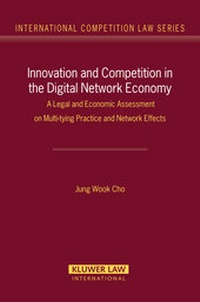
Innovation and Competition in the Digital Network Economy
A Legal and Economic Assessment on Multy-tying Practices and Network Effects
Published on 11. July 2007
Book
Hardback
310 pages
978-90-411-2574-3 (ISBN)
Description
Through an in-depth analysis of the Korea Fair Trade Commission (KFTC)
caseand#8212;which led to a December 2005 decision, currently under appeal at the
Seoul High Court, condemning three fundamental tying practices embedded in
Microsoftand#8217;s global business strategyand#8212;the author clearly establishes the
precise nature of Microsoftand#8217;s anticompetitive practices, complete with clear
technical descriptions of the underlying applications and digital media
systems. The discussion develops valuable guidelines on such core issues as
the following:
and#8226; network effect, tipping effect, and lock-in effect
and#8226; separability of Microsoftand#8217;s tied and tying products
and#8226; forced purchase by consumers of multiple tied products
and#8226; Microsoftand#8217;s reinforcement of market entry barriers
and#8226; Microsoftand#8217;s and#8220;normal business practiceand#8221; defense
and#8226; cumulative damage to consumersand#8217; interests
The bookand#8217;s ultimate legal and economic assessment clarifies ways in which
government competition authorities can select from globally available options
on a case-by-case basis, enforce re-pricing measures, avoid belated remedies,
and continuously monitor new types of anticompetitive conduct.
caseand#8212;which led to a December 2005 decision, currently under appeal at the
Seoul High Court, condemning three fundamental tying practices embedded in
Microsoftand#8217;s global business strategyand#8212;the author clearly establishes the
precise nature of Microsoftand#8217;s anticompetitive practices, complete with clear
technical descriptions of the underlying applications and digital media
systems. The discussion develops valuable guidelines on such core issues as
the following:
and#8226; network effect, tipping effect, and lock-in effect
and#8226; separability of Microsoftand#8217;s tied and tying products
and#8226; forced purchase by consumers of multiple tied products
and#8226; Microsoftand#8217;s reinforcement of market entry barriers
and#8226; Microsoftand#8217;s and#8220;normal business practiceand#8221; defense
and#8226; cumulative damage to consumersand#8217; interests
The bookand#8217;s ultimate legal and economic assessment clarifies ways in which
government competition authorities can select from globally available options
on a case-by-case basis, enforce re-pricing measures, avoid belated remedies,
and continuously monitor new types of anticompetitive conduct.
More details
Other editions
Additional editions
Jung Wook Cho
Innovation and Competition in the Digital Network Economy
A Legal and Economic Assessment on Multy-tying Practices and Network Effects
E-Book
11/2007
Kluwer Law International
€217.99
Available for download
Content
. Abbreviations. Figures and Tables. 1. Introduction. 2. Backgrounds and Case Reference. I. New Digital Network Economy: Digital Media System and Instant Messaging System. II. Global Case References. 3. Korea Microsoft Case: Multiple Tyings in the Digital Media System and Instant Messaging System. I. Korean Legal System: the Monopoly Regulation and Fair Trade Act on Tying Practices. II. Factual Background of the Korea Microsoft Case. III. KFTC Decision (2005). IV. Appeal of the KFTC Decision to the KFTC. V. Appeal of the KFTC Decision to the Court. 4. An Assessment on the Multi-tying Practice. I. Purposes and Methods of Legal and Economic Assessment on the Korea Microsoft Case. II. Microeconomic Assessment. III. Macroeconomic Assessment. IV. Assessment on Efficiencies of Multi-tying Practice. V. Assessment on Corrective Remedies. VI. Transjudicial Availability of the Assessment on Microsoft's Multi-tying Practice. 5. Conclusion. Appendices. References. Glossary. Index.