

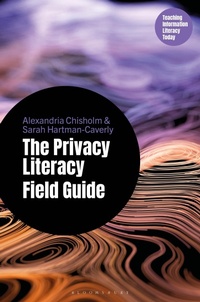
The Privacy Literacy Field Guide
Will be published approx. on 1. October 2026
Book
Hardback
304 pages
979-8-216-38784-8 (ISBN)
Description
Answering a need for practical and theory-informed approaches to privacy literacy practices, The Privacy Literacy Field Guide responds to the challenges that practitioners experience.
By offering privacy literacy programming, libraries can broaden and enhance their impact in an emerging area of societal importance, while leveraging librarians' unique expertise in data flows and ethical commitment to privacy.
The Privacy Literacy Field Guide provides a roadmap for academic librarians to navigate the rapidly evolving information ecosystem, build professional self-efficacy, and implement privacy literacy learning experiences into instructional, student engagement, and outreach programming.
Arranged in three sections, this volume supports librarians in establishing professional privacy knowledge, designing privacy literacy learning experiences, and implementing privacy literacy in their instruction, outreach, and engagement work. The foundations section delivers an introduction to privacy theory, guides readers in the development of a personal privacy current awareness action plan, and discusses pedagogical and learning design considerations-including a chapter on how not to teach privacy literacy. The approaches section reviews contemporary topical approaches to privacy literacy instruction informed by the authors' award-winning privacy workshop series, introducing learning experiences for the digital footprint, digital professionalism and digital citizenship, digital wellness, algorithmic literacy, generative AI, and privacy and social justice. The applications section delivers practical advice on developing privacy literacy programming, collaborating with campus and external partners, and assessing and advocating for privacy literacy work. Each chapter concludes with reflection questions, activities, and supplemental resources to support readers in applying concepts to their work.
By offering privacy literacy programming, libraries can broaden and enhance their impact in an emerging area of societal importance, while leveraging librarians' unique expertise in data flows and ethical commitment to privacy.
The Privacy Literacy Field Guide provides a roadmap for academic librarians to navigate the rapidly evolving information ecosystem, build professional self-efficacy, and implement privacy literacy learning experiences into instructional, student engagement, and outreach programming.
Arranged in three sections, this volume supports librarians in establishing professional privacy knowledge, designing privacy literacy learning experiences, and implementing privacy literacy in their instruction, outreach, and engagement work. The foundations section delivers an introduction to privacy theory, guides readers in the development of a personal privacy current awareness action plan, and discusses pedagogical and learning design considerations-including a chapter on how not to teach privacy literacy. The approaches section reviews contemporary topical approaches to privacy literacy instruction informed by the authors' award-winning privacy workshop series, introducing learning experiences for the digital footprint, digital professionalism and digital citizenship, digital wellness, algorithmic literacy, generative AI, and privacy and social justice. The applications section delivers practical advice on developing privacy literacy programming, collaborating with campus and external partners, and assessing and advocating for privacy literacy work. Each chapter concludes with reflection questions, activities, and supplemental resources to support readers in applying concepts to their work.
Reviews / Votes
The Privacy Literacy Field Guide provides timely, pertinent, scholar-informed, practical guidance for information professionals. The content is situated by the growing dynamic scholarship that the authors have championed over the last decade, specifically on privacy literacy. This title outlines theory, research, and pedagogy, resulting in practical applications for teaching privacy literacy as an emerging literacy in the discipline of information literacy. The book can be used as a stand-alone resource, as a primary source, or as a textbook for information literacy curriculum courses specifically addressing privacy literacy. * Karen F. Kaufmann, Assistant Professor of Instruction, University of South Florida iSchool, USA * In an era where surveillance and automation threaten so much of what makes us human, this book encourages us to be brave and authentic in supporting privacy education. The Privacy Literacy Field Guide will help any library worker build the confidence to get started on principled privacy pedagogy. The workbook style, with many opportunities for reflection, makes it both personal and manageable. I was floored by the sheer number of creative workshop ideas, incorporating design justice and consent principles to support a variety of learners and privacy needs, as well as incentives to help people stay engaged. The authors are well-informed in privacy scholarship and cite many sources for further reading. A highly impressive, holistic, down-to-earth, funny, and comprehensive work from two trusted experts in the field! * Alison Macrina, Executive Director, Library Freedom Project, USA * The Privacy Literacy Field Guide offers an ideal balance between the practical for realistic implementation, and the theoretical for critical foundations supporting the authors' recommendations. This well-researched book goes beyond a general introduction and offers solid pedagogical design guidance, assessment applications, outreach frameworks, advisement for privacy-in-the-disciplines, and considerations for one's own time and labor to engage in this work. This publication fills a gap in greater support for privacy literacy in libraries and I can see it being an essential companion that library workers will turn to again and again -- Nicole Pagowsky * Librarian and Liaison Program Lead, University of Arizona, USA *More details
Series
Language
English
Place of publication
United States
Publishing group
Bloomsbury Publishing Plc
Target group
College/higher education
Product notice
Laminated cover
Dimensions
Height: 235 mm
Width: 156 mm
Thickness: 15 mm
Weight
409 gr
ISBN-13
979-8-216-38784-8 (9798216387848)
Copyright in bibliographic data and cover images is held by Nielsen Book Services Limited or by the publishers or by their respective licensors: all rights reserved.
Schweitzer Classification
Persons
Alexandria Chisholm is an Academic Reference and Instruction librarian at Penn State Berks, USA.
Sarah Hartman-Caverly is an Academic Reference and Instruction librarian at Penn State Berks, USA.
Sarah Hartman-Caverly is an Academic Reference and Instruction librarian at Penn State Berks, USA.
Content
Introduction
Part 1: Foundations
1. Why Privacy Literacy
2. Privacy Current Awareness
3. Pedagogy and Teaching Considerations
4. How Not to Teach Privacy Literacy
Part 2: Approaches
5. Digital Footprint
6. Digital Professionalism and Digital Citizenship
7. Digital Wellness
8. Algorithmic literacy
9. Generative AI
10. Data Justice
Part 3. Applications
11. Learning Design
12. Co-curricular Partnerships
13. Disciplinary Partnerships
14. External Partnerships
15. Assessment
Conclusion
Recommended Readings
Part 1: Foundations
1. Why Privacy Literacy
2. Privacy Current Awareness
3. Pedagogy and Teaching Considerations
4. How Not to Teach Privacy Literacy
Part 2: Approaches
5. Digital Footprint
6. Digital Professionalism and Digital Citizenship
7. Digital Wellness
8. Algorithmic literacy
9. Generative AI
10. Data Justice
Part 3. Applications
11. Learning Design
12. Co-curricular Partnerships
13. Disciplinary Partnerships
14. External Partnerships
15. Assessment
Conclusion
Recommended Readings