

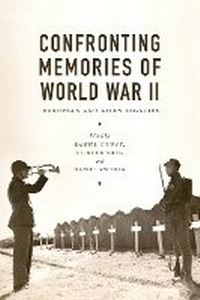
Confronting Memories of World War II
European and Asian Legacies
Published on 1. April 2014
Book
Hardback
340 pages
978-0-295-99345-4 (ISBN)
Description
The legacy of the Second World War has been, like the war itself, an international phenomenon. In both Europe and Asia, common questions of criminality, guilt, and collaboration have intersected with history and politics on the local level to shape the way that wartime experience has been memorialized, reinterpreted, and used.
By directly comparing European and Asian legacies, Confronting Memories of World War II, provides unique insight into the way that World War II continues to influence contemporary attitudes and politics on a global scale. The collection brings together experts from a variety of disciplines and perspectives to explore the often overlooked commonalities between European and Asian handling of memories and reflections about guilt. These commonalities suggest new understandings of the war's legacy and the continuing impact of historical trauma.
By directly comparing European and Asian legacies, Confronting Memories of World War II, provides unique insight into the way that World War II continues to influence contemporary attitudes and politics on a global scale. The collection brings together experts from a variety of disciplines and perspectives to explore the often overlooked commonalities between European and Asian handling of memories and reflections about guilt. These commonalities suggest new understandings of the war's legacy and the continuing impact of historical trauma.
Reviews / Votes
"The book, which acts as a solid overview of various postwar memory cultures, will be an excellent addition to most libraries. It is well-suited for undergraduates, instructors looking to broaden their knowledge of WW II memory cultures, and because of its contemporary relevance, general readers."(Choice) "Wars evoke powerful emotions: grief and pride, humiliation and honor, outrage and exultation. As this excellent volume reveals, such feelings can come to form essential parts of national mythologies, and this has been especially so in the case of World War II."
(Foreign Affairs) "A forceful and timely warning about the dangers of leaving problematic memory legacies unresolved."
- Albert J. Schmidt (Michigan War Studies Review) "[R]efreshingly evenhanded....Even those who have studied these issues extensively will find new ideas in this publication."
- Ivo Plsek (Pacific Affairs)
More details
Series
Language
English
Place of publication
Seattle
United States
Target group
Professional and scholarly
Dimensions
Height: 229 mm
Width: 152 mm
Weight
612 gr
ISBN-13
978-0-295-99345-4 (9780295993454)
Copyright in bibliographic data and cover images is held by Nielsen Book Services Limited or by the publishers or by their respective licensors: all rights reserved.
Schweitzer Classification
Other editions
Additional editions
Daniel Chirot | Gi-Wook Shin | Daniel Sneider
Confronting Memories of World War II
European and Asian Legacies
E-Book
04/2014
1st Edition
University of Washington Press
€29.49
Available for download
Persons
Daniel Chirot is Herbert J. Ellison Professor of Russian and Eurasian Studies at the University of Washington. Gi-Wook Shin is director of the Walter H. Shorenstein Asia-Pacific Research Center at Stanford University, as well as holder of the Tong Yang, Korea Foundation, and Korea Stanford Alumni Chair of Korean Studies. Daniel Sneider is associate director of the Shorenstein Asia-Pacific Center. Contributors include Thomas Berger, Frances Gouda, Julian T. Jackson, Fania Oz-Salzberger, Gilbert Rozman, Igor Torbakov, and Roger Petersen.
Content
Acknowledgments
Introduction
1. Admitting Guilt is Neither Common Nor Easy
2. Interrupted Memories
3. Different Strokes
4. Divided Memories of World War II in the Netherlands and the Dutch East Indies
5. France and the Memory of Occupation
6. Historical Reconciliation in the Northeast Asia
7. Israelis and Germany after the Second World War
8. Historical Memories and International Relations in Northeast Asia
9. Divisive Historical Memories
10. Guilt, Shame, Balts, Jews
Bibliography
Contributors
Index
Introduction
1. Admitting Guilt is Neither Common Nor Easy
2. Interrupted Memories
3. Different Strokes
4. Divided Memories of World War II in the Netherlands and the Dutch East Indies
5. France and the Memory of Occupation
6. Historical Reconciliation in the Northeast Asia
7. Israelis and Germany after the Second World War
8. Historical Memories and International Relations in Northeast Asia
9. Divisive Historical Memories
10. Guilt, Shame, Balts, Jews
Bibliography
Contributors
Index