

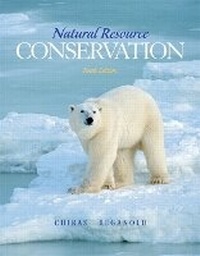
Natural Resource Conservation
Management for a Sustainable Future
10th Edition
Published on 19. March 2009
Book
Hardback
672 pages
978-0-13-225138-9 (ISBN)
Description
For introductory-level, undergraduate courses in natural resource conservation, natural resource management, environmental science, and environmental conservation.
This comprehensive text describes the ecological principles, policies, and practices required to create a sustainable future. It emphasizes practical, cost-effective, sustainable solutions to these problems that make sense from social, economic, and environmental perspectives.
This comprehensive text describes the ecological principles, policies, and practices required to create a sustainable future. It emphasizes practical, cost-effective, sustainable solutions to these problems that make sense from social, economic, and environmental perspectives.
More details
Edition
10th edition
Language
English
Place of publication
United States
Publishing group
Pearson Education (US)
Target group
College/higher education
Dimensions
Height: 283 mm
Width: 222 mm
Thickness: 27 mm
Weight
1430 gr
ISBN-13
978-0-13-225138-9 (9780132251389)
Copyright in bibliographic data and cover images is held by Nielsen Book Services Limited or by the publishers or by their respective licensors: all rights reserved.
Schweitzer Classification
Other editions
Previous edition

Daniel D. Chiras | John P. Reganold | Oliver S. Owen
Natural Resource Conservation
Management for a Sustainable Future
Book
11/2004
9th Edition
Pearson
€84.31
Article exhausted; check for reprint
Persons
Dan Chiras earned his Ph.D. in reproductive physiology from the University of Kansas Medical School. After graduating, Dr. Chiras pursued interests in environmental science and has become a leading authority on environmental issues and sustainability. He has published over 20 books and 250 articles in journals, magazines, newspapers, and encyclopedias. Dr. Chiras lectures widely on ways to build a sustainable society, green building, and renewable energy. He lives in a state-of the art environmental passive solar/solar electric home in Colorado.
John Reganold received his Ph.D. in soil science from the University of California at Davis. As a professor of soil science at Washington State University, he teaches courses in introductory soils, land use, and organic farming and conducts research in land use and sustainable agriculture. Dr. Reganold has published more than 80 papers in scientific journals, magazines, and proceedings, such as Science, Nature, Scientific American, and New Scientist.
John Reganold received his Ph.D. in soil science from the University of California at Davis. As a professor of soil science at Washington State University, he teaches courses in introductory soils, land use, and organic farming and conducts research in land use and sustainable agriculture. Dr. Reganold has published more than 80 papers in scientific journals, magazines, and proceedings, such as Science, Nature, Scientific American, and New Scientist.
Content
1. Natural Resource Conservation and Management: Past, Present and Future
2. Economics, Ethics, and Critical Thinking: Tools for Creating a Sustainable Future
3. Lessons from Ecology
4. The Human Population Challenge
5. World Hunger: Solving the Problem Sustainably
6. The Nature of Soils
7. Soil Conservation and Sustainable Agriculture
8. Integrated Pest Management
9. Aquatic Environments
10. Managing Water Resources Sustainability
11. Water Pollution
12. Fisheries Conservation
13. Rangeland Management
14. Forest Management
15. Plant and Animal Extinction
16. Wildlife Management
17. Sustainable Waste Management
18. Air Pollution
19. Global Warming and Climate Change
20. Acid Deposition and Stratospheric Ozone Depletion
21. Minerals, Mining, and a Sustainable Society
22. Nonrenewable Energy Resources: Issues and Options
23. Creating a Sustainable System of Energy
2. Economics, Ethics, and Critical Thinking: Tools for Creating a Sustainable Future
3. Lessons from Ecology
4. The Human Population Challenge
5. World Hunger: Solving the Problem Sustainably
6. The Nature of Soils
7. Soil Conservation and Sustainable Agriculture
8. Integrated Pest Management
9. Aquatic Environments
10. Managing Water Resources Sustainability
11. Water Pollution
12. Fisheries Conservation
13. Rangeland Management
14. Forest Management
15. Plant and Animal Extinction
16. Wildlife Management
17. Sustainable Waste Management
18. Air Pollution
19. Global Warming and Climate Change
20. Acid Deposition and Stratospheric Ozone Depletion
21. Minerals, Mining, and a Sustainable Society
22. Nonrenewable Energy Resources: Issues and Options
23. Creating a Sustainable System of Energy