

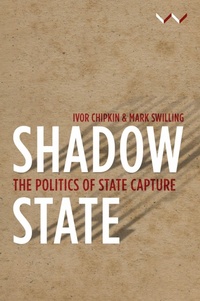
Shadow State
The Politics of State Capture
Published on 1. July 2018
Book
Paperback/Softback
186 pages
978-1-77614-212-5 (ISBN)
Description
A powerful analysis of events that helped galvanise resistance across civil society
The 2017 publication of Betrayal of the Promise, the report that detailed the systematic nature of state capture, marked a key moment in South Africa's most recent struggle for democracy. In the face of growing evidence of corruption and of the weakening of state and democratic institutions, it provided, for the first time, a powerful analysis of events that helped galvanise resistance within the Tripartite Alliance and across civil society. Working often secretly, the authors consolidated, for the first time, large amounts of evidence from a variety of sources. They showed that the Jacob Zuma administration was not simply a criminal network but part of an audacious political project to break the hold of whites and white business on the economy and to create a new class of black industrialists. State-Owned Enterprises (SOEs) such as Eskom and Transnet were central to these plans.
The report introduced a whole new language to discuss state capture, showing how SOEs were 'repurposed', how political power was shifting away from constitutional bodies to 'kitchen cabinets', and how a 'shadow state' at odds with the country's constitutional framework was being built. Shadow State is an updated version of the original, explosive report that changed South Africa's recent history.
The 2017 publication of Betrayal of the Promise, the report that detailed the systematic nature of state capture, marked a key moment in South Africa's most recent struggle for democracy. In the face of growing evidence of corruption and of the weakening of state and democratic institutions, it provided, for the first time, a powerful analysis of events that helped galvanise resistance within the Tripartite Alliance and across civil society. Working often secretly, the authors consolidated, for the first time, large amounts of evidence from a variety of sources. They showed that the Jacob Zuma administration was not simply a criminal network but part of an audacious political project to break the hold of whites and white business on the economy and to create a new class of black industrialists. State-Owned Enterprises (SOEs) such as Eskom and Transnet were central to these plans.
The report introduced a whole new language to discuss state capture, showing how SOEs were 'repurposed', how political power was shifting away from constitutional bodies to 'kitchen cabinets', and how a 'shadow state' at odds with the country's constitutional framework was being built. Shadow State is an updated version of the original, explosive report that changed South Africa's recent history.
Reviews / Votes
"The analysis is so brilliant. I can't think of a better example of how academic research can shape the public debate." - Patrick Heller, Professor of Sociology and International and Public Affairs, Brown University. "This is a compelling example of how committed academics conducting rigorous research and analysis can help crystallize our understanding of fundamental problems in our society." - Blade Nzimande, General Secretary of the South African Communist PartyMore details
Language
English
Place of publication
Johannesburg
South Africa
Target group
Professional and scholarly
Product notice
Paperback (trade)
Illustrations
3 black and white illustrations
Dimensions
Height: 228 mm
Width: 151 mm
Thickness: 15 mm
Weight
298 gr
ISBN-13
978-1-77614-212-5 (9781776142125)
Copyright in bibliographic data and cover images is held by Nielsen Book Services Limited or by the publishers or by their respective licensors: all rights reserved.
Schweitzer Classification
Other editions
Additional editions
E-Book
07/2018
Abingdon Press
€19.49
Available for download
Persons
Ivor Chipkin is the founding director of the Public Affairs Research Institute linked to the University of the Witwatersrand and the University of Cape Town, which has been a pioneer in the field of institutional studies in South Africa, bringing social science methods to the study of government and how it works. He was an associate professor at the University of the Witwatersrand.
Mark Swilling is Distinguished Professor in Sustainable Development at Stellenbosch University. He is the Masters and Doctoral Programme Coordinator: Sustainable Development in the School of Public Leadership; Co-Director of the Centre for Complex Systems in Transition; and Co-Founder and Academic Director of the Sustainability Institute.
Haroon Bhorat is professor of economics and director of the Development Policy Research Unit at the University of Cape Town. He has served as an economic advisor to past ministers of ?nance and holds a National Research Chair.
Mzukisi Qobo is associate professor and deputy director at the NRF Research Chair on African Diplomacy and Foreign Policy, University of Johannesburg. He is also a columnist for the Daily Maverick, and serves on the Board of Corruption Watch.
Sikhulekile Duma is a master's student in Sustainable Development at the University of Stellenbosch. He is also a researcher at the University of Stellenbosch's Centre for Complex Systems in Transitions.
Lumkile Mondi is a senior lecturer in the School of Economics and Business Science at the University of the Witwatersrand.
Camaren Peter is an independent researcher and writer based in Cape Town. He is a physicist by training, but has collaborated across a wide range of disciplinary boundaries over the past two decades.
Mbongiseni Buthelezi is the director of the Public Affairs Research Institute (PARI) and an associate professor in the Department of Anthropology and Development Studies at the University of Johannesburg.
Hannah Friedenstein (pseudonym) is a ?nancial crime risk specialist and a former journalist. She advises investors entering the African market from a reputation and ?nancial crime risk perspective, as well as working in the civic space against state capture and corruption.
Nicky Prins is a freelance analyst, focusing on understanding 'business unusual' practices in South Africa's state-owned entities, in support of e?orts to combat corruption. She is a former chief director of the Capital Projects Appraisal Unit at the National Treasury in South Africa.
Mark Swilling is Distinguished Professor in Sustainable Development at Stellenbosch University. He is the Masters and Doctoral Programme Coordinator: Sustainable Development in the School of Public Leadership; Co-Director of the Centre for Complex Systems in Transition; and Co-Founder and Academic Director of the Sustainability Institute.
Haroon Bhorat is professor of economics and director of the Development Policy Research Unit at the University of Cape Town. He has served as an economic advisor to past ministers of ?nance and holds a National Research Chair.
Mzukisi Qobo is associate professor and deputy director at the NRF Research Chair on African Diplomacy and Foreign Policy, University of Johannesburg. He is also a columnist for the Daily Maverick, and serves on the Board of Corruption Watch.
Sikhulekile Duma is a master's student in Sustainable Development at the University of Stellenbosch. He is also a researcher at the University of Stellenbosch's Centre for Complex Systems in Transitions.
Lumkile Mondi is a senior lecturer in the School of Economics and Business Science at the University of the Witwatersrand.
Camaren Peter is an independent researcher and writer based in Cape Town. He is a physicist by training, but has collaborated across a wide range of disciplinary boundaries over the past two decades.
Mbongiseni Buthelezi is the director of the Public Affairs Research Institute (PARI) and an associate professor in the Department of Anthropology and Development Studies at the University of Johannesburg.
Hannah Friedenstein (pseudonym) is a ?nancial crime risk specialist and a former journalist. She advises investors entering the African market from a reputation and ?nancial crime risk perspective, as well as working in the civic space against state capture and corruption.
Nicky Prins is a freelance analyst, focusing on understanding 'business unusual' practices in South Africa's state-owned entities, in support of e?orts to combat corruption. She is a former chief director of the Capital Projects Appraisal Unit at the National Treasury in South Africa.
Content
List of figures and tables
Abbreviations and acronyms
Key terms
Acknowledgements
Foreword Mcebisi Jonas
Prologue
Introduction
Chapter 1 Structuring the Capture of the State
Chapter 2 The Politics of Betrayal
Chapter 3 Power, Authority and Audacity: How the Shadow State Was Built
Chapter 4 Repurposing Governance
Chapter 5 Conclusion
Afterword Ferial Haffajee
Abbreviations and acronyms
Key terms
Acknowledgements
Foreword Mcebisi Jonas
Prologue
Introduction
Chapter 1 Structuring the Capture of the State
Chapter 2 The Politics of Betrayal
Chapter 3 Power, Authority and Audacity: How the Shadow State Was Built
Chapter 4 Repurposing Governance
Chapter 5 Conclusion
Afterword Ferial Haffajee