

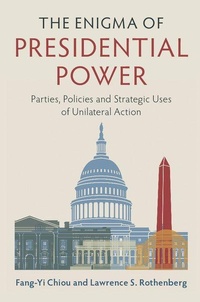
The Enigma of Presidential Power
Parties, Policies and Strategic Uses of Unilateral Action
Published on 18. April 2017
Book
Hardback
242 pages
978-1-107-19150-1 (ISBN)
Description
With gridlock, presidents increasingly rely on unilateral actions - means not requiring legislative statutes - which many view as tantamount to power. Using a variety of approaches, Chiou and Rothenberg show that this need not be the case as, under many conditions, the chief executive's employment of such tools is constrained. Rather, presidents contemplating issuing executive orders are often constrained by worries about challenging the legislature and the courts. Most notably, the ability of Congress to employ extra-statutory means, involving efforts by legislators and their parties that don't require passing a law, limit how presidents utilize their discretion. Additionally, political parties can influence presidential choices and actions both by restricting the ideological direction in which presidents can push policy via discretionary authority and by agenda-setting and disciplining members in the legislative process. Nor are all presidential actions equal, as the policy area involved and the importance of an action condition presidential power.
Reviews / Votes
'Over the past two decades, few features of our Constitutional system have been scrutinized as thoroughly as the apparent rise of presidential powers that has accompanied the rise of the administrative state. But often times the arguments paint with too broad a brush - presidents are too powerful or they are too weak. Thus, Chiou and Rothenberg's nuanced account of the conditions for the successful exercise of presidential power will be an important contribution to this debate.' Nolan McCarty, Susan Dod Brown Professor of Politics and Public Affairs, Princeton University 'Theoretically informed empirical work is alive and well. Chiou and Rothenberg's models feature Congress countering presidential unilateral actions with tools that go well beyond the simple passage of a new law. Support for these models uncovers a robust system of checks and balances, with majority-party strength in Congress seriously constraining imperial instincts of presidents. Challenging past work, this book is a must-read for students of American political institutions.' Craig Volden, University of Virginia 'Chiou and Rothenberg combine exhaustive new data with impressively innovative methods to generate real insight. They have made a key contribution to our understanding of the significance of presidential unilateralism. It's a topic that will only become more central to the field, and more importantly to the country, in the years to come.' Andrew Rudalevige, Thomas Brackett Reed Professor of Government, Bowdoin College, MaineMore details
Language
English
Place of publication
Cambridge
United Kingdom
Target group
College/higher education
Professional and scholarly
Illustrations
Worked examples or Exercises; 35 Tables, black and white; 27 Line drawings, black and white
Dimensions
Height: 235 mm
Width: 157 mm
Thickness: 19 mm
Weight
555 gr
ISBN-13
978-1-107-19150-1 (9781107191501)
Copyright in bibliographic data and cover images is held by Nielsen Book Services Limited or by the publishers or by their respective licensors: all rights reserved.
Schweitzer Classification
Other editions
Additional editions
E-Book
04/2017
Cambridge University Press
€21.99
Available for download
Fang-Yi Chiou | Lawrence S. Rothenberg
The Enigma of Presidential Power
Parties, Policies and Strategic Uses of Unilateral Action
Book
04/2017
Cambridge University Press
€36.50
Shipment within 15-20 days
Fang-Yi Chiou | Lawrence S. Rothenberg
The Enigma of Presidential Power
Parties, Policies and Strategic Uses of Unilateral Action
E-Book
03/2017
Cambridge University Press
€27.99
Available for download
Persons
Fang-Yi Chiou is Full Research Fellow at the Institute of Political Science at Academia Sinica, Taipei, Taiwan. He has published on a variety of subjects in important political science journals, such as the Journal of Politics and the American Journal of Political Science. He was selected to be a member of the Global Young Academy (2010-16), was the recipient of the Elinor Ostrom Award, and has received five prestigious Taiwanese national research awards. Lawrence S. Rothenberg is the Corrigan-Minehan Professor of Political Science and Director of the W. Allen Wallis Institute of Political Economy at the University of Rochester, New York. He is the author of four books, numerous journal articles, and was a recently a co-principal investigator of a multimillion dollar Integrative Graduate Education and Research Traineeship (IGERT) grant for research and training in energy.
Content
1. Introduction; 2. Thinking about power: theoretical models; 3. Not all unilateral actions are created equal: measuring the significance of executive orders; 4. The race for power: empirically examining competing models; 5. Bringing the parties in: legislative partisan influence and presidential power; 6. The subtleties of power - assessing the two presidencies; 7. Conclusions - solving the enigma of presidential power.