

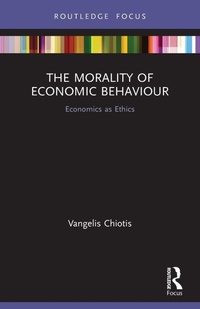
The Morality of Economic Behaviour
Economics as Ethics
1st Edition
Published on 29. April 2022
Book
Paperback/Softback
112 pages
978-0-367-50762-6 (ISBN)
Description
The links between self-interest and morality have been examined in moral philosophy since Plato. Economics is a mostly value-free discipline, having lost its original ethical dimension as described by Adam Smith. Examining moral philosophy through the framework provided by economics offers new insights into both disciplines and the discussion on the origins and nature of morality.
The Morality of Economic Behaviour: Economics as Ethics argues that moral behaviour does not need to be exogenously encouraged or enforced because morality is a side effect of interactions between self-interested agents. The argument relies on two important parameters: behaviour in a social environment and the effects of intertemporal choice on rational behaviour. Considering social structures and repeated interactions on rational maximisation allows an argument for the morality of economic behaviour. Amoral agents interacting within society can reach moral outcomes. Thus, economics becomes a synthesis of moral and rational choice theory bypassing the problems of ethics in economic behaviour whilst promoting moral behaviour and ethical outcomes. This approach sheds new light on practical issues such as economic policy, business ethics and social responsibility.
This book is of interest primarily to students of politics, economics and philosophy but will also appeal to anyone who is interested in morality and ethics, and their relationship with self-interest.
The Morality of Economic Behaviour: Economics as Ethics argues that moral behaviour does not need to be exogenously encouraged or enforced because morality is a side effect of interactions between self-interested agents. The argument relies on two important parameters: behaviour in a social environment and the effects of intertemporal choice on rational behaviour. Considering social structures and repeated interactions on rational maximisation allows an argument for the morality of economic behaviour. Amoral agents interacting within society can reach moral outcomes. Thus, economics becomes a synthesis of moral and rational choice theory bypassing the problems of ethics in economic behaviour whilst promoting moral behaviour and ethical outcomes. This approach sheds new light on practical issues such as economic policy, business ethics and social responsibility.
This book is of interest primarily to students of politics, economics and philosophy but will also appeal to anyone who is interested in morality and ethics, and their relationship with self-interest.
More details
Series
Language
English
Place of publication
London
United Kingdom
Publishing group
Taylor & Francis Ltd
Target group
College/higher education
Postgraduate and Undergraduate
Dimensions
Height: 216 mm
Width: 140 mm
Thickness: 6 mm
Weight
155 gr
ISBN-13
978-0-367-50762-6 (9780367507626)
Copyright in bibliographic data and cover images is held by Nielsen Book Services Limited or by the publishers or by their respective licensors: all rights reserved.
Schweitzer Classification
Other editions
Additional editions
Book
07/2020
1st Edition
Routledge
€76.70
Shipment within 15-20 days
E-Book
05/2020
1st Edition
Routledge
€31.49
Available for download
E-Book
05/2020
1st Edition
Routledge
€31.49
Available for download
Person
Vangelis Chiotis is a Lecturer at Glasgow Caledonian University, UK.
Content
1. Introduction 2. Rational morality in economics 3. Moral economics: constrained maximisation 4. Sociability 5. Intertemporality 6. Information symmetry 7. Ethics, justice and profit