

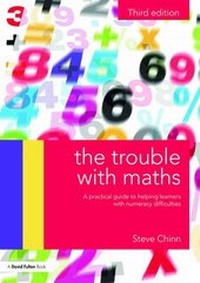
The Trouble with Maths
A practical guide to helping learners with numeracy difficulties
3rd Edition
Published on 12. July 2016
Book
Paperback/Softback
176 pages
978-1-138-18746-7 (ISBN)
Description
Now in third edition, with updates to reflect developments in our understanding of learning difficulties in maths, this award-winning text provides vital insights into the often confusing world of numeracy. By looking at learning difficulties in maths and dyscalculia from several perspectives, including the vocabulary and language of maths, thinking styles and the demands of individual procedures, this book provides a complete overview of the most frequently occurring problems associated with maths teaching and learning. Drawing on tried-and-tested methods based on research and Steve Chinn's years of classroom experience, it provides an authoritative yet accessible one-stop classroom resource.
Combining advice, guidance and practical activities, this user-friendly guide will help you to:
develop flexible thinking styles
use alternative strategies to replace an over-reliance on rote learning for pupils trying to access basic facts
understand the implications of underlying skills, such as working memory, on learning
implement effective pre-emptive measures before demotivation sets in
recognise the manifestations of maths anxiety and tackle affective domain problems
find approaches to solve word problems
select appropriate materials and visual images to enhance understanding.
With useful features such as checklists for the evaluation of books and a comprehensive overview of resources, this book will equip you with essential skills to help you tackle your pupils' maths difficulties and improve standards. This book will be useful for all teachers, classroom assistants, learning support assistants and parents.
Combining advice, guidance and practical activities, this user-friendly guide will help you to:
develop flexible thinking styles
use alternative strategies to replace an over-reliance on rote learning for pupils trying to access basic facts
understand the implications of underlying skills, such as working memory, on learning
implement effective pre-emptive measures before demotivation sets in
recognise the manifestations of maths anxiety and tackle affective domain problems
find approaches to solve word problems
select appropriate materials and visual images to enhance understanding.
With useful features such as checklists for the evaluation of books and a comprehensive overview of resources, this book will equip you with essential skills to help you tackle your pupils' maths difficulties and improve standards. This book will be useful for all teachers, classroom assistants, learning support assistants and parents.
More details
Edition
3rd New edition
Language
English
Place of publication
London
United Kingdom
Publishing group
Taylor & Francis Ltd
Target group
Professional and scholarly
Edition type
New edition
Illustrations
2 s/w Tabellen, 48 s/w Zeichnungen
48 Line drawings, black and white; 2 Tables, black and white
Dimensions
Height: 297 mm
Width: 210 mm
Weight
476 gr
ISBN-13
978-1-138-18746-7 (9781138187467)
Copyright in bibliographic data and cover images is held by Nielsen Book Services Limited or by the publishers or by their respective licensors: all rights reserved.
Schweitzer Classification
Other editions
New editions
Book
09/2020
4th Edition
Routledge
€46.40
Shipment within 15-20 days
Additional editions

Book
07/2016
3rd Edition
Routledge
€163.42
Withdrawn from sale
Person
Steve Chinn is a Visiting Professor at the University of Derby and is also author of More Trouble with Maths: A complete guide to identifying and diagnosing mathematical difficulties, 2nd edition and editor of The Routledge International Handbook of Dyscalculia and Mathematical Learning Difficulties.
Content
1. Introduction: Mathematics Learning Difficulties and dyscalculia 2. Factors that affect learning 3. What the curriculum asks pupils to do and where difficulties may occur 4. Thinking style and mathematics 5. Developmental perspectives 6. The vocabulary and language of maths 7. Anxiety and attributions 8. The inconsistencies of maths 9. Manipulatives, materials and visual images: multisensory learning 10. The nasties...long division and fractions Appendix 1 Further reading Appendix 2 Checklists Appendix 3 Resources References Index