

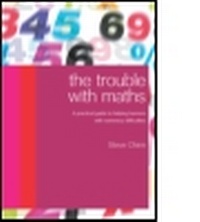
The Trouble with Maths
A Practical Guide to Helping Learners with Numeracy Difficulties
Published on 25. March 2004
Book
Hardback
192 pages
978-0-415-32498-4 (ISBN)
Description
What is the trouble with maths?
This book offers important insights into the often confusing world of numeracy. By looking at learning difficulties in maths from several perspectives, including the language of mathematics, thinking styles and the demands of individual topics, Steve Chinn delivers a comprehensive text that will become an essential classroom companion to anyone who uses it.
Whilst considering every aspect concerning maths and learning, this book provides a perfect balance of advice, guidance and practical activities, enabling the reader to:
* develop flexible thinking skills
* use alternative strategies for pupils to access basic facts
* implement effective preventative measures before disaffection sets in
* recognise maths anxiety and tackle self-esteem problems
* make accurate ongoing assessments of pupils' difficulties
* design informal diagnostic procedures.
With useful features such as checklists for the evaluation of books, software and test materials, this book highlights essential skills that will allow teachers to diagnose and address maths difficulties and improve standards. It draws on tried and tested methods based on the author's years of classroom experience to provide an authoritative yet highly accessible one-stop classroom resource for all teachers, classroom assistants, Special Educational Needs Co-ordinators, student teachers, and learning support staff.
This book offers important insights into the often confusing world of numeracy. By looking at learning difficulties in maths from several perspectives, including the language of mathematics, thinking styles and the demands of individual topics, Steve Chinn delivers a comprehensive text that will become an essential classroom companion to anyone who uses it.
Whilst considering every aspect concerning maths and learning, this book provides a perfect balance of advice, guidance and practical activities, enabling the reader to:
* develop flexible thinking skills
* use alternative strategies for pupils to access basic facts
* implement effective preventative measures before disaffection sets in
* recognise maths anxiety and tackle self-esteem problems
* make accurate ongoing assessments of pupils' difficulties
* design informal diagnostic procedures.
With useful features such as checklists for the evaluation of books, software and test materials, this book highlights essential skills that will allow teachers to diagnose and address maths difficulties and improve standards. It draws on tried and tested methods based on the author's years of classroom experience to provide an authoritative yet highly accessible one-stop classroom resource for all teachers, classroom assistants, Special Educational Needs Co-ordinators, student teachers, and learning support staff.
Reviews / Votes
'It moves away from the search for the perfect maths scheme and much more towards individual responses, looking at the reasons why children might arrive at a different answer and the steps that can be taken to prevent difficulties arising. You wouldn't have to be a learning support specialist to pick-up on its user-friendly strategies' - Times Educational SupplementMore details
Language
English
Place of publication
London
United Kingdom
Publishing group
Taylor & Francis Ltd
Target group
Professional and scholarly
Illustrations
25 s/w Zeichnungen
25 Line drawings, black and white
Dimensions
Height: 298 mm
Width: 210 mm
Weight
499 gr
ISBN-13
978-0-415-32498-4 (9780415324984)
Copyright in bibliographic data and cover images is held by Nielsen Book Services Limited or by the publishers or by their respective licensors: all rights reserved.
Schweitzer Classification
Other editions
New editions
Book
08/2011
2nd Edition
Routledge
€57.13
Article exhausted; check for reprint
Person
Content
1. Introduction: Learning Difficulties in Maths 2. Factors that Affect Learning 3. What the Curriculum Asks Pupils to Do and When Difficulties May Occur 4. Thinking Style in Maths 5. Developmental Perspectives 6. The Language of Maths 7. Anxiety and Attributions 8. The Inconsistencies of Maths 9. Assessment and Diagnosis 10. The Nasties: Long Division and Fractions