

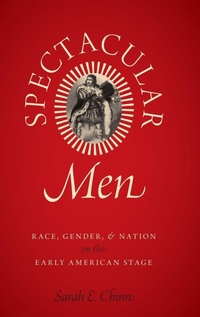
Spectacular Men
Race, Gender, and Nation on the Early American Stage
Published on 4. May 2017
Book
Hardback
264 pages
978-0-19-065367-5 (ISBN)
Description
In Spectacular Men, Sarah E. Chinn investigates how working class white men looked to the early American theatre for examples of ideal manhood. Theatre-going was the primary source of entertainment for working people of the early Republic and the Jacksonian period, and plays implicitly and explicitly addressed the risks and rewards of citizenship. Ranging from representations of the heroes of the American Revolution to images of doomed Indians to plays about ancient Rome, Chinn unearths dozens of plays rarely read by critics. Spectacular Men places the theatre at the center of the self-creation of working white men, as voters, as workers, and as Americans.
Reviews / Votes
Engagingly written, featuring a thorough but by no means overwhelming scholarly apparatus, and reflecting keen awareness of the paradoxes that would lead the "true blue Sons of Liberty" of the 1780s to see themselves as wage slaves by the 1840s, Chinn's book is a welcome entry into the field of early American theater studies. She ably tackles the contingent nature of the class, gender, and racial identities that underpinned so much of the early history of the American theater -- and of the United States itself. * Jason Shaffer, Early American Literature * Chinn [provides] tantalizing glimpses into the elusive minds and possible motivations of the working-class men who filled urban playhouses. While these men yearned for entertainment, they also craved validation and possibly even guidance. In Spectacular Men, Chinn asks all the right questions, effectively drawing the reader into this complex period, challenging their assumptions, and complicating their understanding of the men and plays shaping each other. * Natasha Moore, 19th Century Literature * CHOICE Outstanding Academic Title (2018) ...Spectacular Men's focus crucially shows how a certain strain of masculinity could in fact come to appear monolithic, absolute, inevitable, and natural. That might be one of this study's more important contributions, unpacking as it does the building of normative identity formations. In the process, it becomes apparent that the story of American masculinity is also a story of how gender ideologies could be peddled for profit, reiterated until they seemed natural, and eventually experienced as pleasurable despite the underlying battery of anxieties and insecurities on which they were inevitably based. * Peter Reed, The New England Quarterly *More details
Language
English
Place of publication
New York
United States
Target group
Professional and scholarly
Dimensions
Height: 240 mm
Width: 161 mm
Thickness: 19 mm
Weight
564 gr
ISBN-13
978-0-19-065367-5 (9780190653675)
Copyright in bibliographic data and cover images is held by Nielsen Book Services Limited or by the publishers or by their respective licensors: all rights reserved.
Schweitzer Classification
Other editions
Additional editions
E-Book
03/2017
1st Edition
OUP eBook
€50.49
Available for download
E-Book
03/2017
1st Edition
OUP eBook
€50.49
Available for download
Person
Sarah E. Chinn is Associate Professor of English at Hunter College at the City University of New York.
Content
Acknowledgments
Introduction: "Advancing the interests of private and political virtue": The stakes of the early American stage
Chapter 1: "The Imitation of Life": How Men Act
Chapter 2: American Actors/Acting American
Chapter 3: "O patriotism!/ Thou wond'rous principle of god-like action!": The Changing Meanings of the Revolution
Chapter 4: Love and Death: Staging Indigenous Masculinity
Chapter 5: Tyrants, Republicans, and Rebels: Performing Roman Masculinities
Epilogue: From Sons of Liberty to Wage Slaves
Notes
Index
Introduction: "Advancing the interests of private and political virtue": The stakes of the early American stage
Chapter 1: "The Imitation of Life": How Men Act
Chapter 2: American Actors/Acting American
Chapter 3: "O patriotism!/ Thou wond'rous principle of god-like action!": The Changing Meanings of the Revolution
Chapter 4: Love and Death: Staging Indigenous Masculinity
Chapter 5: Tyrants, Republicans, and Rebels: Performing Roman Masculinities
Epilogue: From Sons of Liberty to Wage Slaves
Notes
Index