

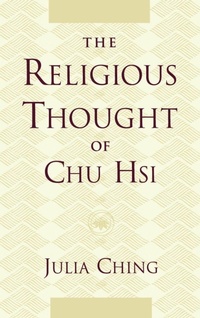
The Religious Thought of Chu Hsi
Published on 7. December 2000
Book
Hardback
360 pages
978-0-19-509189-2 (ISBN)
Description
Recognized as one of the greatest philosophers in classical China, Chu Hsi (1130-1200) is known in the West primarily through translations of one of his many works, the Chin-ssu Lu. In this book, Julia Ching offers the first book-length examination of Chu Hsi's religious thought, based on extensive reading of both primary and secondary sources.
Ching begins by providing an introduction to Chu's twelfth-century intellectual context. She then examines Chu's natural philosophy, looking in particular at the ideas of the Great Ultimate and at spirits and deities and the rituals that honor them. Next, Ching considers Chu's interpretation of human nature and the emotions, highlighting the mystical thrust of the theoretical and practical teachings of spiritual cultivation and meditation. She discusses Chu's philosophical disputes with his contemporariesin particular Lu Chiu-yuanand examines his relationship to Buddhism and Taoism. In the final chapters, Ching looks at critiques of Chu during his lifetime and after and evaluates the relevance of his thinking in terms of contemporary needs and problems. This clearly written and highly accessible study also offers translations of some of Chu's most important philosophical poems, filling a major gap in the fields of both Chinese philosophy and religion.
Ching begins by providing an introduction to Chu's twelfth-century intellectual context. She then examines Chu's natural philosophy, looking in particular at the ideas of the Great Ultimate and at spirits and deities and the rituals that honor them. Next, Ching considers Chu's interpretation of human nature and the emotions, highlighting the mystical thrust of the theoretical and practical teachings of spiritual cultivation and meditation. She discusses Chu's philosophical disputes with his contemporariesin particular Lu Chiu-yuanand examines his relationship to Buddhism and Taoism. In the final chapters, Ching looks at critiques of Chu during his lifetime and after and evaluates the relevance of his thinking in terms of contemporary needs and problems. This clearly written and highly accessible study also offers translations of some of Chu's most important philosophical poems, filling a major gap in the fields of both Chinese philosophy and religion.
Reviews / Votes
the soundness and breadth of Ching's thoughtful analysis may help convince future generations not to wince at the religious elements found throughout Confucian tradition. * Religious Studies Review, vol. 27, no. 3 * Scholars will appreciate the depth and thoroughness with which she explores Chu's positions on ritual, personal cultivation, and spiritual beings, as well as his more well-known ethical and cosmological theorizations. * Religious Studies Review, vol. 27, no. 3 *More details
Language
English
Place of publication
New York
United States
Target group
Professional and scholarly
Illustrations
5 line illustrations
Dimensions
Height: 235 mm
Width: 157 mm
Thickness: 26 mm
Weight
741 gr
ISBN-13
978-0-19-509189-2 (9780195091892)
Copyright in bibliographic data and cover images is held by Nielsen Book Services Limited or by the publishers or by their respective licensors: all rights reserved.
Schweitzer Classification
Other editions
Additional editions
Julia Ching
The Religious Thought of Chu Hsi
E-Book
08/2000
1st Edition
OUP eBook
€144.99
Available for download