

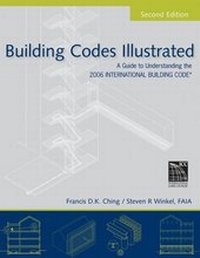
Building Codes Illustrated
A Guide to Understanding the 2006 International Building Code
2nd Edition
Published on 1. November 2006
Book
Paperback/Softback
416 pages
978-0-471-74189-3 (ISBN)
Description
Now more than ever, designers need an interpretive guide to understand how the building code affects the early design of specific projects. Combining the graphic skills of Francis D.K. Ching and the code expertise of Steven Winkel, the newest edition of Building Codes Illustrated thoroughly covers the 2006 updates to the IBC by providing an easy-to-understand interpretation in both words and illustrations.
More details
Series
Edition
2., Auflage
Language
English
Place of publication
New York
United States
Publishing group
John Wiley and Sons Ltd
Target group
Professional and scholarly
Edition type
Revised edition
Illustrations
ill
Dimensions
Height: 27.8 cm
Width: 21.6 cm
Weight
1106 gr
ISBN-13
978-0-471-74189-3 (9780471741893)
Schweitzer Classification
Other editions
New editions
Francis D. K. Ching
Building Codes Illustrated
A Guide to Understanding the 2009 International Building Code
Book
10/2009
3rd Edition
Wiley
€47.90
Article exhausted; check for reprint
Previous edition
Francis D. Ching | Steven Winkel
Building Codes Illustrated
A Guide to Understanding the International Building Code
Book
04/2003
1st Edition
Wiley
€52.90
Article exhausted; check for reprint
Persons
FRANCIS D.K. CHING is a registered architect and a professor at the University of Washington. He is the author or coauthor of numerous architecture and design books, including A Global History of Architecture; Architectural Graphics; Building Construction Illustrated; Architecture: Form, Space, and Order; A Visual Dictionary of Architecture; and Design Drawing (all published by Wiley).
STEVEN R WINKEL, FAIA, an expert in building codes and regulations, is an architect managing the San Francisco office of The Preview Group. Winkel is the architect member of the California Building Standards Commission, a past national board member of The American Institute of Architects (AIA), and past president of the AIA California Council.
The INTERNATIONAL CODE COUNCIL (ICC), a membership association dedicated to building safety and fire prevention, develops the codes used to construct residential and commercial buildings, including homes and schools. Most U.S. cities, counties, and states that adopt codes choose the International Codes developed by the ICC. The ICC mission is to provide the highest quality codes, standards, products, and services for all concerned with the safety and performance of the built environment.
STEVEN R WINKEL, FAIA, an expert in building codes and regulations, is an architect managing the San Francisco office of The Preview Group. Winkel is the architect member of the California Building Standards Commission, a past national board member of The American Institute of Architects (AIA), and past president of the AIA California Council.
The INTERNATIONAL CODE COUNCIL (ICC), a membership association dedicated to building safety and fire prevention, develops the codes used to construct residential and commercial buildings, including homes and schools. Most U.S. cities, counties, and states that adopt codes choose the International Codes developed by the ICC. The ICC mission is to provide the highest quality codes, standards, products, and services for all concerned with the safety and performance of the built environment.
Content
Preface.
1. Building Codes.
2. Navigating the Code.
3. Use and Occupancy.
4. Special Uses and Occupancies.
5. Building Heights and Areas.
6. Types of Construction.
7. Fire-Resistive Construction.
8. Interior Finishes.
9. Fire-Protection Systems.
10. Means of Egress.
11. Accessibility.
12. Interior Environment.
13. Energy Efficiency.
14. Exterior Walls.
15. Roof Assemblies.
16. Structural Provisions.
17. Building Materials and Systems.
18. Existing Structures.
Bibliography.
Index.
1. Building Codes.
2. Navigating the Code.
3. Use and Occupancy.
4. Special Uses and Occupancies.
5. Building Heights and Areas.
6. Types of Construction.
7. Fire-Resistive Construction.
8. Interior Finishes.
9. Fire-Protection Systems.
10. Means of Egress.
11. Accessibility.
12. Interior Environment.
13. Energy Efficiency.
14. Exterior Walls.
15. Roof Assemblies.
16. Structural Provisions.
17. Building Materials and Systems.
18. Existing Structures.
Bibliography.
Index.