

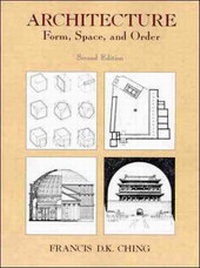
Architecture
Form, Space, and Order
2nd Edition
Published on 1. January 1996
Book
Paperback/Softback
XVI, 400 pages
978-0-471-28616-5 (ISBN)
Description
The Second Edition of this classic introduction to the principles of architecture is everything you would expect from the celebrated architect, author, and illustrator, Francis D. K. Ching. Each page has been meticulously revised to incorporate contemporary examples of the principles of form, space, and order-the fundamental vocabulary of every designer. The result is a beautifully illustrated volume that embraces today's forms and looks at conventional models with a fresh perspective. Here, Ching examines every principal of architecture, juxtaposing images that span centuries and cross cultural boundaries to create a design vocabulary that is both elemental and timeless. Among the topics covered are point, line, plane, volume, proportion, scale, circulation, and the interdependence of form and space. While this revision continues to be a comprehensive primer on the ways form and space are interrelated and organized in the shaping of our environment, it has been refined to amplify and clarify concepts. In addition, the Second Edition contains:
* Numerous new hand-rendered drawings
* Expanded sections on openings and scale
* Expanded chapter on design principles
* New glossary and index categorized by the author
* New 8 1/2 × 11 upright trim
In the Second Edition of Architecture: Form, Space, and Order, the author has opted for a larger format and crisper images. Mr. Ching has retained the style of his hand-lettered text, a hallmark of each of his books. This rich source of architectural prototypes, each rendered in Mr. Ching's signature style, also serves as a guide to architectural drawing. Doubtless, many will want this handsome volume for the sheer beauty of it. Architects and students alike will treasure this book for its wealth of practical information and its precise illustrations. Mr. Ching has once again created a visual reference that illuminates the world of architectural form.
* Numerous new hand-rendered drawings
* Expanded sections on openings and scale
* Expanded chapter on design principles
* New glossary and index categorized by the author
* New 8 1/2 × 11 upright trim
In the Second Edition of Architecture: Form, Space, and Order, the author has opted for a larger format and crisper images. Mr. Ching has retained the style of his hand-lettered text, a hallmark of each of his books. This rich source of architectural prototypes, each rendered in Mr. Ching's signature style, also serves as a guide to architectural drawing. Doubtless, many will want this handsome volume for the sheer beauty of it. Architects and students alike will treasure this book for its wealth of practical information and its precise illustrations. Mr. Ching has once again created a visual reference that illuminates the world of architectural form.
More details
Edition
2., Aufl.
Language
English
Place of publication
New York
United States
Publishing group
John Wiley and Sons Ltd
Target group
College/higher education
Professional and scholarly
Edition type
Revised edition
Illustrations
1000 line drawings
Dimensions
Height: 27.8 cm
Width: 21.5 cm
Weight
1134 gr
ISBN-13
978-0-471-28616-5 (9780471286165)
Schweitzer Classification
Other editions
New editions
Book
06/2007
3rd Edition
Wiley
€47.90
Article exhausted; check for reprint
Previous edition
Book
01/1996
Van Nostrand Reinhold Company
€52.15
Article exhausted; check for reprint
Person
Francis D.K. Ching, Registered Architect, is the principal of Ching Design Associates. He is also a professor of architecture at the University of Washington in Seattle. Mr. Ching is the author of some of the best-known books in the field of architecture, including Architectural Graphics, Building Construction Illustrated, Interior Design Illustrated, Drawing: A Creative Process, and A Visual Dictionary of Architecture, all published by John Wiley & Sons.
Content
Primary Elements; Form; Form and Space; Organization; Circulation; Proportion and Scale; Principles.