

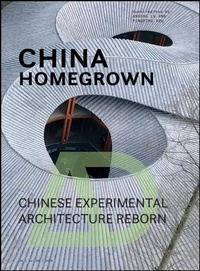
China Homegrown
Chinese Experimental Architecture Reborn
Wiley (Publisher)
1st Edition
Will be published approx. on 23. November 2018
Book
Paperback/Softback
144 pages
978-1-119-37595-1 (ISBN)
Description
Today, architecture in China is at a watershed. Over the last decade, rapid urbanisation and the burgeoning economy turned the country into a playground for the world's signature architects, making it possible to realise extravagant forms and structures at a vast scale. The Chinese government has now drawn a line under this phenomenon by issuing a directive calling an end to the 'oversized, xenocentric, weird' buildings devoid of character or cultural heritage that have sprung up across the country, requiring that urban architecture be 'suitable, economic, green and pleasing to the eye'.
This government directive comes at a time when homegrown architecture has become increasingly self-assured and reflective in its approach. A new generation of architects in China in their 30s and 40s are emerging, and in a wholly contemporary way they are exploring local responses to often bewildering urban and rural conditions and serious social and environmental challenges. This is often expressed through a revival of interest in traditional street patterns, courtyards and gardens. At the same time, architects are also recognising the opportunities to harness the potential of China's established manufacturing base to develop prefabricated building systems. Innovative practices are employing new modes of working, such as research-based studio teaching and exhibitions, field workshops, cross-disciplinary collaboration, laboratory-based practice, design think-tanks and collective projects, generating a vibrant culture of design research.
Contributors: Lu Feng, Murray Fraser, Xiao Fu and Wei You, Xiahong Hua and Shen Zhuang, Xinggang Li, Yichun Liu, James Shen, Yehao Song, Hui Wang, Shuo Wang, Xin Wang and Qiuye Jin, Philip F Yuan and Xiang Wang, Li Zhang, Xin Zhang and Jingxiang Zhu.
Featured architects: Archi-Union Architects, Atelier Archmixing, Atelier Deshaus, Atelier Li Xinggang, Integrated Architecture Studio, LanD Studio, META-Project, People's Architecture Office, SUP Atelier, URBANUS and Zaoyuan Gardening Studio
This government directive comes at a time when homegrown architecture has become increasingly self-assured and reflective in its approach. A new generation of architects in China in their 30s and 40s are emerging, and in a wholly contemporary way they are exploring local responses to often bewildering urban and rural conditions and serious social and environmental challenges. This is often expressed through a revival of interest in traditional street patterns, courtyards and gardens. At the same time, architects are also recognising the opportunities to harness the potential of China's established manufacturing base to develop prefabricated building systems. Innovative practices are employing new modes of working, such as research-based studio teaching and exhibitions, field workshops, cross-disciplinary collaboration, laboratory-based practice, design think-tanks and collective projects, generating a vibrant culture of design research.
Contributors: Lu Feng, Murray Fraser, Xiao Fu and Wei You, Xiahong Hua and Shen Zhuang, Xinggang Li, Yichun Liu, James Shen, Yehao Song, Hui Wang, Shuo Wang, Xin Wang and Qiuye Jin, Philip F Yuan and Xiang Wang, Li Zhang, Xin Zhang and Jingxiang Zhu.
Featured architects: Archi-Union Architects, Atelier Archmixing, Atelier Deshaus, Atelier Li Xinggang, Integrated Architecture Studio, LanD Studio, META-Project, People's Architecture Office, SUP Atelier, URBANUS and Zaoyuan Gardening Studio
More details
Series
Language
English
Place of publication
New York
United States
Target group
Professional and scholarly
Product notice
Paperback (trade)
Unsewn / adhesive bound
Dimensions
Height: 284 mm
Width: 209 mm
Thickness: 12 mm
Weight
628 gr
ISBN-13
978-1-119-37595-1 (9781119375951)
Copyright in bibliographic data and cover images is held by Nielsen Book Services Limited or by the publishers or by their respective licensors: all rights reserved.
Schweitzer Classification
Other editions
Additional editions
E-Book
02/2019
1st Edition
Wiley-ISTE
€35.99
Available for download
Persons
Andong Lu is Professor of Urbanism and Architectural Theory at Nanjing University and a Fellow of Wolfson College, Cambridge. He has also been a Guest Professor at Dessau Institute of Architecture (2011-12). He has written widely on the subjects of Chinese urbanism, gardens and cinema.
Pingping Dou is Associate Professor in the School of Architecture and Urban Planning at Nanjing University and Principal Architect of LanD Studio. She holds a PhD in Architecture and Urban Studies from Queens' College, Cambridge University and has practiced at RMJM in London.
Pingping Dou is Associate Professor in the School of Architecture and Urban Planning at Nanjing University and Principal Architect of LanD Studio. She holds a PhD in Architecture and Urban Studies from Queens' College, Cambridge University and has practiced at RMJM in London.
Content
About the Guest-Editors 5 Introduction: Responsive Experimentalism 6
Integrating Geometry Within a Poetic Setting: Steering a Path Between the Artifi cial and the Natural 16
Arcadia: A Contemporary Chinese Garden Experiment 24
Lost and Found: Reinventing Multi-Screen Adaptable Architecture 32
Constructing Critically: Prefabricated Systems with Soul 40
Plugin Society: Bridging the Gap Between Top-Down and Bottom-Up Approaches to Urban Development 46
Everyday Change and the Unrecognisable System 52
Informal Density: Animating Historical Neighbourhoods 58
A New Protocol for Space Production: Generating Socially Cohesive Urban Architecture 66
Three Main Drivers of Sustainable Design: A New Architectural Vernacular for China 74
Basic Green Building Design: Reconnecting Sustainability to the Vernacular 80
Responsive Structure: Architecture as a Thing-scape 88
From Theory to Praxis: Digital Tools and the New Architectural Authorship 94
Lighting-Led Architecture: A Collaborative Approach 102
Architecture as Synthetic Agency: Narrative-Augmented Design in Practice 110
Imagining the Immediate Present: Responsive Approaches to the Investigation of Things 116
Turning East: Design Research in China in a Global Context 124
Counterpoint: Alternative Modernity, Rural Rediscovery and What Next: The Ongoing Debate on the Modern in China 134
Contributors 142
Integrating Geometry Within a Poetic Setting: Steering a Path Between the Artifi cial and the Natural 16
Arcadia: A Contemporary Chinese Garden Experiment 24
Lost and Found: Reinventing Multi-Screen Adaptable Architecture 32
Constructing Critically: Prefabricated Systems with Soul 40
Plugin Society: Bridging the Gap Between Top-Down and Bottom-Up Approaches to Urban Development 46
Everyday Change and the Unrecognisable System 52
Informal Density: Animating Historical Neighbourhoods 58
A New Protocol for Space Production: Generating Socially Cohesive Urban Architecture 66
Three Main Drivers of Sustainable Design: A New Architectural Vernacular for China 74
Basic Green Building Design: Reconnecting Sustainability to the Vernacular 80
Responsive Structure: Architecture as a Thing-scape 88
From Theory to Praxis: Digital Tools and the New Architectural Authorship 94
Lighting-Led Architecture: A Collaborative Approach 102
Architecture as Synthetic Agency: Narrative-Augmented Design in Practice 110
Imagining the Immediate Present: Responsive Approaches to the Investigation of Things 116
Turning East: Design Research in China in a Global Context 124
Counterpoint: Alternative Modernity, Rural Rediscovery and What Next: The Ongoing Debate on the Modern in China 134
Contributors 142