

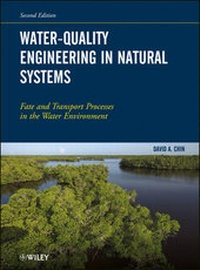
Water-Quality Engineering in Natural Systems
Fate and Transport Processes in the Water Environment
2nd Edition
Published on 4. January 2013
Book
Hardback
472 pages
978-1-118-07860-0 (ISBN)
Description
Provides the tools needed to control and remediate the quality of natural water systems
Now in its Second Edition, this acclaimed text sets forth core concepts and principles that govern the fate and transport of contaminants in water, giving environmental and civil engineers and students a full set of tools to design systems that effectively control and remediate the quality of natural waters. Readers will find coverage of all major classes of water bodies. Moreover, the author discusses the terrestrial fate and transport of contaminants in watersheds, underscoring the link between terrestrial loadings and water pollution.
Water-Quality Engineering in Natural Systems begins with an introduction exploring the sources of water pollution and the control of water pollution. It then presents the fundamentals of fate and transport, including the derivation and application of the advection-diffusion equation. Next, the text covers issues that are unique to:
* Rivers and streams
* Groundwater
* Watersheds
* Lakes and reservoirs
* Wetlands
* Oceans and estuaries
The final two chapters are dedicated to analyzing water-quality measurements and modeling water quality.
This Second Edition is thoroughly updated based on the latest findings, practices, and standards. In particular, readers will find new methods for calculating total maximum daily loads for river contaminants, with specific examples detailing the fate and transport of bacteria, a pressing problem throughout the world.
With end-of-chapter problems and plenty of worked examples, Water-Quality Engineering in Natural Systems enables readers to not only understand what happens to contaminants in water, but also design systems to protect people from toxic pollutants.
Reviews / Votes
"This book is obviously a very valuable tool for the specialists in the field, for researchers, and students for enlarging their horizon on water-quality engineering in natural systems." (Environmental Engineering and Management Journal, 1 April 2013) "This well-organized, comprehensive book is intended to be used as the sole water quality textbook for upper-level undergraduate and graduate courses, but it would also make an excellent reference for environmental engineering professionals. Summing Up: Highly recommended. Upper-division undergraduates through professionals/practitioners." (Choice, 1 August 2013)More details
Other editions
New editions
David A. Chin
Water-Quality Engineering in Natural Systems
Fate and Transport Processes in the Water Environment
Book
11/2020
Wiley-Blackwell
€147.50
Article not available at the moment
Previous edition
David A. Chin
Water-Quality Engineering in Natural Systems
Book
04/2006
1st Edition
Wiley
€145.00
Article exhausted; check for reprint
Person
DAVID A. CHIN, PhD, is Professor of Civil and Environmental Engineering at the University of Miami as well as a registered Professional Engineer. Dr. Chin has published extensively, with important contributions on the fate and transport of contaminants in rivers, groundwater, oceans, and watersheds. His research interests also extend to wetland hydrology and vadose-zone hydrology. Dr. Chin is a recipient of the prestigious Collingwood Prize awarded by the American Society of Civil Engineers.
Content
1. Introduction 1
1.1 The Problem 1
1.2 Sources of Water Pollution 3
1.3 Control of Water Pollution 10
2. Water Quality 13
2.1 Introduction 13
2.2 Physical Measures 14
2.3 Chemical Measures 19
2.4 Biological Measures 40
Problems 52
3. Fundamentals of Fate and Transport 55
3.1 Introduction 55
3.2 The Advection-Diffusion Equation 57
3.3 Fundamental Solutions of the Advection-Diffusion Equation 70
3.4 Transport of Suspended Particles 123
3.5 Turbulent Diffusion 127
3.6 Dispersion 139
Problems 147
4. Rivers and Streams 159
4.1 Introduction 159
4.2 Transport Processes 162
4.3 Models of Spills 184
4.4 Models of Dissolved Oxygen 195
4.5 Models of Nutrients 238
4.6 Models of Pathogens 241
4.7 Contaminant Loads 244
4.8 Management and Restoration 267
Problems 274
5. Ground Water 289
5.1 Introduction 289
5.2 Contaminant Sources 290
5.3 Fate and Transport Models 300
5.4 Transport Processes 326
5.5 Fate Processes 313
5.6 Nonaqueous-Phase Liquids 345
5.7 Monitoring Wells 356
5.8 Remediation of Subsurface Contamination 364
Problems 399
6. Watersheds 413
6.1 Introduction 413
6.2 Urban Watersheds 415
6.3 Agricultural Watersheds 454
6.4 Airsheds 489
Problems 490
7. Lakes and Reservoirs 495
7.1 Introduction 495
7.2 Physical Processes 500
7.3 Eutrophication 507
7.4 Thermal Stratification 522
7.5 Water-Quality Models 534
7.6 Management and Restoration 561
Problems 576
8. Wetlands 585
8.1 Introduction 585
8.2 Natural Wetlands 585
8.3 Constructed Treatment Wetlands 599
Problems 626
9. Oceans and Estuaries 629
9.1 Introduction 629
9.2 Ocean-Outfall Discharges 730
9.3 Estuaries 672
Problems 691
10. Analysis of Water Quality Measurements 697
10.1 Introduction 697
10.2 Probability Distributions 698
10.3 Fundamental Probability Distributions 701
10.4 Derived Probability Distributions 710
10.5 Estimation of Population Distribution from Sample Data 715
10.6 Estimation of Parameters of Population Distribution 723
10.7 Probability Distributions of Sample Statistics 731
10.8 Confidence Intervals 737
10.9 Hypothesis Testing 741
10.10 Relationships between Variables 757
10.11 Functions of Random Variables 766
10.12 Kriging 773
Problems 788
11. Modeling of Water-Quality 799
11.1 Introduction 799
11.2 Code Selection 801
11.3 Calibration 802
11.4 Validation 833
11.5 Simulation 834
11.6 Uncertainty Analysis 834
A. Units and Conversion Factors 843
B. Fluid Properties 849
C. Statistical Tables 855
D. Special Functions 863