

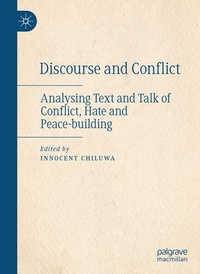
Discourse and Conflict
Description
Reviews / Votes
"This book needs to be in the hands of anybody who is, has been, or is going to be a practitioner and/or theoretician working in the vast terrain where the struggle for individual freedom, joined with collective collaboration, is going on. In particular, this collection singles out some of the most vulnerable sections and notable flashpoints of contended zones in that struggle, and places itself where it is most needed: the emancipation and strengthening of the most seriously underprivileged and oppressed participants."
- Jacob L. Mey, Emeritus Professor of Linguistics, University of Southern Denmark"This collection presents an impressive line-up of up-to-date case studies on conflict rhetoric, covering several major world regions and assembling an equally diverse range of contributors. The perceptive analyses on display here deserve a wide hearing in the international community of discourse analysts and scholars of conflict and peace studies."
- Christian Mair , University of Freiburg, Germany
"This is a fantastic and timely contribution to the field. It has a unique multi-level approach to discourses of conflict, and its focus on resolution. The book enjoys a truly international cast of lively contributors."
- Gwen Bouvier , Zhejiang University, ChinaMore details
Other editions
Additional editions
Person
Content
Chapter 1: Introduction: Discourse, Conflict and Conflict Resolution (Innocent Chiluwa).- Part 1: The Language of Conflict.- Chapter 2: Taking radical disagreement seriously: Filling the discourse analytic gap in the study of intractable asymmetric conflicts (Oliver Ramsbotham).- Chapter 3: Language in the service of lawfare: The "working definition of antisemitism" of the International Holocaust Remembrance Alliance (IHRA) (Susan Blackwell).- Chapter 4: Metaphors of Intolerance: A Comparative Analysis between the Speeches and Cartoons of Jair Bolsonaro and Donald Trump on Immigration (Argus Romero Abreu de Morais and Luciane Correa Ferreira).- Part 2: Hate Speech in Online and Offline Media.- Chapter 5: How do haters hate? Verbal aggression in Lithuanian online comments (Jurate Ruzaite).- Chapter 6: Different Shades of Hate: The Grey Zone between Offensive and Discriminatory Language in the Social Media Accounts of Flemish Politicians (Martina Temmerman and Raymond Harder).-Chapter 7: Reframing Hate: From Disaffected Young Men to Domestic Terrorists (Federica Fornaciari and Laine Goldman).- Chapter 8: Communicating hate on YouTube: The Macedonian identity in focus (Minos-Athanasios Karyotakis).- Chapter 9: "Who Wants to Sterilise the Sinhalese?" A Discourse Historical Analysis of Extreme Speech Online in Post-War Sri Lanka (Carmen Aguilera-Carnerero).- Chapter 10: Facebook comments on the 'refugee crisis': Discursive strategies to legitimise hate speech online (Dario Lucchesi).- Part 3: Discourse and peace-building.- Chapter 11: Positioning the voices of conflict: Language manipulation in the Diálogos de Paz (Lawrence N. Berlin).- Chapter 12: Building bridges after a riot: Talking towards mutual understanding following Charlottesville (Linda M. Doornbosch and Mark van Vuuren).- Chapter 13: Person to person peace building through intercultural communication: Discourse analysis of an online intercultural service-learning project with Afghanistan (Amy Jo Minett et al).- Chapter 14 Talk and Action as Discourse in UN Military Observer Course: Routines and Practices of Navigation (Iira Rautiainen).- Chapter 15: An analysis of public discourse on Albania's transitional justice system (Islam Jusufi et al.).- Chapter 16: Afterword (Innocent Chiluwa).