

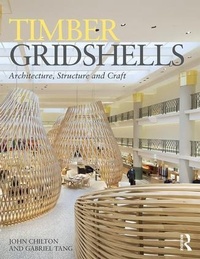
Timber Gridshells
Architecture, Structure and Craft
1st Edition
Published on 18. October 2016
Book
Paperback/Softback
258 pages
978-1-138-77530-5 (ISBN)
Description
Throughout history, people have constructed simple timber lattice shelters such as the tepee or yurt, covered with animal skins, leaves, grasses and woven fabrics. Over the last fifty years, more sophisticated 'webs of wood' have emerged, with timber gridshells in particular becoming a structurally expressive form of architecture. Recent developments in digital design, 3-D modelling software, timber fabrication technologies as well as trends towards low-carbon construction have further reinforced architects' interest in the use of lightweight timber grids and lattice structures.
This timely book charts the origin and evolution of the timber gridshell and its relation to timber lattice architecture. Drawing on a range of international case studies, the authors trace the effect advances in technology have had on design and construction in this field, providing a clear understanding of the structure, morphology, design process, and construction technology, and examining both the application and constraints of timber gridshells in architectural design.
Timber Gridshells is a highly illustrated, up-to-date resource which provides detailed answers and inspires new ideas. As such, it is essential reading for students of architecture as well as professional architects.
This timely book charts the origin and evolution of the timber gridshell and its relation to timber lattice architecture. Drawing on a range of international case studies, the authors trace the effect advances in technology have had on design and construction in this field, providing a clear understanding of the structure, morphology, design process, and construction technology, and examining both the application and constraints of timber gridshells in architectural design.
Timber Gridshells is a highly illustrated, up-to-date resource which provides detailed answers and inspires new ideas. As such, it is essential reading for students of architecture as well as professional architects.
More details
Language
English
Place of publication
London
United Kingdom
Publishing group
Taylor & Francis Ltd
Target group
College/higher education
Professional and scholarly
Postgraduate, Professional, Professional Practice & Development, and Undergraduate
Product notice
Paperback (trade)
Unsewn / adhesive bound
Illustrations
275 farbige Abbildungen, 1 s/w Tabelle
1 Tables, black and white; 275 Illustrations, color
Dimensions
Height: 241 mm
Width: 183 mm
Thickness: 18 mm
Weight
794 gr
ISBN-13
978-1-138-77530-5 (9781138775305)
Copyright in bibliographic data and cover images is held by Nielsen Book Services Limited or by the publishers or by their respective licensors: all rights reserved.
Schweitzer Classification
Other editions
Additional editions
E-Book
11/2016
Routledge
€86.99
Available for download
E-Book
11/2016
Routledge
€86.99
Available for download
Book
10/2016
1st Edition
Routledge
€267.41
Shipment within 10-20 days
Persons
John Chilton is Professor of Architecture and Tectonics at the University of Nottingham, UK. With a special interest in the history, design and construction of innovative and non-conventional structures, he is an active member of the International Association for Shell and Spatial Structures (IASS) and chaired their Working Group 12 - Spatial Timber Structures - from 1998 to 2015. He is the author of Space Grid Structures and Heinz Isler: The Engineer's Contribution to Contemporary Architecture, a book on the work of the Swiss reinforced concrete shell-builder Heinz Isler.
Gabriel Tang is an architect and Senior Lecturer in Architecture at Sheffield Hallam University, UK. He trained at the Bartlett, University College London, UK, and worked in the offices of Foster + Partners, London. Currently completing a PhD at the University of Edinburgh, UK, on the novel use of deployable gridshells as formwork for concrete shell construction, his research interests lie in technology culture, material tectonics and the innovation synergies between architecture, structure and construction processes.
Gabriel Tang is an architect and Senior Lecturer in Architecture at Sheffield Hallam University, UK. He trained at the Bartlett, University College London, UK, and worked in the offices of Foster + Partners, London. Currently completing a PhD at the University of Edinburgh, UK, on the novel use of deployable gridshells as formwork for concrete shell construction, his research interests lie in technology culture, material tectonics and the innovation synergies between architecture, structure and construction processes.
Content
Acknowledgements. Preface. 1. Introduction: Shells with Holes 2. Early Gridshells 3. Second Generation Deployable Gridshells (Post-Mannheim) 4. Ribbed Gridshells 5. Alternative Materials and Systems 6. Small Scale Projects and Experimentation 7. Made to Measure - Digital Fabrication 8. Current and Future Projects Under Construction Postscript. References and Bibliography. Index