

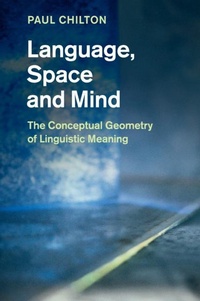
Language, Space and Mind
The Conceptual Geometry of Linguistic Meaning
Published on 12. December 2019
Book
Paperback/Softback
354 pages
978-1-108-81038-8 (ISBN)
Description
The idea that spatial cognition provides the foundation of linguistic meanings, even highly abstract meanings, has been put forward by a number of linguists in recent years. This book takes this proposal into new dimensions and develops a theoretical framework based on simple geometric principles. All speakers are conceptualisers who have a point of view both in a literal and in an abstract sense, choosing their perspective in space, time and the real world. The book examines the conceptualising properties of verbs, including tense, aspect, modality and transitivity, as well as the conceptual workings of grammatical constructions associated with counterfactuality, other minds and the expression of moral force. It makes links to the cognitive sciences throughout and concludes with a discussion of the relationship between language, brain and mind.
Reviews / Votes
'For many years cognitive linguists have argued that language is grounded in space. This accessible and engaging book explores just how far simple geometric principles can be pushed to account for a wide range of language phenomena.' Kenny Coventry, University of East AngliaMore details
Language
English
Place of publication
Cambridge
United Kingdom
Target group
Professional and scholarly
Product notice
Paperback (trade)
Illustrations
1 Halftones, unspecified; 1 Halftones, black and white; 94 Line drawings, black and white
Dimensions
Height: 229 mm
Width: 152 mm
Thickness: 19 mm
Weight
472 gr
ISBN-13
978-1-108-81038-8 (9781108810388)
Copyright in bibliographic data and cover images is held by Nielsen Book Services Limited or by the publishers or by their respective licensors: all rights reserved.
Schweitzer Classification
Other editions
Additional editions
Book
07/2014
Cambridge University Press
€127.50
Shipment within 15-20 days
Person
Paul Chilton is Emeritus Professor of Linguistics at Lancaster University.
Content
1. Introduction: space, geometry, mind; 2. Viewpoint, reference frames and transformations; 3. Distance, direction and verbs; 4. Event types and cognitive operators; 5. Times, tenses and reference frames; 6. Counterfactual reflections; 7. Reference frames and other minds; 8. Mental distance and complement clauses; 9. Verbs, complements and their conceptual effects; 10. The deontic dimension; 11. Concluding perspectives.