

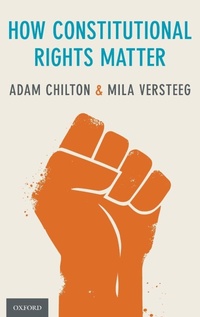
How Constitutional Rights Matter
Published on 17. September 2020
Book
Hardback
396 pages
978-0-19-087145-1 (ISBN)
Description
Does constitutionalizing rights improve respect for those rights in practice? Drawing on statistical analyses, survey experiments, and case studies from around the world, this book argues that enforcing constitutional rights is not easy, but that some rights are harder to repress than others.
First, enshrining rights in constitutions does not automatically ensure that those rights will be respected. For rights to matter, rights violations need to be politically costly. But this is difficult to accomplish for unconnected groups of citizens.
Second, some rights are easier to enforce than others, especially those with natural constituencies that can mobilize for their enforcement. This is the case for rights that are practiced by and within organizations, such as the rights to religious freedom, to unionize, and to form political parties. Because religious groups, trade unions and parties are highly organized, they are well-equipped to use the constitution to resist rights violations. As a result, these rights are systematically associated with better practices. By contrast, rights that are practiced on an individual basis, such as free speech or the prohibition of torture, often lack natural constituencies to enforce them, which makes it easier for governments to violate these rights.
Third, even highly organized groups armed with the constitution may not be able to stop governments dedicated to rights-repression. When constitutional rights are enforced by dedicated organizations, they are thus best understood as speed bumps that slow down attempts at repression.
An important contribution to comparative constitutional law, this book provides a comprehensive picture of the spread of constitutional rights, and their enforcement, around the world.
First, enshrining rights in constitutions does not automatically ensure that those rights will be respected. For rights to matter, rights violations need to be politically costly. But this is difficult to accomplish for unconnected groups of citizens.
Second, some rights are easier to enforce than others, especially those with natural constituencies that can mobilize for their enforcement. This is the case for rights that are practiced by and within organizations, such as the rights to religious freedom, to unionize, and to form political parties. Because religious groups, trade unions and parties are highly organized, they are well-equipped to use the constitution to resist rights violations. As a result, these rights are systematically associated with better practices. By contrast, rights that are practiced on an individual basis, such as free speech or the prohibition of torture, often lack natural constituencies to enforce them, which makes it easier for governments to violate these rights.
Third, even highly organized groups armed with the constitution may not be able to stop governments dedicated to rights-repression. When constitutional rights are enforced by dedicated organizations, they are thus best understood as speed bumps that slow down attempts at repression.
An important contribution to comparative constitutional law, this book provides a comprehensive picture of the spread of constitutional rights, and their enforcement, around the world.
Reviews / Votes
How Constitutional Rights Matter is the most accomplished monograph on the reality of constitutional rights. * EuConst *More details
Language
English
Place of publication
New York
United States
Target group
Professional and scholarly
Dimensions
Height: 240 mm
Width: 161 mm
Thickness: 26 mm
Weight
760 gr
ISBN-13
978-0-19-087145-1 (9780190871451)
Copyright in bibliographic data and cover images is held by Nielsen Book Services Limited or by the publishers or by their respective licensors: all rights reserved.
Schweitzer Classification
Other editions
Additional editions
Adam Chilton | Mila Versteeg
How Constitutional Rights Matter
E-Book
06/2020
OUP eBook
€62.99
Available for download
Adam Chilton | Mila Versteeg
How Constitutional Rights Matter
E-Book
06/2020
OUP eBook
€48.99
Available for download
Persons
Adam Chilton is Professor of Law and Walter Mader Research Scholar at the University of Chicago Law School.
Mila Versteeg is the Class of 1941 Research Professor of Law at the University of Virginia School of Law and a Carnegie Fellow at the Andrew Carnegie Foundation of New York.
Mila Versteeg is the Class of 1941 Research Professor of Law at the University of Virginia School of Law and a Carnegie Fellow at the Andrew Carnegie Foundation of New York.
Author
Professor of LawProfessor of Law, The University of Chicago Law School
Martha Lubin Karsh and Bruce A. Karsh Bicentennial Professor of Law, and Director of the Human Rights ProgramMartha Lubin Karsh and Bruce A. Karsh Bicentennial Professor of Law, and Director of the Human Rights Program, University of Virginia School of Law
Content
Chapter 1. Introduction
PART I: Theory, Background, & Methods
Chapter 2. The Organizational Basis of Constitutional Rights Protection
Chapter 3. Existing Evidence
Chapter 4. The Rise of Rights Constitutionalism
Chapter 5. Research Methods
PART II: Individual Rights
Chapter 6. Individual Rights: Speech, Torture, and Movement
Chapter 7. Social Rights: Education and Healthcare
Chapter 8. Support for Constitutional Rights Violations
PART III: Organizational Rights
Chapter 9. Freedom of Religion
Chapter 10. Right to Unionize
Chapter 11. Right to Form Political Parties
PART IV: The Limits of Constitutional Rights
Chapter 12. Conclusion
APPENDIX
A1. Data Sources
A2. Regression Results
A3. Conditional Results: Courts and Democracy
PART I: Theory, Background, & Methods
Chapter 2. The Organizational Basis of Constitutional Rights Protection
Chapter 3. Existing Evidence
Chapter 4. The Rise of Rights Constitutionalism
Chapter 5. Research Methods
PART II: Individual Rights
Chapter 6. Individual Rights: Speech, Torture, and Movement
Chapter 7. Social Rights: Education and Healthcare
Chapter 8. Support for Constitutional Rights Violations
PART III: Organizational Rights
Chapter 9. Freedom of Religion
Chapter 10. Right to Unionize
Chapter 11. Right to Form Political Parties
PART IV: The Limits of Constitutional Rights
Chapter 12. Conclusion
APPENDIX
A1. Data Sources
A2. Regression Results
A3. Conditional Results: Courts and Democracy