

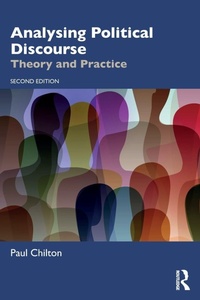
Analysing Political Discourse
Theory and Practice
2nd Edition
Published on 30. July 2025
Book
Paperback/Softback
246 pages
978-1-032-51251-8 (ISBN)
Description
In today's world, analysing political language is more important than ever. This revised edition, while retaining the historically significant case studies, adds new analyses that reflect the 2010s and 2020s. It retains the original analytical tools, including the discourse space model, and in a fresh chapter advocates development of tools from neuroscience.
The book begins by exploring some fundamental questions concerning the relationship between language and politics, putting forward the idea that society, language and politics are closely intertwined. There cannot be any politics, as we know it, without language. The following chapters focus on key aspects of language in relation to political institutions, practices and ideologies: the interaction between speakers and hearers, the projection of different world-views, and the arousal of political emotions. The final chapters are devoted to historical examples of perennial political issues: racism, international conflict and the role of religion.
Written in a lively and engaging style with summaries and further reading to aid learning, this book provides an essential introduction to political discourse analysis for students of language, communication, politics sociology, international relations and applied linguistics.
The book begins by exploring some fundamental questions concerning the relationship between language and politics, putting forward the idea that society, language and politics are closely intertwined. There cannot be any politics, as we know it, without language. The following chapters focus on key aspects of language in relation to political institutions, practices and ideologies: the interaction between speakers and hearers, the projection of different world-views, and the arousal of political emotions. The final chapters are devoted to historical examples of perennial political issues: racism, international conflict and the role of religion.
Written in a lively and engaging style with summaries and further reading to aid learning, this book provides an essential introduction to political discourse analysis for students of language, communication, politics sociology, international relations and applied linguistics.
More details
Edition
2nd edition
Language
English
Place of publication
London
United Kingdom
Publishing group
Taylor & Francis Ltd
Target group
College/higher education
Postgraduate and Undergraduate Advanced
Illustrations
15 s/w Abbildungen, 15 s/w Zeichnungen, 9 s/w Tabellen
9 Tables, black and white; 15 Line drawings, black and white; 15 Illustrations, black and white
Dimensions
Height: 234 mm
Width: 156 mm
Thickness: 14 mm
Weight
409 gr
ISBN-13
978-1-032-51251-8 (9781032512518)
Copyright in bibliographic data and cover images is held by Nielsen Book Services Limited or by the publishers or by their respective licensors: all rights reserved.
Schweitzer Classification
Other editions
Additional editions
E-Book
07/2025
2nd Edition
Routledge
€55.49
Available for download
E-Book
07/2025
2nd Edition
Routledge
€55.49
Available for download
Book
07/2025
2nd Edition
Routledge
€206.60
Shipment within 10-20 days
Previous edition
Book
12/2003
1st Edition
Routledge
€90.55
Shipment within 15-20 days
Person
Paul Chilton is Emeritus Professor of Linguistics at Lancaster University, Associate Member of the Linguistics Faculty, University of Oxford and Associate Fellow at the University of Warwick. His publications include Language, Space and Mind (2014), Religion, Language and the Human Mind (co-ed. 2018) and Brexitspeak: Demagoguery and the Decline of Democracy (2024).
Content
List of Figures
List of Tables
Foreword to the Second Edition
Preface
Acknowledgements
Part I: Political animals as articulate mammals
1. Politics and language
2. Language and politics
3. Interaction
4. Representation
5. Emotion
Part II: The domestic arena
6. Political interviews
7. Parliamentary language
8. Foreigners: ethnocentrism and racism
Part III: The global arena
9. Distant places
10. Worlds apart
11. The role of religion
Part IV: Concluding thoughts
12. Language and politics in the contemporary world
Appendix
Bibliography
Name Index
Subject Index
List of Tables
Foreword to the Second Edition
Preface
Acknowledgements
Part I: Political animals as articulate mammals
1. Politics and language
2. Language and politics
3. Interaction
4. Representation
5. Emotion
Part II: The domestic arena
6. Political interviews
7. Parliamentary language
8. Foreigners: ethnocentrism and racism
Part III: The global arena
9. Distant places
10. Worlds apart
11. The role of religion
Part IV: Concluding thoughts
12. Language and politics in the contemporary world
Appendix
Bibliography
Name Index
Subject Index