

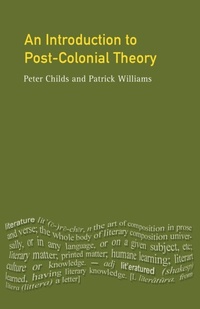
Introduction To Post-Colonial Theory
1st Edition
Published on 19. December 1996
Book
Paperback/Softback
256 pages
978-0-13-232919-4 (ISBN)
Description
The first book of its kind in the field, this timely introduction to post- colonial theory offers lucid and accessible summaries of the major work of key theorists such as Frantz Fanon, Edward Said.Homi Bhabha and Gayatri Spivak. The Guide also Explores the lines of resistance against colonialism and highlights the theories of post-colonial identity that have been responsible for generating some of the most influential and challenging critical work of recent decades. Designed for undergraduates and postgraduates taking courses related to colonialisn or post-colonialism, the book summarieses the major topics and issues as well as covering the contributions of major and less familiar figures in the field.
Reviews / Votes
"The book provides a concise, rich and lucid guide to the subject (...) This new introduction constitutes a worthy companion to the reader." Interventions, 2000More details
Language
English
Place of publication
London
United Kingdom
Publishing group
Taylor & Francis Ltd
Target group
Professional and scholarly
Dimensions
Height: 216 mm
Width: 140 mm
Thickness: 14 mm
Weight
322 gr
ISBN-13
978-0-13-232919-4 (9780132329194)
Copyright in bibliographic data and cover images is held by Nielsen Book Services Limited or by the publishers or by their respective licensors: all rights reserved.
Schweitzer Classification
Other editions
Additional editions
Peter Childs | Patrick Williams
An Introduction To Post-Colonial Theory
Book
07/2016
1st Edition
Routledge
€206.10
Shipment within 10-20 days
Peter Childs | Patrick Williams
An Introduction To Post-Colonial Theory
E-Book
06/2014
1st Edition
Routledge
€101.99
Available for download
Peter Childs | Patrick Williams
An Introduction To Post-Colonial Theory
E-Book
06/2014
1st Edition
Routledge
€101.99
Available for download
Persons
Peter Childs, Patrick Williams
Content
1. Introduction: Points of Departure.
2. Lines of Resistance Metropolitan Therorizing Said and Orientalism.
3. Bhabha and Ambivalence.
4. Spivak and the Subaltern.
5. Intersections and Implications.
6. Conclusion.
7. Notes.
Index.
2. Lines of Resistance Metropolitan Therorizing Said and Orientalism.
3. Bhabha and Ambivalence.
4. Spivak and the Subaltern.
5. Intersections and Implications.
6. Conclusion.
7. Notes.
Index.