

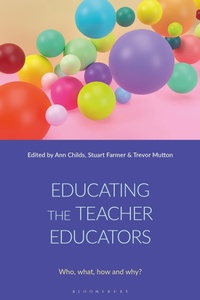
Educating the Teacher Educators
Who, what, how and why?
Will be published approx. on 4. March 2027
Book
Hardback
256 pages
978-1-350-54231-0 (ISBN)
Description
This book presents the voices of a very diverse group of practising teacher educators as they develop their professional thinking and practice across a wide range of contexts and settings through practitioner research and inquiry. It explores and extends our understanding of who teacher educators are, and what they see as the most significant theoretical insights that inform their work.
It goes on to show how they have used particular strategies to work with learner teachers and how they continue to grapple with conceptual, policy and practical issues in their day-to-day work. These everyday challenges and methods include stimulated recall, observation and feedback, and teacher agency. In their closing chapters, internationally recognised experts Viv Ellis and Maria Assuncao Flores distil the most important and valuable insights from these case studies, making this an ideal resource for early career teacher educators in all settings.
It goes on to show how they have used particular strategies to work with learner teachers and how they continue to grapple with conceptual, policy and practical issues in their day-to-day work. These everyday challenges and methods include stimulated recall, observation and feedback, and teacher agency. In their closing chapters, internationally recognised experts Viv Ellis and Maria Assuncao Flores distil the most important and valuable insights from these case studies, making this an ideal resource for early career teacher educators in all settings.
More details
Language
English
Place of publication
London
United Kingdom
Publishing group
Bloomsbury Publishing PLC
Target group
Professional and scholarly
Dimensions
Height: 234 mm
Width: 156 mm
ISBN-13
978-1-350-54231-0 (9781350542310)
Copyright in bibliographic data and cover images is held by Nielsen Book Services Limited or by the publishers or by their respective licensors: all rights reserved.
Schweitzer Classification
Persons
Ann Childs is an Associate Professor in Science Education, University of Oxford, Department of Education. She is currently the Director of the Masters in Teacher education.
Stuart Farmer is an ex-head of physics in Scotland and currently the Learning and Skills Manager (Scotland), Institute of Physics and an Honorary Associate Fellow, Stirling Centre for Research into Curriculum Making, University of Stirling.
Trevor Mutton is an Associate Professor in Education at the University of Oxford, Department of Education. He was PGCE course director from 2009 to 2017 and subsequently Director of Professional Programmes and Director of Graduate Studies.
Stuart Farmer is an ex-head of physics in Scotland and currently the Learning and Skills Manager (Scotland), Institute of Physics and an Honorary Associate Fellow, Stirling Centre for Research into Curriculum Making, University of Stirling.
Trevor Mutton is an Associate Professor in Education at the University of Oxford, Department of Education. He was PGCE course director from 2009 to 2017 and subsequently Director of Professional Programmes and Director of Graduate Studies.
Content
Part One: Who are the teacher educators?
1. Who are the teacher educators? Ann Childs (Oxford University, UK), Stuart Farmer (Institute of Physics, UK), Trevor Mutton (Oxford University, UK)
Part Two: What is the role of key theories in enhancing teacher educators' professional thinking and practice?
2. The Knowledge Quartet, Claire Aspinall (Learning and Skills Consultant, UK), Jackie Flaherty (The Ogden Trust, UK), Stuart Farmer (Institute of Physics, UK), Sinead Godden (Southfields Academy, UK), Will Haywood (University of Warwick, UK), Susan Jones (University of Wales Trinity St David, UK), Amanda Wilkinson (University of the West of England, UK) and John Chun Yin Wong (The University of Hong Kong)
3. What is the role of Clarke & Hollingsworth's model of teacher professional growth in enhancing teacher educator's thinking and practice? Stephen Hearn (Charterhouse School, UK), Gill Knight (primary maths consultant, UK) and Rachel Robinson (University of Oxford, UK)
4. Realistic Teacher Education and the ALACT model, Dongjie Chen (United World College South East Asia, Singapore), Jackie Flaherty (The Ogden Trust, UK), Jesus Garcia Jorda (International School of Beijing, China), Tim Lissimore (Wilson's School, UK)
5. Communities of Practice, Charlotte Fell (e-Qualitas Teacher Training, UK), Jessica Rowson (The Ogden Trust, UK) and Henry Sykes (Our Lady's Catholic High School, UK)
Part Three: How do teacher educators educate teachers? Key strategic approaches used to educate teachers
6. Stimulated recall, Julie Reynolds (University of Southampton, UK) Ian Campton (University of Southampton, UK)
7. Observation and feedback, Gillian Knight (primary maths consultant), Susan Jones (University of Wales Trinity St David, UK), Will Haywood (University of Warwick, UK)
8. Lesson study, Matt Lewis (National Centre for the Excellence in the Teaching of Mathematics, UK), Tim Lissimore (Wilson's School, UK), Ciaran Shannon (King Richard School, Cyprus)
9. Networking and Collaboration, Dan Cottle (University of Birmingham, UK) and Stuart Farmer (Institute of Physics, UK)
10. Mentoring and Coaching, Dongjie Chen (United World College South East Asia, Singapore), Dan Cottle (University of Birmingham, UK), Charlotte Fell (e-Qualitas Teacher Training, UK) and Jennifer Sacks (Woodford Green Preparatory School, UK)
Part Four: How can teacher educators promote transformative professionalism?
11. Teacher agency, autonomy, resisting and subverting - bottom-up teacher education, Will Haywood (University of Warwick, UK), Jesus Garcia Jorda (International School of Beijing, China) and Robyn Starr (Teach First, UK)
12. Social Justice for Teacher Education: The experiences of teachers from minority ethnic backgrounds and the implications for teacher education, Zamanganga Mbatha (Royal Docks Academy, UK), Saffron Powell (King's College London, UK) and Rachel Robinson (University of Oxford, UK)
Part Five: Why is this book important? An international perspective
13. Response 1 from a key international academic in Teacher education, Viv Ellis (Monash University, Australia)
14. Response 2 from a key international academic in Teacher Education, Dr Maria Assuncao Flores (University of Minho, Portugal)
1. Who are the teacher educators? Ann Childs (Oxford University, UK), Stuart Farmer (Institute of Physics, UK), Trevor Mutton (Oxford University, UK)
Part Two: What is the role of key theories in enhancing teacher educators' professional thinking and practice?
2. The Knowledge Quartet, Claire Aspinall (Learning and Skills Consultant, UK), Jackie Flaherty (The Ogden Trust, UK), Stuart Farmer (Institute of Physics, UK), Sinead Godden (Southfields Academy, UK), Will Haywood (University of Warwick, UK), Susan Jones (University of Wales Trinity St David, UK), Amanda Wilkinson (University of the West of England, UK) and John Chun Yin Wong (The University of Hong Kong)
3. What is the role of Clarke & Hollingsworth's model of teacher professional growth in enhancing teacher educator's thinking and practice? Stephen Hearn (Charterhouse School, UK), Gill Knight (primary maths consultant, UK) and Rachel Robinson (University of Oxford, UK)
4. Realistic Teacher Education and the ALACT model, Dongjie Chen (United World College South East Asia, Singapore), Jackie Flaherty (The Ogden Trust, UK), Jesus Garcia Jorda (International School of Beijing, China), Tim Lissimore (Wilson's School, UK)
5. Communities of Practice, Charlotte Fell (e-Qualitas Teacher Training, UK), Jessica Rowson (The Ogden Trust, UK) and Henry Sykes (Our Lady's Catholic High School, UK)
Part Three: How do teacher educators educate teachers? Key strategic approaches used to educate teachers
6. Stimulated recall, Julie Reynolds (University of Southampton, UK) Ian Campton (University of Southampton, UK)
7. Observation and feedback, Gillian Knight (primary maths consultant), Susan Jones (University of Wales Trinity St David, UK), Will Haywood (University of Warwick, UK)
8. Lesson study, Matt Lewis (National Centre for the Excellence in the Teaching of Mathematics, UK), Tim Lissimore (Wilson's School, UK), Ciaran Shannon (King Richard School, Cyprus)
9. Networking and Collaboration, Dan Cottle (University of Birmingham, UK) and Stuart Farmer (Institute of Physics, UK)
10. Mentoring and Coaching, Dongjie Chen (United World College South East Asia, Singapore), Dan Cottle (University of Birmingham, UK), Charlotte Fell (e-Qualitas Teacher Training, UK) and Jennifer Sacks (Woodford Green Preparatory School, UK)
Part Four: How can teacher educators promote transformative professionalism?
11. Teacher agency, autonomy, resisting and subverting - bottom-up teacher education, Will Haywood (University of Warwick, UK), Jesus Garcia Jorda (International School of Beijing, China) and Robyn Starr (Teach First, UK)
12. Social Justice for Teacher Education: The experiences of teachers from minority ethnic backgrounds and the implications for teacher education, Zamanganga Mbatha (Royal Docks Academy, UK), Saffron Powell (King's College London, UK) and Rachel Robinson (University of Oxford, UK)
Part Five: Why is this book important? An international perspective
13. Response 1 from a key international academic in Teacher education, Viv Ellis (Monash University, Australia)
14. Response 2 from a key international academic in Teacher Education, Dr Maria Assuncao Flores (University of Minho, Portugal)