

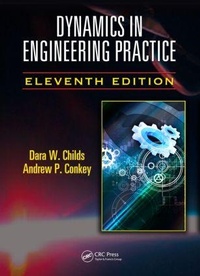
Dynamics in Engineering Practice
11th Edition
Published on 1. April 2015
Book
Hardback
474 pages
978-1-4822-5025-1 (ISBN)
Description
Observing that most books on engineering dynamics left students lacking and failing to grasp the general nature of dynamics in engineering practice, the authors of Dynamics in Engineering Practice, Eleventh Edition focused their efforts on remedying the problem. This text shows readers how to develop and analyze models to predict motion. While establishing dynamics as an evolution of continuous motion, it offers a brief history of dynamics, discusses the SI and US customary unit systems, and combines topics that are typically covered in an introductory and intermediate, or possibly even an advanced dynamics course. It also contains plenty of computer example problems and enough tools to enable readers to fully grasp the subject. A free support book with worked computer examples using MATLAB (R) is available upon request.
New in the Eleventh Edition:
A large number of problems have been added; specifically, 59 new problems have been included in the original problem sets provided in chapters two through five. Chapter six has been added and covers the application of Lagrange's equations for deriving equations of motion.
The new and improved chapters in this text:
Address the fundamental requirements of dynamics, including units, force, and mass, and provides a brief history of the development of dynamics
Explore the kinematics of a particle, including displacement, velocity, and acceleration in one and two dimensions
Cover planar kinetics of rigid bodies, starting with inertia properties and including the mass moment of inertia, the radius of gyration, and the parallel-axis formula
Explain how to develop equations of motion for dynamics using Lagrange's equations
Dynamics in Engineering Practice, Eleventh Edition shows readers how to develop general kinematic equations and EOMs, analyze systems, and set up and solve equations, using a revolutionary approach to modeling and analysis along with current computer techniques.
New in the Eleventh Edition:
A large number of problems have been added; specifically, 59 new problems have been included in the original problem sets provided in chapters two through five. Chapter six has been added and covers the application of Lagrange's equations for deriving equations of motion.
The new and improved chapters in this text:
Address the fundamental requirements of dynamics, including units, force, and mass, and provides a brief history of the development of dynamics
Explore the kinematics of a particle, including displacement, velocity, and acceleration in one and two dimensions
Cover planar kinetics of rigid bodies, starting with inertia properties and including the mass moment of inertia, the radius of gyration, and the parallel-axis formula
Explain how to develop equations of motion for dynamics using Lagrange's equations
Dynamics in Engineering Practice, Eleventh Edition shows readers how to develop general kinematic equations and EOMs, analyze systems, and set up and solve equations, using a revolutionary approach to modeling and analysis along with current computer techniques.
Reviews / Votes
"It is easy to identify students who learned dynamics from (previous editions) of this book.... They are confident, they approach new problems based on fundamental principles, they are not afraid of dynamics. The integrated, differential equations & fundamental principles based approach removes the dread from dynamics! No longer is there fear an uncertainty of picking the correct equation & guessing the correct special case... every problem can be methodically approached from the same few principles and conquered."-James R Morgan, Charles Sturt University, Bathurst, NSW, Australia "It is easy to identify students who learned dynamics from (previous editions) of this book.... They are confident, they approach new problems based on fundamental principles, they are not afraid of dynamics. The integrated, differential equations and fundamental principles based approach removes the dread from dynamics! No longer is there fear; an uncertainty of picking the correct equation and guessing the correct special case... every problem can be methodically approached from the same few principles and conquered."
-James R Morgan, Charles Sturt University, Bathurst, NSW, Australia
More details
Series
Edition
11th edition
Language
English
Place of publication
Bosa Roca
United States
Publishing group
Taylor & Francis Inc
Target group
College/higher education
Product notice
sewn/stitched
Cloth over boards
Illustrations
706 s/w Abbildungen
706 Illustrations, black and white
Dimensions
Height: 287 mm
Width: 220 mm
Thickness: 32 mm
Weight
1364 gr
ISBN-13
978-1-4822-5025-1 (9781482250251)
Copyright in bibliographic data and cover images is held by Nielsen Book Services Limited or by the publishers or by their respective licensors: all rights reserved.
Schweitzer Classification
Other editions
Additional editions
Dara W. Childs | Andrew P. Conkey
Dynamics in Engineering Practice
E-Book
04/2015
11th Edition
CRC Press
€205.99
Available for download
Dara W. Childs | Andrew P. Conkey
Dynamics in Engineering Practice
E-Book
04/2015
11th Edition
CRC Press
€205.99
Available for download
Previous edition
Dara W. Childs
Dynamics in Engineering Practice, Tenth Edition
Book
08/2010
10th Edition
CRC Press
€112.84
Article exhausted; check for reprint
Persons
Dr. Dara Childs is professor of mechanical engineering at Texas A&M University (TAMU) in College Station, Texas. He has been director of the TAMU Turbomachinery Laboratory since 1984. He has received several best-paper awards, is an American Society of Mechanical Engineers (ASME) life fellow, and received the ASME Henry R. Worthington medal for outstanding contributions in pumping machinery. He is the author of many conference and journal papers plus two prior books. Dr. Childs has taught graduate and undergraduate courses in dynamics and vibrations since 1968: Colorado State University (1968-1971), University of Louisville (1971-1980), TAMU (1980-present).
Andrew P. Conkey
received his PhD from Texas A&M University (TAMU) in 2007, where his research was in the application of the fiber Fabry-Perot interferometer to machinery/vibration measurements. He received his bachelor's and master's degrees from TAMU-Kingsville. He has over 16 years of teaching experience, having taught at TAMU-Kingsville, TAMU-College Station, TAMU-Qatar, and TAMU-Corpus Christi. In addition to teaching, he has worked for a refinery, a fiber-optic sensor company, and an engineering consulting firm.
Andrew P. Conkey
received his PhD from Texas A&M University (TAMU) in 2007, where his research was in the application of the fiber Fabry-Perot interferometer to machinery/vibration measurements. He received his bachelor's and master's degrees from TAMU-Kingsville. He has over 16 years of teaching experience, having taught at TAMU-Kingsville, TAMU-College Station, TAMU-Qatar, and TAMU-Corpus Christi. In addition to teaching, he has worked for a refinery, a fiber-optic sensor company, and an engineering consulting firm.
Content
Introduction and Fundamentals. Planar Kinematics of Particles. Planar Kinetics of Particles. Planar Kinematics of Rigid Bodies. Planar Kinetics of Rigid Bodies. Appendices. Index.