

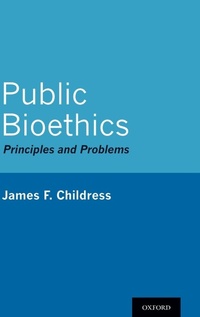
Public Bioethics
Principles and Problems
Published on 29. June 2020
Book
Hardback
346 pages
978-0-19-979848-3 (ISBN)
Description
Public Bioethics collects the most influential essays and articles of James F. Childress, a leading figure in the field of contemporary bioethics. These essays, including new, previously-unpublished material, cohere around the idea of 'public bioethics,' which concerns the analysis and assessment of public policies in biomedicine, health care, and public health.
The volume is divided into four sections - The first examines the principle of respect for autonomy and paternalistic policies and practices. The second explores the tension between bioethics, public policy, and religious convictions, such as the right of health care providers to conscientiously refuse to provide treatment to certain patients. The third section looks at practices and policiies related to organ transplantation; Childress places particular focus on determining death, obtaining first-person consent for deceased organ donation, fairly allocating donated organs, and related issues in the distribution of scarce resources. The final section maps the broad terrain of public ethics; Childress propoposes a triage framework for the use of resources in public health crises, addresses public health interventions that potentially infringe civil liberties, and sheds light on John Stuart Mill's misunderstood legacy on public health ethics.
Public Bioethics deftly explicates both contemporary bioethical issues and the processes involved in determining appropriate policies and publicly justifying collective recommendations, reflecting the author's vast experience serving on public bioethics committees, particularly at the national level in the United States. Providing a thorough account of the principles that govern issues within the healthcare system, this book will appeal to bioethicists, physicians, and public policy-makers.
The volume is divided into four sections - The first examines the principle of respect for autonomy and paternalistic policies and practices. The second explores the tension between bioethics, public policy, and religious convictions, such as the right of health care providers to conscientiously refuse to provide treatment to certain patients. The third section looks at practices and policiies related to organ transplantation; Childress places particular focus on determining death, obtaining first-person consent for deceased organ donation, fairly allocating donated organs, and related issues in the distribution of scarce resources. The final section maps the broad terrain of public ethics; Childress propoposes a triage framework for the use of resources in public health crises, addresses public health interventions that potentially infringe civil liberties, and sheds light on John Stuart Mill's misunderstood legacy on public health ethics.
Public Bioethics deftly explicates both contemporary bioethical issues and the processes involved in determining appropriate policies and publicly justifying collective recommendations, reflecting the author's vast experience serving on public bioethics committees, particularly at the national level in the United States. Providing a thorough account of the principles that govern issues within the healthcare system, this book will appeal to bioethicists, physicians, and public policy-makers.
More details
Language
English
Place of publication
New York
United States
Target group
College/higher education
Dimensions
Height: 240 mm
Width: 161 mm
Thickness: 23 mm
Weight
675 gr
ISBN-13
978-0-19-979848-3 (9780199798483)
Copyright in bibliographic data and cover images is held by Nielsen Book Services Limited or by the publishers or by their respective licensors: all rights reserved.
Schweitzer Classification
Other editions
Additional editions
E-Book
02/2020
1st Edition
OUP eBook
€40.99
Available for download
E-Book
02/2020
1st Edition
OUP eBook
€40.99
Available for download
Person
James F. Childress is the John Allen Hollingsworth Professor of Ethics at the University of Virginia, where he directs the Institute for Practical Ethics and Public Life. He was born in North Carolina, and studied at Guilford and Yale. He held the position of research chair at the Kennedy Institute of Ethics at Georgetown, and has been actively involved in several national committees examining bioethics and public policy. He was vice chair of the national Task Force on Organ Transplantation and served on the Board of Directors of the United Network for Organ Sharing (UNOS), the UNOS Ethics Committee, and the Recombinant DNA Advisory Committee, among others. He was appointed by President Clinton to the National Bioethics Advisory Commission from 1996-2001. He is an elected member of the National Academy of Medicine and the American Academy of Arts and Sciences, as well as a Fellow of the Hastings Center. He is the co-author (with Tom L. Beauchamp) of Principles of Bioethics, and has
authored several books and numerous articles on biomedical ethics, and other topics within the field of ethics.
authored several books and numerous articles on biomedical ethics, and other topics within the field of ethics.
Content
Chapter 1: Respecting Personal Autonomy in Bioethics: Relational Autonomy as a Corrective?
Chapter 2: Paternalism in Health Care and Health Policy
Chapter 3: Narratives vs. Norms: A Misplaced Debate in Bioethics
Chapter 4: Religion, Bioethics, and Public Policy: Debates about Secularization
Chapter 5: Religion, Morality, and Public Policy: The Controversy about Human Cloning
Chapter 6: Conscientious Refusals in Health Care
Chapter 7: Difficulties of Determining Death: What Should We Do about the "Dead Donor Rule"?
Chapter 8: The Failure to Give: Facilitating First-Person Deceased Organ Donation
Chapter 9: Putting Patients First in Organ Allocation: An Ethical Analysis of Policy Debates in the U.S.
Chapter 10: Public Health Ethics: Mapping the Terrain
Chapter 11: Public Health and Civil Liberties: Resolving Conflicts
Chapter 12: Triage in a Public Health Crisis: The Case of a Bioterrorist Attack
Chapter 13: John Stuart Mill's Legacy for Public Health Ethics: On Liberty and Beyond
Chapter 2: Paternalism in Health Care and Health Policy
Chapter 3: Narratives vs. Norms: A Misplaced Debate in Bioethics
Chapter 4: Religion, Bioethics, and Public Policy: Debates about Secularization
Chapter 5: Religion, Morality, and Public Policy: The Controversy about Human Cloning
Chapter 6: Conscientious Refusals in Health Care
Chapter 7: Difficulties of Determining Death: What Should We Do about the "Dead Donor Rule"?
Chapter 8: The Failure to Give: Facilitating First-Person Deceased Organ Donation
Chapter 9: Putting Patients First in Organ Allocation: An Ethical Analysis of Policy Debates in the U.S.
Chapter 10: Public Health Ethics: Mapping the Terrain
Chapter 11: Public Health and Civil Liberties: Resolving Conflicts
Chapter 12: Triage in a Public Health Crisis: The Case of a Bioterrorist Attack
Chapter 13: John Stuart Mill's Legacy for Public Health Ethics: On Liberty and Beyond