

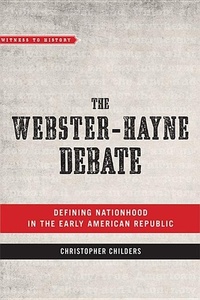
The Webster-Hayne Debate
Defining Nationhood in the Early American Republic
Will be published approx. on 10. October 2018
Book
Hardback
184 pages
978-1-4214-2613-6 (ISBN)
Description
A crucial senatorial debate on the question of the states' relationship to the federal government.
Two generations after the founding, Americans still disagreed on the nature of the Union. Was it a confederation of sovereign states or a nation headed by a central government? To South Carolina Senator Robert Y. Hayne and others of his mindset, only the vigilant protection of states' rights could hold off an attack on the southern way of life, which was undergirded by slavery. Massachusetts Senator Daniel Webster, on the other hand, believed that the political and economic ascendancy of New England-and the nation-required a strong, activist national government.
In The Webster-Hayne Debate, Christopher Childers focuses on the sharp dispute that engaged Webster and Hayne in January 1830. During Senate discussion of western land policy, Childers explains, the senators' exchanges grew first earnest and then heated, finally landing on the question of union-its nature and its value in a federal republic. Childers argues that both Webster and Hayne, and the factions they represented, saw the West as key to the success of their political plans and sought to cultivate western support for their ideas.
A short, accessible account of the conflict and the related issues it addressed, The Webster-Hayne Debate captures an important moment in the early republic. Ideal for use in college classrooms or for readers interested in American history, this book examines a pivotal moment and a critical problem in the history of US politics. It also shows how Americans grappled with the issues of nationalism, sectionalism, and the meaning of union itself-issues that still resonate today.
Two generations after the founding, Americans still disagreed on the nature of the Union. Was it a confederation of sovereign states or a nation headed by a central government? To South Carolina Senator Robert Y. Hayne and others of his mindset, only the vigilant protection of states' rights could hold off an attack on the southern way of life, which was undergirded by slavery. Massachusetts Senator Daniel Webster, on the other hand, believed that the political and economic ascendancy of New England-and the nation-required a strong, activist national government.
In The Webster-Hayne Debate, Christopher Childers focuses on the sharp dispute that engaged Webster and Hayne in January 1830. During Senate discussion of western land policy, Childers explains, the senators' exchanges grew first earnest and then heated, finally landing on the question of union-its nature and its value in a federal republic. Childers argues that both Webster and Hayne, and the factions they represented, saw the West as key to the success of their political plans and sought to cultivate western support for their ideas.
A short, accessible account of the conflict and the related issues it addressed, The Webster-Hayne Debate captures an important moment in the early republic. Ideal for use in college classrooms or for readers interested in American history, this book examines a pivotal moment and a critical problem in the history of US politics. It also shows how Americans grappled with the issues of nationalism, sectionalism, and the meaning of union itself-issues that still resonate today.
Reviews / Votes
In The Webster-Hayne Debate, Christopher Childers examines the context of the debate between Daniel Webster of Massachusetts and his Senate colleague Robert S. Hayne of South Carolina in January 1830 . . . Readers will finish the book with a clear idea of the reason Webster's "Reply" became so influential in its own day. They will also better understand the debate's political context.-Asaf Almog, University of Virginia, Western Historical Quarterly Christopher Childers's contribution to Johns Hopkins University Press's highly regarded Witness to History series reminds us that the [Webster-Hayne] debate remains a subject well worth considering, both for its oratorical power and, perhaps even more importantly, for what it reveals about the complex and intricately nuanced nature of the nation's Jacksonian political culture. The chief strength of Childers's work is its ability to provide readers with a sophisticated overview of the shifting political landscape that inspired this highly charged and symbolically rich exchange.
-Martin Hershock, University of Michigan-Dearborn, Journal of American History The Webster-Hayne Debate: Defining Nationhood in the Early American Republic is an excellent fit for the undergraduate classroom and will surely spark conversation about the relationship between the states and the Union . . . this work serves as an introduction to this pivotal moment and to the politics of early antebellum America.
-Thomas Blake Earle, Texas A&M University at Galveston, Journal of Southern History
More details
Series
Language
English
Place of publication
Baltimore, MD
United States
Target group
College/higher education
Product notice
sewn/stitched
Cloth over boards
Illustrations
10 s/w Photographien bzw. Rasterbilder
10 Halftones, black and white
Dimensions
Height: 231 mm
Width: 157 mm
Thickness: 18 mm
Weight
386 gr
ISBN-13
978-1-4214-2613-6 (9781421426136)
DOI
10.56021/9781421426136
Copyright in bibliographic data and cover images is held by Nielsen Book Services Limited or by the publishers or by their respective licensors: all rights reserved.
Schweitzer Classification
Other editions
Additional editions
Book
10/2018
Johns Hopkins University Press
€22.50
Article not available at the moment
E-Book
10/2018
Johns Hopkins University Press
€15.49
Available for download
Person
Christopher Childers is an assistant professor of history at Pittsburg State University. He is the author of The Failure of Popular Sovereignty: Slavery, Manifest Destiny, and the Radicalization of Southern Politics and the coauthor of The American South: A History.
Content
Preface
Acknowledgments
Prologue. We the States or We the People?
1. New England's March toward Nationalism
2. The South's March toward Sectionalism
3. The West Asserts Its Power
4. The Great Debate
5. Nullification and Nationhood
Epilogue. The Webster-Hayne Debate in Historical Memory
Notes
Essay on Sources
Index
Acknowledgments
Prologue. We the States or We the People?
1. New England's March toward Nationalism
2. The South's March toward Sectionalism
3. The West Asserts Its Power
4. The Great Debate
5. Nullification and Nationhood
Epilogue. The Webster-Hayne Debate in Historical Memory
Notes
Essay on Sources
Index