

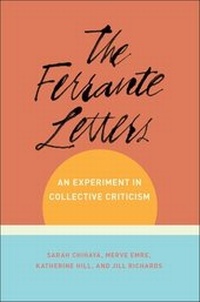
The Ferrante Letters
An Experiment in Collective Criticism
Published on 7. January 2020
Book
Hardback
288 pages
978-0-231-19456-3 (ISBN)
Description
Like few other works of contemporary literature, Elena Ferrante's Neapolitan novels found an audience of passionate and engaged readers around the world. Inspired by Ferrante's intense depiction of female friendship and women's intellectual lives, four critics embarked upon a project that was both work and play: to create a series of epistolary readings of the Neapolitan Quartet that also develops new ways of reading and thinking together.
In a series of intertwined, original, and daring readings of Ferrante's work and her fictional world, Sarah Chihaya, Merve Emre, Katherine Hill, and Juno Jill Richards strike a tone at once critical and personal, achieving a way of talking about literature that falls between the seminar and the book club. Their letters make visible the slow, fractured, and creative accretion of ideas that underwrites all literary criticism and also illuminate the authors' lives outside the academy. The Ferrante Letters offers an improvisational, collaborative, and cumulative model for reading and writing with others, proposing a new method the authors call collective criticism. A book for fans of Ferrante and for literary scholars seeking fresh modes of intellectual exchange, The Ferrante Letters offers incisive criticism, insouciant riffs, and the pleasure of giving oneself over to an extended conversation about fiction with friends.
In a series of intertwined, original, and daring readings of Ferrante's work and her fictional world, Sarah Chihaya, Merve Emre, Katherine Hill, and Juno Jill Richards strike a tone at once critical and personal, achieving a way of talking about literature that falls between the seminar and the book club. Their letters make visible the slow, fractured, and creative accretion of ideas that underwrites all literary criticism and also illuminate the authors' lives outside the academy. The Ferrante Letters offers an improvisational, collaborative, and cumulative model for reading and writing with others, proposing a new method the authors call collective criticism. A book for fans of Ferrante and for literary scholars seeking fresh modes of intellectual exchange, The Ferrante Letters offers incisive criticism, insouciant riffs, and the pleasure of giving oneself over to an extended conversation about fiction with friends.
Reviews / Votes
With fiery insight and feminist spirit, they have written a fitting companion to Ferrante's books. * Booklist (starred review) * The intimate tone lends a beguiling humanity to the book, inducing a pleasure more often associated with novels: the pleasure of character. * New Yorker * A truly innovative approach to understanding the author-reader connection made all the more compelling for having one of the 20th century's greatest literary works at its core. * Library Journal * The combination of intellectual rigor and personal reaction makes this fascinating reading for Ferrante fans. * Publishers Weekly * If The Ferrante Letters is meant to be an experiment in what would happen if boundaries, forms, and the shape of literary criticism were to dissolve and the opinions of critics blurred into one another, it is one that the authors recognize as both an exciting and frightening possibility. * New Republic * The Ferrante Letters gives us a unique opportunity to read-or reread-the Neapolitan novels with four distinct guides beside us, both literary and personal, posing questions and offering insights, analysis, and discussion that enrich and deepen our experience of the books. -- Ann Goldstein, translator of Elena Ferrante's Neapolitan novels The Ferrante Letters is a smart, beautiful, often moving meditation on the experience of reading the Neapolitan Quartet. This collection of letters and essays deftly manages that tricky balance of the creative, the critical, and the personal. A magnificent accomplishment. -- Namwali Serpell, author of <i>The Old Drift: A Novel</i> These four smart feminist critics reflect on the Neapolitan novels' exploration of women's friendship, intellectual labor, and personal lives. Reading The Ferrante Letters feels like you have stumbled upon your favorite reading group talking about your favorite author. It captures the way critical thinking should work, not in isolation but in conversation. -- Pamela Thurschwell, University of Sussex In The Ferrante Letters, expertise and passion dovetail to great effect. This absorptive, idiosyncratic book is a work of collective criticism that offers a set of rigorous, convivial, and stylish readings of its primary texts, staging the critical act as also a creative one. This book reveals that the form literary criticism takes is as important as its content. -- Sarah Blackwood, author of <i>The Portrait's Subject: Inventing Inner Life in the Nineteenth-Century United States</i> While it is primarily Ferrante devotees who will find this book most intriguing, those interested in alternative modes of critical inquiry should take a look as well. A sharp and lively book for fans and scholars. * Kirkus Reviews * This book is a must-read for anyone who loves Elena Ferrante and for anyone who wants to think about new directions in literary criticism. * Bookriot * If you are new at the Ferrante's world this one will be a great introduction...Highly recommended. * Il Feminile * The Ferrante Letters is a bold, often inspiring attempt to rethink literary criticism and teaching practices on a collective basis, bridging the personal, critical and pleasurable. * Times Higher Education * I would heartily recommend The Ferrante Letters to fellow Ferrante fans, to feminist scholars, to readers interested in collective critical experiments. * Times Literary Supplement * What Chihaya, Emre, Hill, and Richards have created might cater more to the cultivated reader of Ferrante than the scholar, yet academics stand to learn much from as daring and novel a form of criticism as this one. * World Literature Today * The Ferrante Letters is extremely absorbing. It's rare to come across university-nurtured criticism, informed by theory, that is jargon-free and studded with insight. * Virginia Quarterly Review * I was thoroughly compelled by the rigor and candor with which Chihaya, Emre, Hill, and Richards explore the intimacies that readers create through and with novels-and by their readiness in The Ferrante Letters to put their own reading lives under the microscope while they do so. I want to continue to read with these four critics, jointly and severally. They certainly should be your companions as well, dear readers, the next time all of us, severally or jointly, read Ferrante's Neapolitan Quartet. -- Deidre Lynch * Novel: A Forum on Fiction *More details
Series
Language
English
Place of publication
New York
United States
Target group
Professional and scholarly
College/higher education
Product notice
Trade binding
Dimensions
Height: 216 mm
Width: 140 mm
ISBN-13
978-0-231-19456-3 (9780231194563)
Copyright in bibliographic data and cover images is held by Nielsen Book Services Limited or by the publishers or by their respective licensors: all rights reserved.
Schweitzer Classification
Other editions
Additional editions
Sarah Chihaya | Merve Emre | Katherine Hill
The Ferrante Letters
An Experiment in Collective Criticism
E-Book
02/2020
1st Edition
Columbia University Press
€26.49
Available for download
Sarah Chihaya | Merve Emre | Katherine Hill
The Ferrante Letters
An Experiment in Collective Criticism
Book
01/2020
Columbia University Press
€24.76
Available immediately
Persons
Sarah Chihaya is assistant professor of English at Princeton University.
Merve Emre is associate professor of English at the University of Oxford. Her most recent book is The Personality Brokers: The Strange History of Myers-Briggs and the Birth of Personality Testing (2018).
Katherine Hill is assistant professor of English at Adelphi University and the author of the novel The Violet Hour (2013).
Jill Richards is assistant professor of English and affiliated faculty in Women, Gender, and Sexuality Studies at Yale University.
Merve Emre is associate professor of English at the University of Oxford. Her most recent book is The Personality Brokers: The Strange History of Myers-Briggs and the Birth of Personality Testing (2018).
Katherine Hill is assistant professor of English at Adelphi University and the author of the novel The Violet Hour (2013).
Jill Richards is assistant professor of English and affiliated faculty in Women, Gender, and Sexuality Studies at Yale University.
Content
Introduction: Collective Criticism
I. Letters (2015)
My Brilliant Friend
The Story of a New Name
Those Who Leave and Those Who Stay
The Story of the Lost Child
II. Essays (2018)
Unform, by Sarah Chihaya
The Story of a Fiction, by Katherine Hill
The Queer Counterfactual, by Jill Richards
The Cage of Authorship, by Merve Emre
Afterword
Appendix: Guest Letters, by Sara Marcus, Marissa Brostoff, Lili Loofbourow, Cecily Swanson, and Amy Schiller
Acknowledgments
Notes
Bibliography
I. Letters (2015)
My Brilliant Friend
The Story of a New Name
Those Who Leave and Those Who Stay
The Story of the Lost Child
II. Essays (2018)
Unform, by Sarah Chihaya
The Story of a Fiction, by Katherine Hill
The Queer Counterfactual, by Jill Richards
The Cage of Authorship, by Merve Emre
Afterword
Appendix: Guest Letters, by Sara Marcus, Marissa Brostoff, Lili Loofbourow, Cecily Swanson, and Amy Schiller
Acknowledgments
Notes
Bibliography