

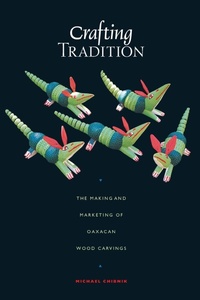
Crafting Tradition
The Making and Marketing of Oaxacan Wood Carvings
Published on 1. April 2003
Book
Paperback/Softback
304 pages
978-0-292-71248-5 (ISBN)
Description
Since the mid-1980s, whimsical, brightly colored wood carvings from the Mexican state of Oaxaca have found their way into gift shops and private homes across the United States and Europe, as Western consumers seek to connect with the authenticity and tradition represented by indigenous folk arts. Ironically, however, the Oaxacan wood carvings are not a traditional folk art. Invented in the mid-twentieth century by non-Indian Mexican artisans for the tourist market, their appeal flows as much from intercultural miscommunication as from their intrinsic artistic merit.
In this beautifully illustrated book, Michael Chibnik offers the first in-depth look at the international trade in Oaxacan wood carvings, including their history, production, marketing, and cultural representations. Drawing on interviews he conducted in the carving communities and among wholesalers, retailers, and consumers, he follows the entire production and consumption cycle, from the harvesting of copal wood to the final purchase of the finished piece. Along the way, he describes how and why this "invented tradition" has been promoted as a "Zapotec Indian" craft and explores its similarities with other local crafts with longer histories. He also fully discusses the effects on local communities of participating in the global market, concluding that the trade in Oaxacan wood carvings is an almost paradigmatic case study of globalization.
In this beautifully illustrated book, Michael Chibnik offers the first in-depth look at the international trade in Oaxacan wood carvings, including their history, production, marketing, and cultural representations. Drawing on interviews he conducted in the carving communities and among wholesalers, retailers, and consumers, he follows the entire production and consumption cycle, from the harvesting of copal wood to the final purchase of the finished piece. Along the way, he describes how and why this "invented tradition" has been promoted as a "Zapotec Indian" craft and explores its similarities with other local crafts with longer histories. He also fully discusses the effects on local communities of participating in the global market, concluding that the trade in Oaxacan wood carvings is an almost paradigmatic case study of globalization.
Reviews / Votes
"It is hard for me to praise this book sufficiently... It is a major contribution to the field of Oaxacan/Mexican studies, as well as economic anthropology and the study of tourism and crafts." Arthur Murphy, Georgia State University, coauthor of Social Inequality in Oaxaca: A History of Resistance and ChangeMore details
Language
English
Place of publication
Austin, TX
United States
Target group
Professional and scholarly
Product notice
Paperback (trade)
Illustrations
53 b&w photos, 3 maps
Dimensions
Height: 229 mm
Width: 152 mm
Thickness: 18 mm
Weight
500 gr
ISBN-13
978-0-292-71248-5 (9780292712485)
Copyright in bibliographic data and cover images is held by Nielsen Book Services Limited or by the publishers or by their respective licensors: all rights reserved.
Schweitzer Classification
Person
Michael Chibnik is Professor of Anthropology at the University of Iowa in Iowa City.
Content
Preface
Acknowledgments
Chapter 1. Introduction
Chapter 2. History of Oaxacan Wood Carving (1940-1985)
Chapter 3. Contemporary Wood Carving
Chapter 4. Wood-Carving Communities
Chapter 5. Economic Strategies
Chapter 6. Making Wood Carvings
Chapter 7. Global Markets and Local Work Organization
Chapter 8. Specializations
Chapter 9. How Artisans Attain Success
Chapter 10. Popular Journalism, Artistic Styles, and Economic Success
Chapter 11. Sales in Oaxaca
Chapter 12. Sales in the United States
Chapter 13. Conclusion
Epilogue
References Cited
Acknowledgments
Chapter 1. Introduction
Chapter 2. History of Oaxacan Wood Carving (1940-1985)
Chapter 3. Contemporary Wood Carving
Chapter 4. Wood-Carving Communities
Chapter 5. Economic Strategies
Chapter 6. Making Wood Carvings
Chapter 7. Global Markets and Local Work Organization
Chapter 8. Specializations
Chapter 9. How Artisans Attain Success
Chapter 10. Popular Journalism, Artistic Styles, and Economic Success
Chapter 11. Sales in Oaxaca
Chapter 12. Sales in the United States
Chapter 13. Conclusion
Epilogue
References Cited