

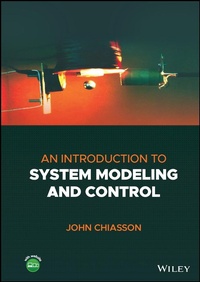
An Introduction to System Modeling and Control
1st Edition
Published on 17. March 2022
Book
Hardback
600 pages
978-1-119-84289-7 (ISBN)
Description
This book is an introduction to modeling and control for students in electrical and mechanical engineering. It begins by explaining the need for control in the form of a description of how an airplane flies using several figures to illustrate the specifics. It then moves on to a review of Laplace transform theory and the solution of differential equations using it. Later chapters explore concepts in modeling such as a review of Newton's laws, torque and moment of inertia, two gear systems, and more. The book closes with chapters on the notion of statespace models and their stability, designing trajectory tracking controllers, and state and parameter estimation.
More details
Other editions
Additional editions
John Chiasson
An Introduction to System Modeling and Control
E-Book
01/2022
1st Edition
Wiley
€141.99
Available for download
John Chiasson
An Introduction to System Modeling and Control
E-Book
01/2022
1st Edition
Wiley
€141.99
Available for download
Person
Content
1 Introduction 1
1.1 Aircraft 1
1.2 Quadrotors 7
1.3 Inverted Pendulum 11
1.4 Magnetic Levitation 12
1.5 General Control Problem 14
2 Laplace Transforms 15
2.1 Laplace TransformProperties 17
2.2 Partial Fraction Expansion 21
2.3 Poles and Zeros 31
2.4 Poles and Partial Fractions 32
Appendix: Exponential Function 35
Problems 38
3 Differential Equations and Stability 45
3.1 Differential Equations 45
3.2 PhasorMethod of Solution 48
3.3 Final Value Theorem 52
3.4 Stable Transfer Functions 56
3.5 Routh-Hurwitz Stability Test 59
3.5.1 Special Case - A Row of the Routh Array has all Zeros* 65
3.5.2 Special Case - Zero in First Column, but the Row is Not Identically Zero* 68
Problems 71
4 Mass-Spring-Damper Systems 81
4.1 MechanicalWork 81
4.2 ModelingMass-Spring-Damper Systems 82
4.3 Simulation 88
Problems 92
5 Rigid Body Rotational Dynamics 103
5.1 Moment of Inertia 103
5.2 Newton's Law of RotationalMotion 104
5.3 Gears 111
5.3.1 Algebraic Relationships Between Two Gears 112
5.3.2 Dynamic Relationships Between Two Gears 112
5.4 Rolling Cylinder* 117
Problems 125
6 The Physics of the DC Motor 139
6.1 Magnetic Force 139
6.2 Single-LoopMotor 141
6.2.1 Torque Production 141
6.2.2 Wound Field DCMotor 143
6.2.3 Commutation of the Single-LoopMotor 143
6.3 Faraday's Law 145
6.3.1 The Surface Element Vector S 146
6.3.2 Interpreting the Sign of 147
6.3.3 Back Emf in a Linear DCMachine 147
6.3.4 Back Emf in the Single-LoopMotor 149
6.3.5 Self-Induced Emf in the Single-LoopMotor 150
6.4 Dynamic Equations of the DCMotor 152
6.5 Optical EncoderModel 154
6.6 Tachometer for a DCMachine* 157
6.6.1 Tachometer for the Linear DCMachine 157
6.6.2 Tachometer for the Single-Loop DCMotor 157
6.7 TheMultiloop DCMotor* 159
6.7.1 Increased Torque Production 159
6.7.2 Commutation of the Armature Current 159
Problems 163
7 BlockDiagrams 173
7.1 Block Diagramfor a DCMotor 173
7.2 Block DiagramReduction 175
Problems 185
8 System Responses 191
8.1 First-Order SystemResponse 191
8.2 Second-Order SystemResponse 193
8.2.1 Transient Response and Closed-Loop Poles 194
8.2.2 Peak Time and Percent Overshoot 198
8.2.3 Settling Time 200
8.2.4 Rise Time 202
8.2.5 Summary of 202
8.2.6 Choosing the Gain of a Proportional Controller 202
8.3 Second-Order Systems with Zeros 205
8.4 Third-Order Systems 210
Appendix - Root LocusMatlab File 211
Problems 212
9 Tracking and Disturbance Rejection 221
9.1 Servomechanism 221
9.2 Control of a DC ServoMotor 226
9.2.1 Tracking 226
9.2.2 Disturbance Rejection 231
9.2.3 Summary of the PI Controller for a DC Servo 234
9.2.4 Proportional plus Integral plus Derivative Control 234
9.3 Theory of Tracking and Disturbance Rejection 238
9.4 InternalModel Principle 242
9.5 Design Example: PI-D Control of Aircraft Pitch 244
9.6 Model Uncertainty and Feedback* 250
Problems 258
10 Pole Placement, 2 DOF Controllers, and Internal Stability 271
10.1 Output Pole Placement 271
10.1.1 DisturbanceModel 276
10.1.2 Effect of the Initial Conditions on the Control Design 278
10.2 Two Degrees of FreedomControllers 283
10.3 Internal Stability 292
10.3.1 Unstable Pole-Zero Cancellation Inside the Loop (Bad) 295
10.3.2 Unstable Pole-Zero Cancellation Outside the Loop (Good) 298
10.4 Design Example: 2 DOF Control of Aircraft Pitch 300
10.5 Design Example: Satellite with Solar Panels (Collocated Case) 303
Appendix: Output Pole Placement 306
Appendix:Multinomial Expansions 310
Appendix: Overshoot 311
Appendix: Unstable Pole-Zero Cancellation 315
Appendix: Undershoot 317
Problems 320
11 Frequency Response Methods 339
11.1 Bode Diagrams 339
11.1.1 Simple Examples 343
11.1.2 More Bode DiagramExamples 345
11.2 Nyquist Theory 359
11.2.1 Principle of the Argument 359
11.2.2 Nyquist Test for Stability 368
11.3 Relative Stability: Gain and Phase Margins 377
11.4 Closed-Loop Bandwidth 383
11.5 Lead and Lag Compensation 387
11.6 Double Integrator Control via Lead-Lag Compensation 392
11.7 Inverted Pendulum with Output 399
Appendix: Bode and Nyquist Plots inMatlab 401
Problems 402
12 Root Locus 419
12.1 Angle Condition and Root Locus Rules 420
12.2 Asymptotes and Their Intercept 427
12.3 Angles of Departure 434
12.4 Effect of Open-Loop Poles on the Root Locus 450
12.5 Effect of Open-Loop Zeros on the Root Locus 451
12.6 Breakaway Points and the Root Locus 452
12.7 Design Example: Satellite with Solar Panels (Noncollocated) 453
Problems 458
13 Inverted Pendulum, Magnetic Levitation, and Cart on a Track 467
13.1 Inverted Pendulum 467
13.1.1 Mathematical Model of the Inverted Pendulum 467
13.1.2 Linear ApproximateModel 470
13.1.3 Transfer FunctionModel 470
13.1.4 Inverted PendulumControl Using Nested Feedback Loops 472
13.2 Linearization of NonlinearModels 475
13.3 Magnetic Levitation 478
13.3.1 Conservation of Energy 479
13.3.2 StatespaceModel 480
13.3.3 Linearization About an Equilibrium Point 481
13.3.4 Transfer FunctionModel 483
13.4 Cart on a Track System 483
13.4.1 Mechanical Equations 484
13.4.2 Electrical Equations 485
13.4.3 Equations ofMotion and Block Diagram 486
Problems 488
14 State Variables 501
14.1 Statespace Form 501
14.2 Transfer Function to Statespace 503
14.2.1 Control Canonical Form 505
14.3 Laplace Transformof the Statespace Equations 513
14.4 Fundamental Matrix Phi 516
14.4.1 Exponential Matrix 517
14.5 Solution of the Statespace Equation* 520
14.5.1 Scalar Case 521
14.5.2 Matrix Case 522
14.6 Discretization of a StatespaceModel* 523
Problems 525
15 State Feedback 529
15.1 Two Examples 529
15.2 General State Feedback Trajectory Tracking 537
15.3 Matrix Inverses and the Cayley-Hamilton Theorem 538
15.3.1 Matrix Inverse 538
15.3.2 Cayley-Hamilton Theorem 541
15.4 Stabilization and State Feedback 543
15.5 State Feedback and Disturbance Rejection 547
15.6 Similarity Transformations 551
15.7 Pole Placement 555
15.7.1 State Feedback Does Not Change the SystemZeros 559
15.8 Asymptotic Tracking of Equilibrium Points 560
15.9 Tracking Step Inputs via State Feedback 562
15.10 Inverted Pendulum on an Inclined Track* 569
15.11 Feedback Linearization Control* 574
Appendix: Disturbance Rejection in the Statespace 579
Problems 581
16 State Estimators and Parameter Identification 595
16.1 State Estimators 595
16.1.1 General Procedure for State Estimation 600
16.1.2 Separation Principle 608
16.2 State Feedback and State Estimation in the Laplace Domain* 610
16.3 Multi-Output Observer Design for the Inverted Pendulum* 613
16.4 Properties ofMatrix Transpose and Inverse 615
16.5 Duality* 617
16.6 Parameter Identification 619
Problems 626
17 Robustness and Sensitivity of Feedback 641
17.1 Inverted Pendulum with Output 641
17.2 Inverted Pendulum with Output 655
17.3 Inverted Pendulumwith State Feedback 657
17.4 Inverted Pendulumwith an Integrator and State Feedback 661
17.5 Inverted Pendulumwith State Feedback via State Estimation 663
Problems 666
References 671
Index 675