

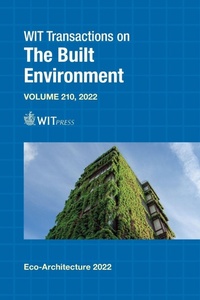
Eco-Architecture IX
Harmonisation between Architecture and Nature
Published on 13. September 2022
Book
Hardback
268 pages
978-1-78466-473-2 (ISBN)
Description
Architecture is very multi-disciplinary, attracting many different professions. This is reflected in the contributions contained in this volume and that were originally presented at the 9th International Conference on Harmonisation between Architecture and Nature.
The included works review the challenges and new opportunities of contemporary architecture as a result of advances in design and new building technologies, as well as the development of new materials.
Many of the changes are motivated by a drive towards eco-architecture, trying to harmonise architectural products with nature. Another important issue is the adaptation of the architectural design to the natural environment, learning from nature and traditional construction techniques.
Contemporary architecture is at the threshold of a new stage of evolution, deeply influenced by the advances in information and computer systems and the development of new materials and products, as well as construction processes that will drastically change the industry.
Emphasis is placed on the minimum use of energy at each stage of the building process, the design by passive systems, life cycle assessment, resources optimisation and rehabilitation.
Never before in history have architects and engineers had such a range of new processes and products open to them. In spite of that, the construction industry lags behind all others in taking advantage of a wide variety of new technologies. This is understandable, due to the inherent complexity and uniqueness of each architectural project. Advances in computer and information systems, including robotics, offers the possibility of developing new architectural forms, construction products and building technologies that are just now starting to emerge. Changes have also taken place in the way modern society works and lives, due to the impact of modern technologies.
Patterns of work have been disrupted and changed, affecting transportation and the home environment. The demand is for a new type of habitat that can respond to the changes and the consequent requirements in terms of the urban environment.
Such topics are dealt with as building technologies, design by passive systems, design with nature, cultural sensitivity, life cycle assessment, resources and rehabilitation and many others including case studies from many different places around the world.
The included works review the challenges and new opportunities of contemporary architecture as a result of advances in design and new building technologies, as well as the development of new materials.
Many of the changes are motivated by a drive towards eco-architecture, trying to harmonise architectural products with nature. Another important issue is the adaptation of the architectural design to the natural environment, learning from nature and traditional construction techniques.
Contemporary architecture is at the threshold of a new stage of evolution, deeply influenced by the advances in information and computer systems and the development of new materials and products, as well as construction processes that will drastically change the industry.
Emphasis is placed on the minimum use of energy at each stage of the building process, the design by passive systems, life cycle assessment, resources optimisation and rehabilitation.
Never before in history have architects and engineers had such a range of new processes and products open to them. In spite of that, the construction industry lags behind all others in taking advantage of a wide variety of new technologies. This is understandable, due to the inherent complexity and uniqueness of each architectural project. Advances in computer and information systems, including robotics, offers the possibility of developing new architectural forms, construction products and building technologies that are just now starting to emerge. Changes have also taken place in the way modern society works and lives, due to the impact of modern technologies.
Patterns of work have been disrupted and changed, affecting transportation and the home environment. The demand is for a new type of habitat that can respond to the changes and the consequent requirements in terms of the urban environment.
Such topics are dealt with as building technologies, design by passive systems, design with nature, cultural sensitivity, life cycle assessment, resources and rehabilitation and many others including case studies from many different places around the world.
More details
Series
Language
English
Place of publication
Southampton
United Kingdom
Target group
College/higher education
Dimensions
Height: 260 mm
Width: 183 mm
Thickness: 19 mm
Weight
705 gr
ISBN-13
978-1-78466-473-2 (9781784664732)
Copyright in bibliographic data and cover images is held by Nielsen Book Services Limited or by the publishers or by their respective licensors: all rights reserved.
Schweitzer Classification
Content
Section 1: Circular economy
Sustainable model for architecture and retailing environments based on the circular economy concept; Designing an urban food system for achieving circular economy targets: A conceptual model
Section 2: Energy performance
Overview of the performance of an external vacuum insulation composite system; Biomimicry approach design of petrol stations with integrating renewable energy in the UAE; Impact of nano insulating materials on energy retrofit of buildings
Section 3: Occupant and user behaviour
Key factors of occupants' behaviour characteristics and indoor air quality perception on occupancy comfort in multi-storey residential buildings in Thailand; Urban fabrics of housing forms and its impact on human behaviour; Service design and quality: Restaurants in Bahrain
Section 4: Sustainable cities
How to build food-sustainable cities and give health to the ageing urban residents: A tale of two community gardens in Lisbon, Portugal; Contribution of the biophilic design approach to the UN sustainable development goals; Residential neighborhood assessment in the city of Al Ain, United Arab Emirates, and the impact on climate change (heat island effect analysis)
Section 5: Innovative materials and products
Durability performances of compressed earth blocks exposed to wetting-drying cycles and high temperature; Integrative reinforcement of natural fiber: Fabrication of peanut shell tiles in building construction; Graphene in architecture
Section 6: Design for eco-architecture
Monotony of parts of contemporary architecture: The absence of small details and separations; Landform buildings and the future of constructed topographies;
An integrated approach to user-centered design: Mobile brain/heart imaging in virtual reality; Are floating cities the urban future?; Use of engineered wood for the retrofitting of existing structures; Healthy buildings: A combination of nature and technology can secure a sustainable future
Sustainable model for architecture and retailing environments based on the circular economy concept; Designing an urban food system for achieving circular economy targets: A conceptual model
Section 2: Energy performance
Overview of the performance of an external vacuum insulation composite system; Biomimicry approach design of petrol stations with integrating renewable energy in the UAE; Impact of nano insulating materials on energy retrofit of buildings
Section 3: Occupant and user behaviour
Key factors of occupants' behaviour characteristics and indoor air quality perception on occupancy comfort in multi-storey residential buildings in Thailand; Urban fabrics of housing forms and its impact on human behaviour; Service design and quality: Restaurants in Bahrain
Section 4: Sustainable cities
How to build food-sustainable cities and give health to the ageing urban residents: A tale of two community gardens in Lisbon, Portugal; Contribution of the biophilic design approach to the UN sustainable development goals; Residential neighborhood assessment in the city of Al Ain, United Arab Emirates, and the impact on climate change (heat island effect analysis)
Section 5: Innovative materials and products
Durability performances of compressed earth blocks exposed to wetting-drying cycles and high temperature; Integrative reinforcement of natural fiber: Fabrication of peanut shell tiles in building construction; Graphene in architecture
Section 6: Design for eco-architecture
Monotony of parts of contemporary architecture: The absence of small details and separations; Landform buildings and the future of constructed topographies;
An integrated approach to user-centered design: Mobile brain/heart imaging in virtual reality; Are floating cities the urban future?; Use of engineered wood for the retrofitting of existing structures; Healthy buildings: A combination of nature and technology can secure a sustainable future