

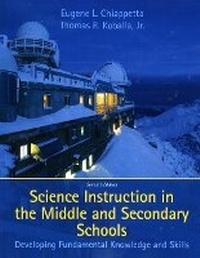
Science Instruction in the Middle and Secondary Schools
Developing Fundamental Knowledge and Skills
7th Edition
Published on 6. August 2009
Book
Paperback/Softback
312 pages
978-0-13-715304-6 (ISBN)
Description
This science methods textbook is designed to provide middle and high school science teachers with the skills they need to help students become scientifically and technologically literate. To be successful, beginning teachers must master the basic functions of teaching. They are:
Understanding the purpose of science teaching
Planning science lessons that are engaging and lead to meaningful learning
Managing the science learning environment in ways that emphasize student responsibility
Assessing students science learning throughout the instructional process
Teaching in a way that is both active and personally rewarding.
Once these basic skills have been mastered, then pre-service teachers are ready to tackle the other important topics relevant to science teaching and learning. In order to meet this goal, the authors immediately engage their readers with six introductory chapters on these basic skills. The remaining chapters focus on the foundational areas of science education and strategies for science teaching. Many vignettes and examples of classroom practices are included to reinforce the chapter content. The appendices provide Puzzling Situations, science demonstrations, science laboratory activities, and a scoring key for the science inventory found in Chapter One.
New To This Edition:
NEW: Opens each of the six introductory chapters with revised vignettes that serve as advanced organizers of the chapter-Focuses on the basic functions of science teaching-purpose: planning, assessing, teaching, and managing.
NEW! Correlates the chapter content with the NSTA/NCATE 2003 Professional Standards for Science Teacher Preparation-Facilitates the preparation of the NCATE review process at many universities.
NEW! Uses backwards design strategies (Wiggins & McTighe, 2005) to guide the discussion of instructional planning in Chapter Three-Emphasizes unit planning (rather than lesson planning) and the state science standards.
Guided by backward design strategies, the book stresses the use of state and locally developed curriculum frameworks and science literacy (strand) maps presented online by the National Science Digital Library.
NEW! Introduces a Beginning Science Teacher's Checklist for evaluating lesson assessment practices (Chapter 4)-These three sections focus on assessment practices that should be addressed before, during, and after a lesson.
NEW! Addresses Differentiated Instruction in Chapter 8 Diverse Adolescent Learners and Differentiated Instruction-Suggests ways teachers can address the diverse learning needs of today's students.
NEW! Emphasizes the use of Technological Tools of Science Learning such as computer data collection probe-ware and graphing calculators in Chapter 15-Discusses their use in student investigations.
NEW! Addresses learning through talk and argumentation in sections of Chapter 11-Shows uses of discussion, demonstration, and lecture in science teaching.
Understanding the purpose of science teaching
Planning science lessons that are engaging and lead to meaningful learning
Managing the science learning environment in ways that emphasize student responsibility
Assessing students science learning throughout the instructional process
Teaching in a way that is both active and personally rewarding.
Once these basic skills have been mastered, then pre-service teachers are ready to tackle the other important topics relevant to science teaching and learning. In order to meet this goal, the authors immediately engage their readers with six introductory chapters on these basic skills. The remaining chapters focus on the foundational areas of science education and strategies for science teaching. Many vignettes and examples of classroom practices are included to reinforce the chapter content. The appendices provide Puzzling Situations, science demonstrations, science laboratory activities, and a scoring key for the science inventory found in Chapter One.
New To This Edition:
NEW: Opens each of the six introductory chapters with revised vignettes that serve as advanced organizers of the chapter-Focuses on the basic functions of science teaching-purpose: planning, assessing, teaching, and managing.
NEW! Correlates the chapter content with the NSTA/NCATE 2003 Professional Standards for Science Teacher Preparation-Facilitates the preparation of the NCATE review process at many universities.
NEW! Uses backwards design strategies (Wiggins & McTighe, 2005) to guide the discussion of instructional planning in Chapter Three-Emphasizes unit planning (rather than lesson planning) and the state science standards.
Guided by backward design strategies, the book stresses the use of state and locally developed curriculum frameworks and science literacy (strand) maps presented online by the National Science Digital Library.
NEW! Introduces a Beginning Science Teacher's Checklist for evaluating lesson assessment practices (Chapter 4)-These three sections focus on assessment practices that should be addressed before, during, and after a lesson.
NEW! Addresses Differentiated Instruction in Chapter 8 Diverse Adolescent Learners and Differentiated Instruction-Suggests ways teachers can address the diverse learning needs of today's students.
NEW! Emphasizes the use of Technological Tools of Science Learning such as computer data collection probe-ware and graphing calculators in Chapter 15-Discusses their use in student investigations.
NEW! Addresses learning through talk and argumentation in sections of Chapter 11-Shows uses of discussion, demonstration, and lecture in science teaching.
More details
Edition
7th edition
Language
English
Place of publication
United States
Publishing group
Pearson Education (US)
Target group
Professional and scholarly
Dimensions
Height: 274 mm
Width: 218 mm
Thickness: 14 mm
Weight
600 gr
ISBN-13
978-0-13-715304-6 (9780137153046)
Copyright in bibliographic data and cover images is held by Nielsen Book Services Limited or by the publishers or by their respective licensors: all rights reserved.
Schweitzer Classification
Other editions
New editions
Eugene Chiappetta | Thomas Koballa
Science Instruction in the Middle and Secondary Schools
Developing Fundamental Knowledge and Skills, Loose-Leaf Version
Loose-leaf edition
03/2014
8th Edition
Pearson
€116.36
Shipment within 15-20 days
Previous edition
Eugene L. Chiappetta | Thomas R. Koballa
Science Instruction in the Middle and Secondary Schools
Developing Fundamental Knowledge and Skills for Teaching
Book
07/2005
6th Edition
Pearson
€53.22
Article exhausted; check for reprint
Persons
Eugene L. Chiappetta is a professor of science education in the Department of Curriculum and Instruction at the University
of Houston. Dr. Chiappetta holds a bachelor's degree in Biology from Allegheny College and master's degree in General
Science, and a Ph.D. in Science Education from Syracuse University. He has coauthored many textbook analysis research
studies, using the nature of science as a framework. Recently, a recipient of the National Association for Research in Science
Teaching Paper Award for Examination of Science Textbook Analysis Research Conducted on Textbooks Published over the Past
100 Years in the United States, The "Skoog Cup" for Significant Contributions and Leadership in the Development of
Quality Science Education in Texas, and "Teaching Excellence" Award in the College of Education. Professor Chiappetta
teaches undergraduate and graduate courses in science education and has coordinated teacher certification and science
education programs for over three decades.
Thomas R. Koballa, Jr. is a professor of science education in the Department of Mathematics and Science Education at
the University of Georgia. Dr. Koballa holds a bachelor's degree in Biology and master's degree in Science Education from
East Carolina University, and a Ph.D. in Curriculum and Instruction from the Pennsylvania State University. He is past
president of the National Association for Research in Science Teaching and the recipient of the Association of Science
Teacher Education's Outstanding Mentoring Award. He teaches undergraduate and graduate classes in science education
and has authored or coauthored more than 50 journal articles and chapters. His current research foci include science
teacher learning and mentoring.
of Houston. Dr. Chiappetta holds a bachelor's degree in Biology from Allegheny College and master's degree in General
Science, and a Ph.D. in Science Education from Syracuse University. He has coauthored many textbook analysis research
studies, using the nature of science as a framework. Recently, a recipient of the National Association for Research in Science
Teaching Paper Award for Examination of Science Textbook Analysis Research Conducted on Textbooks Published over the Past
100 Years in the United States, The "Skoog Cup" for Significant Contributions and Leadership in the Development of
Quality Science Education in Texas, and "Teaching Excellence" Award in the College of Education. Professor Chiappetta
teaches undergraduate and graduate courses in science education and has coordinated teacher certification and science
education programs for over three decades.
Thomas R. Koballa, Jr. is a professor of science education in the Department of Mathematics and Science Education at
the University of Georgia. Dr. Koballa holds a bachelor's degree in Biology and master's degree in Science Education from
East Carolina University, and a Ph.D. in Curriculum and Instruction from the Pennsylvania State University. He is past
president of the National Association for Research in Science Teaching and the recipient of the Association of Science
Teacher Education's Outstanding Mentoring Award. He teaches undergraduate and graduate classes in science education
and has authored or coauthored more than 50 journal articles and chapters. His current research foci include science
teacher learning and mentoring.
Content
Part One: Getting into Science Teaching Quickly
Chapter One Thoughts and Actions of Beginning Science Teachers
Chapter Two The Purpose of Teaching Science
Chapter Three Planning to Teach Science
Chapter Four Assessing Science Learning
Chapter Five Teaching Science
Chapter Six The Science Learning Environment
Part Two: Background for Science Teaching
Chapter Seven The Nature of Science
Chapter Eight Inquiry and Teaching Science Chapter Nine Diverse Adolescent Learners and Their Schools
Chapter Ten Learning in Middle Grades and Secondary Schools
Part Three Strategies for Science Teaching
Chapter Eleven Discussion, Demonstration, and Lecture
Chapter Twelve Science, Technology, and Society
Chapter Thirteen Laboratory Work and Fieldwork
Chapter Fourteen Safety in the Laboratory and Classroom
Chapter Fifteen Computers and Electronic Technologies
Appendices
A Little Science Puzzlers
B Science Demonstrations
C Science Laboratory Activities
D Scoring Key for Science Teaching Inventory Found in Chapter One
Chapter One Thoughts and Actions of Beginning Science Teachers
Chapter Two The Purpose of Teaching Science
Chapter Three Planning to Teach Science
Chapter Four Assessing Science Learning
Chapter Five Teaching Science
Chapter Six The Science Learning Environment
Part Two: Background for Science Teaching
Chapter Seven The Nature of Science
Chapter Eight Inquiry and Teaching Science Chapter Nine Diverse Adolescent Learners and Their Schools
Chapter Ten Learning in Middle Grades and Secondary Schools
Part Three Strategies for Science Teaching
Chapter Eleven Discussion, Demonstration, and Lecture
Chapter Twelve Science, Technology, and Society
Chapter Thirteen Laboratory Work and Fieldwork
Chapter Fourteen Safety in the Laboratory and Classroom
Chapter Fifteen Computers and Electronic Technologies
Appendices
A Little Science Puzzlers
B Science Demonstrations
C Science Laboratory Activities
D Scoring Key for Science Teaching Inventory Found in Chapter One