

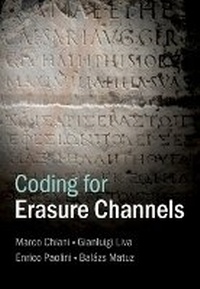
Coding for Erasure Channels
Will be published approx. on 31. January 2026
Book
Hardback
354 pages
978-1-107-13155-2 (ISBN)
Description
Understand how to make wireless communication networks, digital storage systems and computer networks robust and reliable in the first unified, comprehensive treatment of erasure correcting codes. Data loss is unavoidable in modern computer networks; as such, data recovery can be crucial and these codes can play a central role. Through a focused, detailed approach, you will gain a solid understanding of the theory and the practical knowledge to analyze, design and implement erasure codes for future computer networks and digital storage systems. Starting with essential concepts from algebra and classical coding theory, the book provides specific code descriptions and efficient design methods, with practical applications and advanced techniques stemming from cutting-edge research. This is an accessible and self-contained reference, invaluable to both theorists and practitioners in electrical engineering, computer science and mathematics.
More details
Language
English
Place of publication
Cambridge
United Kingdom
Target group
College/higher education
Professional and scholarly
Dimensions
Height: 250 mm
Width: 175 mm
Thickness: 23 mm
Weight
770 gr
ISBN-13
978-1-107-13155-2 (9781107131552)
Copyright in bibliographic data and cover images is held by Nielsen Book Services Limited or by the publishers or by their respective licensors: all rights reserved.
Schweitzer Classification
Persons
Marco Chiani is a Professor of Information Theory at the University of Bologna, Italy. He is an IEEE Fellow, and a Research Affiliate at MIT. He received the IEEE Abraham Prize, Ellersick Prize, and Rice Prize.
Content
1. Introduction; 2. Basics; 3. Erasure channel modes and bounds; 4. Low-density parity-check codes; 5. Weight distribution and minimum distance of LDPC codes; 6. Iterative and maximum-likelihood decoding of LDPC codes; 7. Iterative LDPC decoder analysis; 8. Maximum-likelihood LDPC decoder analysis; 9. Low-density parity-check codes: generalisations; 10. Polar codes; 11. Fountain codes; Appendix A; Appendix B.