

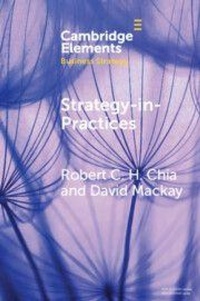
Strategy-In-Practices
A Process-Philosophical Perspective on Strategy-Making
Published on 23. March 2023
Book
Paperback/Softback
94 pages
978-1-009-09648-5 (ISBN)
Description
This Element maintains that increasing strategic effectiveness involves paying greater attention to the idiosyncratic capabilities and know-how already accumulated in an organization's shared practices and the modus operandi contained therein. An organization's modus operandi describes the practiced patterned regularities that enables it to achieve a consistency of response in strategic circumstances even in the absence of any clear, formalized strategic plan. This patterned regularity known as Strategy-in-Practices (SiP) draws attention to the tacit influence of an organization's shared practices on its formal strategy-making efforts. It emphasizes the need for both these to be aligned so that the organization is better prepared to cope with the challenges and opportunities it faces.
More details
Series
Language
English
Place of publication
Cambridge
United Kingdom
Product notice
Paperback (trade)
Illustrations
Worked examples or Exercises
Dimensions
Height: 221 mm
Width: 145 mm
Thickness: 8 mm
Weight
154 gr
ISBN-13
978-1-009-09648-5 (9781009096485)
Copyright in bibliographic data and cover images is held by Nielsen Book Services Limited or by the publishers or by their respective licensors: all rights reserved.
Schweitzer Classification
Other editions
Additional editions
Robert C. H. Chia | David Mackay
Strategy-In-Practices
A Process-Philosophical Perspective on Strategy-Making
E-Book
03/2023
Cambridge University Press
€22.49
Available for download
Robert C. H. Chia | David Mackay
Strategy-In-Practices
E-Book
03/2023
Cambridge University Press
€22.49
Available for download
Persons
Content
1. Introduction; 2. The creative response: the theoretical framework; 3. The innovation function; 4. The knowledge generation function; 5. The technology production function; 6. The knowledge intensive direction of technological change; 7. The performance equation; 8. Conclusions: Schumpeterian loops; References.