

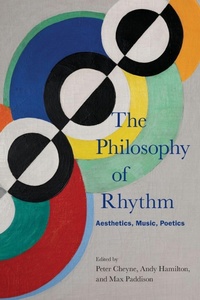
The Philosophy of Rhythm
Aesthetics, Music, Poetics
Published on 8. January 2020
Book
Hardback
440 pages
978-0-19-934777-3 (ISBN)
Description
Rhythm is the fundamental pulse that animates poetry, music, and dance across all cultures. And yet the recent explosion of scholarly interest across disciplines in the aural dimensions of aesthetic experience--particularly in sociology, cultural and media theory, and literary studies--has yet to explore this fundamental category. This book furthers the discussion of rhythm beyond the discrete conceptual domains and technical vocabularies of musicology and prosody. With original essays by philosophers, psychologists, musicians, literary theorists, and ethno-musicologists, The Philosophy of Rhythm opens up wider-and plural-perspectives, examining formal affinities between the historically interconnected fields of music, dance, and poetry, while addressing key concepts such as embodiment, movement, pulse, and performance. Volume editors Peter Cheyne, Andy Hamilton, and Max Paddison bring together a range of key questions: What is the distinction between rhythm and pulse? What is the relationship between everyday embodied experience, and the specific experience of music, dance, and poetry? Can aesthetics offer an understanding of rhythm that helps inform our responses to visual and other arts, as well as music, dance, and poetry? And, what is the relation between psychological conceptions of entrainment, and the humane concept of rhythm and meter? Overall, The Philosophy of Rhythm appeals across disciplinary boundaries, providing a unique overview of a neglected aspect of aesthetic experience.
Reviews / Votes
While the overarching rubric is philosophical, the arguments take up residency across the diverse terrain of philosophy ("analytic" and "continental"), cognitive psychology, neuroscience, anthropology, literary studies, musicology, and even visual culture. Most chapters are impressively accessible to non-specialists. * Martin Scherzinger, Revue de musicologie * It won't be an exaggeration to say that this volume is a philosophical landmark in the realm of aesthetics. * Pablo Seoane Rodriguez, Teorema * This remarkable collection of essays brings together philosophical and empirical approaches to the significance of rhythm across the arts. The approach is refreshingly interdisciplinary. Anyone concerned with the place of rhythm and metric structure in the arts, and-more generally-within the wider domain of human practices will find this an extraordinarily helpful volume. * Robert Kraut, The Ohio State University * Fascinating and mysterious, rhythm is at the heart of music, dance, poetry, sociology, and neuroscience. This inspired volume engages, enlightens, and is the first to explore rhythm across a broad range of philosophical, aesthetic, and perceptual domains. This book is required reading for anyone concerned with time and rhythm in contemporary life. * Peter Nelson, University of Edinburgh * A fascinating and broad overview. This book covers dance, poetry, literature, and painting, as well as music, all considered from a multidisciplinary perspective and including both Continental and analytic approaches to philosophy. This unfairly neglected topic richly rewards the serious treatment thatThe Philosophy of Rhythm accords it. * Stephen Davies, University of Auckland * This wonderful collection considers questions about rhythm from a wide variety of angles, perspectives, and disciplines-among them analytic and continental philosophy, musicology, art history, poetics, and neuroscience. Like the dialogue that opens the book, The Philosophy of Rhythm supports no particular line of thought or argument but enormously deepens our understanding of a topic so palpable and yet so mysterious. * Christoph Cox, Hampshire College *More details
Language
English
Place of publication
New York
United States
Target group
Professional and scholarly
Illustrations
11 musical examples, 24 illustrations
Dimensions
Height: 260 mm
Width: 183 mm
Thickness: 28 mm
Weight
1014 gr
ISBN-13
978-0-19-934777-3 (9780199347773)
Copyright in bibliographic data and cover images is held by Nielsen Book Services Limited or by the publishers or by their respective licensors: all rights reserved.
Schweitzer Classification
Other editions
Additional editions
Book
01/2020
Oxford University Press Inc
€68.20
Shipment within 15-20 days
E-Book
10/2019
OUP eBook
€29.49
Available for download
E-Book
10/2019
1st Edition
OUP eBook
€29.49
Available for download
Persons
Peter Cheyne is Associate Professor at Shimane University, and Visiting Fellow in Philosophy at Durham University. He leads two international projects, one on the Aesthetics of Perfection and Imperfection, and the other on the 17th- to 19th-century Philosophy of the Life Sciences.
Andy Hamilton teaches philosophy at Durham University, UK. He specialises in aesthetics, philosophy of mind, political philosophy, and history of 19th- and 20th-century philosophy, especially Wittgenstein.
Max Paddison is Emeritus Professor of Music Aesthetics at the University of Durham. He works in critical theory, philosophy, contemporary music, and popular music.
Andy Hamilton teaches philosophy at Durham University, UK. He specialises in aesthetics, philosophy of mind, political philosophy, and history of 19th- and 20th-century philosophy, especially Wittgenstein.
Max Paddison is Emeritus Professor of Music Aesthetics at the University of Durham. He works in critical theory, philosophy, contemporary music, and popular music.
Content
List of Illustrations
List of Abbreviations
Notes on Contributors
Introduction
Part I: Movement and Stasis
1. Dialogue on Rhythm: Entrainment and the Dynamic Thesis
2. Rhythm and Movement
3. The Ontology of Rhythm
4. 'Feeling the Beat': Multimodal Perception and the Experience of Musical Movement
5. Dance Rhythm
Part II. Emotion and Expression
6. The Life of Rhythm: Dewey, Relational Perception, and the 'Cumulative Effect'
7. Rhythm, Preceding its Abstraction
8. Mozart's 'Dissonance' and the Dialectic of Language and Thought in Classical Theories of Rhythm
9. Rhythm and Popular Music
10. Rhythms, Resemblance, and Musical Expressiveness
Part III: Entrainment and the Social Dimension
11. Metric Entrainment and the Problem(s) of Perception
12. Entrainment and the Social Origins of Musical Rhythm
13. How Many Kinds of Rhythm Are There?
14. Temporal Processing and the Experience of Rhythm: A Neuro-psychological Approach
Part IV. Time and Experience: Subjective and Objective Rhythm
15. Complexity and Passage: Experimenting with Poetic Rhythm
16. Encoded and Embodied Rhythm: An Unprioritized Ontology
17. Time, Duration, Rhythm: The Aesthetics of Temporality in Bachelard and Deliege
18. Husserl's Model of Time-Consciousness, and the Phenomenology of Rhythm
19. Pictorial Experience and the Perception of Rhythm
20. Soundless Rhythm
Part V. Reading Rhythm
21. Hearing it Right: Rhythm and Reading
22. The Not-so-silent Reading: What Does it Mean to Say that we Appreciate Rhythm in Literature?
23. Leaving it Out: Rhythm and Short Form in the Modernist Poetic Tradition
24. Rhythm, Meter, and the Poetics of Abstraction
List of Abbreviations
Notes on Contributors
Introduction
Part I: Movement and Stasis
1. Dialogue on Rhythm: Entrainment and the Dynamic Thesis
2. Rhythm and Movement
3. The Ontology of Rhythm
4. 'Feeling the Beat': Multimodal Perception and the Experience of Musical Movement
5. Dance Rhythm
Part II. Emotion and Expression
6. The Life of Rhythm: Dewey, Relational Perception, and the 'Cumulative Effect'
7. Rhythm, Preceding its Abstraction
8. Mozart's 'Dissonance' and the Dialectic of Language and Thought in Classical Theories of Rhythm
9. Rhythm and Popular Music
10. Rhythms, Resemblance, and Musical Expressiveness
Part III: Entrainment and the Social Dimension
11. Metric Entrainment and the Problem(s) of Perception
12. Entrainment and the Social Origins of Musical Rhythm
13. How Many Kinds of Rhythm Are There?
14. Temporal Processing and the Experience of Rhythm: A Neuro-psychological Approach
Part IV. Time and Experience: Subjective and Objective Rhythm
15. Complexity and Passage: Experimenting with Poetic Rhythm
16. Encoded and Embodied Rhythm: An Unprioritized Ontology
17. Time, Duration, Rhythm: The Aesthetics of Temporality in Bachelard and Deliege
18. Husserl's Model of Time-Consciousness, and the Phenomenology of Rhythm
19. Pictorial Experience and the Perception of Rhythm
20. Soundless Rhythm
Part V. Reading Rhythm
21. Hearing it Right: Rhythm and Reading
22. The Not-so-silent Reading: What Does it Mean to Say that we Appreciate Rhythm in Literature?
23. Leaving it Out: Rhythm and Short Form in the Modernist Poetic Tradition
24. Rhythm, Meter, and the Poetics of Abstraction