

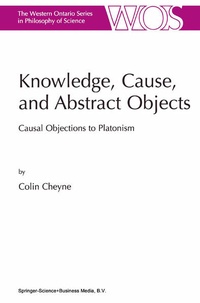
Knowledge, Cause, and Abstract Objects
Causal Objections to Platonism
Published on 28. October 2010
Book
Paperback/Softback
XVIII, 240 pages
978-90-481-5836-2 (ISBN)
Description
According to platonists, entities such as numbers, sets, propositions and properties are abstract objects. But abstract objects lack causal powers and a location in space and time, so how could we ever come to know of the existence of such impotent and remote objects? In
Knowledge, Cause, and Abstract Objects
, Colin Cheyne presents the first systematic and detailed account of this epistemological objection to the platonist doctrine that abstract objects exist and can be known. Since mathematics has such a central role in the acquisition of scientific knowledge, he concentrates on mathematical platonism. He also concentrates on our knowledge of what exists, and argues for a causal constraint on such existential knowledge. Finally, he exposes the weaknesses of recent attempts by platonists to account for our supposed platonic knowledge.
This book will be of particular interest to researchers and advanced students of epistemology and of the philosophy of mathematics and science. It will also be of interest to all philosophers with a general interest in metaphysics and ontology.
This book will be of particular interest to researchers and advanced students of epistemology and of the philosophy of mathematics and science. It will also be of interest to all philosophers with a general interest in metaphysics and ontology.
More details
Series
Edition
1st ed. Softcover of orig. ed. 2001
Language
English
Place of publication
Dordrecht
Netherlands
Target group
Professional and scholarly
Research
Illustrations
XVIII, 240 p.
Dimensions
Height: 240 mm
Width: 160 mm
Thickness: 15 mm
Weight
421 gr
ISBN-13
978-90-481-5836-2 (9789048158362)
DOI
10.1007/978-94-015-9747-0
Schweitzer Classification
Other editions
Additional editions
E-Book
03/2013
Springer
€96.29
Available for download
Book
10/2001
Kluwer Academic Publishers
€106.99
Shipment within 15-20 days
Content
1. Platonism and Causality.- 2. Beliefs and Facts.- 3. Beliefs and Causes.- 4. The Case for a Causal Connection.- 5. Is a Causal Connection Necessary for Knowledge?.- 6. Other Theories of Knowledge.- 7. Existence Claims and Causality.- 8. The Burden of Proof.- 9. Platonic Knowledge by Intuition.- 10. Apriorism.- 11. Indispensability and Platonic Knowledge.- 12. Problems with Prolifigate Platonism.- Conclusion.- Appendices.- I. Does Knowledge Require Belief?.- 1.1. The traditional analysis of knowledge.- 1.2. The truth condition.- 1.3. The consistency of belief and knowledge.- 1.4. Radford's counterexample.- 1.5. Information and knowledge.- II. Can We Choose Our Beliefs?.- II. 1. Belief-voluntarism and epistemic justification.- 11.2. Belief-voluntarism - is it possible?.- 11.3. Direct belief-voluntarism - is it actual?.- 11.4. Belief and acceptance.- 11.5. Choosing beliefs indirectly.