

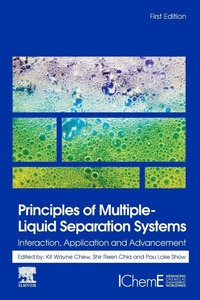
Principles of Multiple-Liquid Separation Systems
Interaction, Application and Advancement
Published on 17. January 2023
Book
Paperback/Softback
394 pages
978-0-323-91728-5 (ISBN)
Description
Principles of Multiple-Liquid Separation Systems: Interaction, Application and Advancement describes the basic principles and advancements of multiple-liquid separation systems in downstream processing. Several important elements are included, such as the fundamental process and mechanisms of the multiple-liquid separation system, key principles of the interaction between different solvents and phase components, applications, and green solvents for the separation system. Furthermore, the book gives insights in commercializing this separation technique to industrial scale and making the process environmentally and economically sustainable. The book also presents constructive critics of this separation technique for both past and the latest findings.
More details
Language
English
Place of publication
Philadelphia
United States
Target group
Professional and scholarly
(Post)graduate students and researchers in academia in chemical and biochemical engineering working on downstream processing
Product notice
Paperback (trade)
Dimensions
Height: 229 mm
Width: 152 mm
Thickness: 21 mm
Weight
527 gr
ISBN-13
978-0-323-91728-5 (9780323917285)
Copyright in bibliographic data and cover images is held by Nielsen Book Services Limited or by the publishers or by their respective licensors: all rights reserved.
Schweitzer Classification
Other editions
Additional editions
Kit Wayne Chew | Shir Reen Chia | Pau Loke Show
Principles of Multiple-Liquid Separation Systems
Interaction, Application and Advancement
E-Book
01/2023
Elsevier
€200.00
Available for download
Persons
Dr. Kit Wayne Chew is Assistant Professor in Nanyang Technological University's School of Chemistry, Chemical Engineering and Biotechnology. He obtained his PhD from the University of Nottingham, where he began his research in sustainable bioprocess engineering for food and pharmaceutical products. His current research examines the utilization of algae biotechnology to develop cost-effective and environmentally friendly methods for the synthesis of functional ingredients. Dr. Chew's professional appointments include Associate Member in the Institution of Chemical Engineers Malaysia (IChemE), Graduate Engineer registered with the Board of Engineers Malaysia, and Graduate Technologist registered with the Malaysia Board of Technologies. He is listed as the #5 author contributing research on the topic of "Microalgal Technology? on SciVal.
Dr. Shir Reen Chia is a research associate at the Department of Chemical and Environmental Engineering, Faculty of Engineering, University of Nottingham Malaysia (UNM). Her research focuses on downstream processing of biomolecules. She is working on the utilization of liquid bi-and triphasic partitioning of biomolecules from biomass. Professor Ir. Ts. Dr. Pau-Loke Show?is currently a Full Professor in the Department of Chemical and Petroleum Engineering at Khalifa University, Abu Dhabi, United Arab Emirates. Also, he has been affiliated with University of Nottingham Malaysia, where he is the Professor of Biochemical Engineering. He is also the former President and Founder of International Bioprocessing Society based in Malaysia. Prof Ir. Ts. Dr. Show has successfully obtained his PhD in two years' time after obtaining his bachelor's degree from Universiti Putra Malaysia. In the year of 2022, he was elected as a Fellow of the Institution of Chemical Engineers IChemE (FIChemE). He is currently a Professional Engineer (PEng) registered with the Board of Engineers Malaysia (BEM), Chartered Engineer of the Engineering Council UK (CEng), Corporate Member of The Institution of Engineers, Malaysia (MIEM), and Professional Technologist (PTech) registered with the Malaysia Board of Technologists (MBOT). Prof Ir. Ts. Dr. Show obtained the Post Graduate Certificate of Higher Education (PGCHE) in 2014 and is now a Fellow of the Higher Education Academy (FHEA) UK. For more information, please refer to the follow webpage: https://showpauloke.com/
Dr. Shir Reen Chia is a research associate at the Department of Chemical and Environmental Engineering, Faculty of Engineering, University of Nottingham Malaysia (UNM). Her research focuses on downstream processing of biomolecules. She is working on the utilization of liquid bi-and triphasic partitioning of biomolecules from biomass. Professor Ir. Ts. Dr. Pau-Loke Show?is currently a Full Professor in the Department of Chemical and Petroleum Engineering at Khalifa University, Abu Dhabi, United Arab Emirates. Also, he has been affiliated with University of Nottingham Malaysia, where he is the Professor of Biochemical Engineering. He is also the former President and Founder of International Bioprocessing Society based in Malaysia. Prof Ir. Ts. Dr. Show has successfully obtained his PhD in two years' time after obtaining his bachelor's degree from Universiti Putra Malaysia. In the year of 2022, he was elected as a Fellow of the Institution of Chemical Engineers IChemE (FIChemE). He is currently a Professional Engineer (PEng) registered with the Board of Engineers Malaysia (BEM), Chartered Engineer of the Engineering Council UK (CEng), Corporate Member of The Institution of Engineers, Malaysia (MIEM), and Professional Technologist (PTech) registered with the Malaysia Board of Technologists (MBOT). Prof Ir. Ts. Dr. Show obtained the Post Graduate Certificate of Higher Education (PGCHE) in 2014 and is now a Fellow of the Higher Education Academy (FHEA) UK. For more information, please refer to the follow webpage: https://showpauloke.com/
Editor
Assistant Professor, Nanyang Technological University's School of Chemistry, Chemical Engineering and Biotechnology, Singapore
Research Associate, Department of Chemical and Environmental Engineering, Faculty of Engineering, University of Nottingham Malaysia (UNM), Malaysia
Full Professor, Department of Chemical Engineering, Khalifa University, Abu Dhabi, United Arab Emirates
Content
1. Polymer-polymer interaction
2. Polymer-salt interaction
3. Alcohol-salt interaction
4. Sugar-solvent interaction
5. Ionic liquid-salt interaction
6. T-butanol-salt three phase interaction
7. Green solvents for multiphase
8. Economical sustainability
9. Environmental sustainability
10. Potential upscaling
2. Polymer-salt interaction
3. Alcohol-salt interaction
4. Sugar-solvent interaction
5. Ionic liquid-salt interaction
6. T-butanol-salt three phase interaction
7. Green solvents for multiphase
8. Economical sustainability
9. Environmental sustainability
10. Potential upscaling