

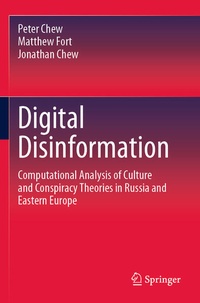
Digital Disinformation
Computational Analysis of Culture and Conspiracy Theories in Russia and Eastern Europe
Published on 19. May 2024
Book
Paperback/Softback
XVIII, 457 pages
978-3-031-28837-1 (ISBN)
Description
This book uniquely combines the authors' personal experiences, deep cultural and professional experience of living and working in Russia and the former USSR, and interest and experience with language and computational analysis, to shed light on a highly contemporary question: what is motivating conflict and unrest in Russia and its surrounding countries? How does Russian government suppression of information manifest in practice today, and how does it fit into the historical cultural pattern for Russia? The authors take a computational look at social and traditional media in the original languages, from Russia, Ukraine, Lithuania, Latvia, Estonia, Poland, and the English-speaking world, to glean insights and separate fact from fiction.
This book helps readers interested in Eastern Europe to 'take the temperature' of the region today, but it is also of interest to readers in the policy and analysis community, because it offers a template, an analytical 'how-to' guide which aims to follow in the footsteps of CIA author Richards Heuer's 'Psychology of Intelligence Analysis', to show how state-of-the-art computational analysis techniques could be applied to similar problems in other topic areas, with the human analyst and computational techniques each working together to create a whole greater than the sum of its parts.
More details
Edition
2023 ed.
Language
English
Place of publication
Cham
Switzerland
Publishing group
Springer International Publishing
Illustrations
49 s/w Abbildungen, 171 farbige Abbildungen
XVIII, 457 p. 220 illus., 171 illus. in color.
Dimensions
Height: 235 mm
Width: 155 mm
Thickness: 26 mm
Weight
715 gr
ISBN-13
978-3-031-28837-1 (9783031288371)
DOI
10.1007/978-3-031-28835-7
Schweitzer Classification
Other editions
Additional editions

Peter Chew | Matthew Fort | Jonathan Chew
Digital Disinformation
Computational Analysis of Culture and Conspiracy Theories in Russia and Eastern Europe
Book
05/2023
Springer
€149.79
Shipment within 15-20 days
Persons
Peter Chew
is the President and owner of Galisteo Consulting Group, Inc., a consulting company in Albuquerque, New Mexico with a focus on national security. His specialty is in data analytics. Peter has previously worked in a research capacity for the U.S. national laboratories, and as an auditor for Price Waterhouse, where his assignments included field audits of Russian oil and gas companies. Peter's education is a D.Phil. in Russian computational linguistics at the University of Oxford (where he was a recipient of a British Academy scholarship) and a B.A. in Russian and Polish language and literature at the School of Slavonic and East European Studies (University of London), where he earned distinctions in linguistics. Peter has authored and co-authored many articles, primarily in the field of computational linguistics. In the area of finance, where he has also applied his analytical skills, Peter is also a Certified Public Accountant and Certified Fraud Examiner. Peter is fluent in Russian and competent in Polish.
Content
Information Maneuvers in and around Ukraine: What is Really Driving Conflict with Russia?.- Background.- Issues surrounding Ukraine.- What does social media say about the issues?.- Conclusions and recommendations for strategic communications.- Information Maneuvers in the Baltic region.- A distillation of multiple threat assessments and perspectives.- Analysis of social media landscape.- Conclusions and recommendations for strategic communications.- Information Maneuvers in and around Poland: Historical Revisionism and Rule of Law.- Background.- Current issues surrounding Poland.- Analysis of social media landscape in Poland versus East Slavdom.- Conclusions and recommendations for strategic communications.- References.- Information Maneuvers for Soviet Union 2.0.- Background.- Features of everyday Soviet life in the twentieth century.- Social media analysis.- Conclusions and recommendations for strategic communications.- Finding and Analyzing Information Maneuvers on the Fringe.- Fringe narratives: an illustrative example involving Russia and its Eurasian ambitions.- The 'brotherhood of nations' - a historical pattern, not an anomaly.- Eurasian integration: coming in the near future?.- How can we analyze fringe beliefs?.- Demonstration and technical implementation.- Conclusions.- Russian media narratives on Ukraine in 2022:a computational analysis.- Background.- Data used for this report, and method of collection.- Our approach: signal processing (and SVD) fundamentals.- Key narratives in 2022 in Russian media.- What's 'mainstream' and what's 'fringe' in Russian media?.- How topics changed over time in Russian media.- Conclusions.