

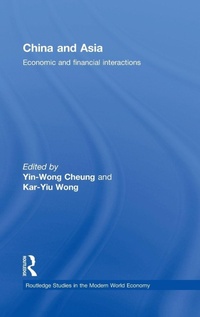
China and Asia
Economic and Financial Interactions
1st Edition
Published on 5. December 2008
Book
Hardback
302 pages
978-0-415-77609-7 (ISBN)
Description
It is difficult to overstate the growing importance of China and Asia in the global economy. Despite the sharp downturn experienced in the 1997 financial crisis, China and Asia have bounced back strongly in the new millennium and delivered solid economic growth. In this book, Ying-Wong Cheung and Kar-Yiu Wong have gathered together 35 renowned researchers from four continents to examine contemporary issues on the economic and financial interactions with a focus on China and Asia. Four broad areas are discussed. The first part deals with China and her interactions with other economies, the second with economic interactions within the region, the third with foreign exchange rate issues facing Asian economies, and the fourth with financial market development in the region.
Within these chapters, some interesting results are explained, many of which differ from what is commonly believed. For example it is explained how exports from China and other Asian economies follow the "flying geese' pattern and that these economies can grow in harmony; that appreciating the Asian exchange rates would not have much impact on their current account surpluses; that financial liberalization in Thailand did not create the short-term debt problem, which is believed to a major cause of the 1997 financial crisis. It is also described how developments in the US have very strong influences on Asian economies and that Mainland China was a less important source of external shocks than is commonly held.
Within these chapters, some interesting results are explained, many of which differ from what is commonly believed. For example it is explained how exports from China and other Asian economies follow the "flying geese' pattern and that these economies can grow in harmony; that appreciating the Asian exchange rates would not have much impact on their current account surpluses; that financial liberalization in Thailand did not create the short-term debt problem, which is believed to a major cause of the 1997 financial crisis. It is also described how developments in the US have very strong influences on Asian economies and that Mainland China was a less important source of external shocks than is commonly held.
More details
Series
Language
English
Place of publication
London
United Kingdom
Publishing group
Taylor & Francis Ltd
Target group
College/higher education
Illustrations
56 s/w Tabellen, 67 s/w Zeichnungen, 67 s/w Abbildungen
56 Tables, black and white; 67 Line drawings, black and white; 67 Illustrations, black and white
Dimensions
Height: 240 mm
Width: 161 mm
Thickness: 22 mm
Weight
649 gr
ISBN-13
978-0-415-77609-7 (9780415776097)
Copyright in bibliographic data and cover images is held by Nielsen Book Services Limited or by the publishers or by their respective licensors: all rights reserved.
Schweitzer Classification
Other editions
Additional editions
Book
11/2013
1st Edition
Routledge
€54.70
Shipment within 15-20 days
E-Book
12/2008
1st Edition
Routledge
€126.49
Available for download
E-Book
12/2008
Routledge
€47.49
Available for download
E-Book
12/2008
1st Edition
Routledge
€47.49
Available for download
Persons
Yin-Wong Cheung is a Professor in the Economics Department at the University of California, Santa Cruz, California, USA. Kar-yiu Wong is a Professor of Economics at the University of Washington, Seattle, USA.
Content
Introduction Yin-Wong Cheung and Kar-yiu Wong Part 1: China Flying Geese or Sitting Ducks? China's Impact on the Trading Fortunes of other Asian Countries Alan Ahearne, John Fernald, Prakash Loungani, and John Schindler. A Decade of Flow of Funds in China (1995-2006) Lin Guijun and Ronald M. Schramm. China's Approach to Capital Flows since 1978: A Brief Overview Juann Hung. The Estimation of Domestic Value-Added and Employment Induced by Exports: An Application to Chinese Exports to the United States Chen Xikang, Leonard K. Cheng, K. C. Fung, and Lawrence J. Lau. Part 2 : Economic Interactions External Shocks, Transmission Mechanisms and Deflation in Asia Hans Genberg. External Balances in Five Asian Countries Jaewoo Lee. What Drives Business Cycle Synchronization in the Pacific Rim Countries? Jakob de Haan, Richard Jong-A-Pin and Mark Mink Part 3: Foreign Exchange Rates Have Exchange Rate Regimes in Asia Become More Flexible Post Crisis? Re-Visiting the Evidence Tony Cavoli and Ramkishen S. Rajan. The Evolution of the East Asia Currency Baskets - Still Undisclosed and Changing Gunther Schnabl. Effective Exchange Rates in Asia with Entrepot and Growing Intra-Regional Trade San Sau Fung, Marc Klau, Guonan Ma and Robert McCauley Part 4: Financial Markets Foreign Intermediation in Japan During the Lost Decade Jose A. Lopez and Mark M. Spiegel. The Core-AMU denominated Asian Bonds for Local Investors in East Asia Eiji Ogawa and Junko Shimizu. A New Framework for Analyzing Adequate and Excessive Reserve Levels under High Capital Mobility Jie Li, Ozan Sula and Thomas D. Willett. Financial Liberalization and Corporate Debt Maturity in Thailand, 1993-97 Federico Guerrero and Elliott Parker. Foreign Lending Under Limited Enforcement Nedim M. Alemdar, Sibel Sirakaya and Stephen J. Turnovsky