

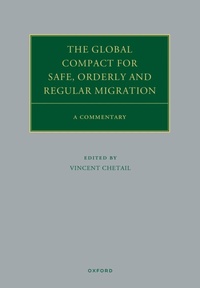
The Global Compact for Safe, Orderly and Regular Migration
A Commentary
Will be published approx. on 25. August 2026
Book
Hardback
648 pages
978-0-19-886338-0 (ISBN)
Description
The Global Compact for Safe, Orderly and Regular Migration (GCM) is the first intergovernmental agreement adopted by the United Nations to address all dimensions of international migration. This authoritative legal commentary provides a comprehensive and insightful analysis of the Compact's normative foundations, legal content, and policy relevance, serving scholars, practitioners, and policymakers concerned with international law and migration governance.
Beginning with a critical examination of its preamble, vision, and guiding principles, the book explores the normative aspirations that underpin the GCM, highlighting its grounding in state sovereignty, responsibility-sharing, non-discrimination, and human rights. It then provides detailed commentary on each of the Compact's twenty-three objectives, assessing their legal content, policy orientation, and alignment with existing international legal frameworks. The commentary also situates each objective within the broader contexts of human rights and migration governance, while evaluating its potential to influence both national legislation and international practice. Crucially, the book also addresses the mechanisms and challenges of implementation, unveiling how states, international organizations, local authorities, and non-state actors—including civil society and the private sector—interpret and operationalize the Compact's provisions.
Bridging legal scholarship, critical perspectives, and real-world practice, this commentary offers an in-depth analysis of the role and relevance of international law and intergovernmental cooperation on one of the most polarized issues of our times. It also contributes a forward-looking assessment of the Compact's role in shaping the future of global migration governance.
Research for the book was supported by the nccr - on the move, funded by the Swiss National Science Foundation grant 51NF40-205605.
Beginning with a critical examination of its preamble, vision, and guiding principles, the book explores the normative aspirations that underpin the GCM, highlighting its grounding in state sovereignty, responsibility-sharing, non-discrimination, and human rights. It then provides detailed commentary on each of the Compact's twenty-three objectives, assessing their legal content, policy orientation, and alignment with existing international legal frameworks. The commentary also situates each objective within the broader contexts of human rights and migration governance, while evaluating its potential to influence both national legislation and international practice. Crucially, the book also addresses the mechanisms and challenges of implementation, unveiling how states, international organizations, local authorities, and non-state actors—including civil society and the private sector—interpret and operationalize the Compact's provisions.
Bridging legal scholarship, critical perspectives, and real-world practice, this commentary offers an in-depth analysis of the role and relevance of international law and intergovernmental cooperation on one of the most polarized issues of our times. It also contributes a forward-looking assessment of the Compact's role in shaping the future of global migration governance.
Research for the book was supported by the nccr - on the move, funded by the Swiss National Science Foundation grant 51NF40-205605.
More details
Series
Language
English
Place of publication
Oxford
United Kingdom
Target group
College/higher education
Professional and scholarly
Product notice
sewn/stitched
Cloth over boards
Dimensions
Height: 246 mm
Width: 171 mm
ISBN-13
978-0-19-886338-0 (9780198863380)
Copyright in bibliographic data and cover images is held by Nielsen Book Services Limited or by the publishers or by their respective licensors: all rights reserved.
Schweitzer Classification
Person
Vincent Chetail is Professor of International Law and Director of the Global Migration Centre at the Geneva Graduate Institute of International and Development Studies. He has held research positions at Harvard Law School, King's College London, and the European University Institute, and has taught at various other universities, including Sciences Po Paris and Queen Mary University. An internationally recognized authority on international law, migration, and displacement, he regularly serves as a consultant and advisor to governments, NGOs, and international organizations. He has extensively published on several issues of international law, and his work is frequently referred to by the media, courts, and the United Nations.
Content
- Part One: Preamble
- The Vision and Guiding Principles of the Global Compact for Safe, Orderly and Regular Migration
- Part Two: Objectives For Safe, Orderly, And Regular Migration
- Objective 1: Collect and utilize accurate and disaggregated data as a basis for evidence-based policies
- Objective 2: Minimize the adverse drivers and structural factors that compel people to leave their country of origin
- Objective 3: Provide accurate and timely information at all stages of migration
- Objective 4: Provide all migrants with proof of legal identity, proper identification, and documentation
- Objective 5: Enhance the availability and flexibility of pathways for regular migration
- Objective 6: Facilitate fair and ethical recruitment and safeguard conditions that ensure decent work
- Objective 7: Address and reduce vulnerabilities in migration
- Objective 8: Save lives and establish coordinated international efforts on missing migrants
- Objective 9: Strengthen the transnational response to smuggling of migrants
- Objective 10: Prevent, combat, and eradicate trafficking in persons in the context of international migration
- Objective 11: Manage borders in an integrated, secure, and coordinated manner
- Objective 12: Strengthen certainty and predictability in migration procedures for appropriate screening, assessment, and referral
- Objective 13: Use immigration detention only as a measure of last resort and work towards alternatives
- Objective 14: Enhance consular protection, assistance, and cooperation throughout the migration cycle
- Objective 15: Provide access to basic services for migrants
- Objective 16: Empower migrants and societies to realize full inclusion and social cohesion
- Objective 17: Eliminate all forms of discrimination and promote evidence-based public discourse to shape perceptions of migration
- Objective 18: Invest in skills development and facilitate mutual recognition of skills, qualifications, and competences
- Objective 19: Create conditions for migrants and diasporas to fully contribute to sustainable development in all countries
- Objective 20: Promote faster, safer, and cheaper transfer of remittances and foster financial inclusion of migrants
- Objective 21: Cooperate in facilitating safe and dignified return and readmission, as well as sustainable reintegration
- Objective 22: Establish mechanisms for the portability of social security entitlements and earned benefits
- Objective 23: Strengthen international cooperation and global partnerships for safe, orderly, and regular migration
- Part Three: Implementation, Follow-Up, And Review
- The Implementation, Follow-up, and Review of the Global Compact for Safe, Orderly and Regular Migration Within the United Nations System and Beyond
- States and the Implementation of the Global Compact for Safe, Orderly and Regular Migration: glass half full or half empty?
- The Role of Cities and Non-state Actors in the Implementation of the Global Compact for Safe, Orderly and Regular Migration