

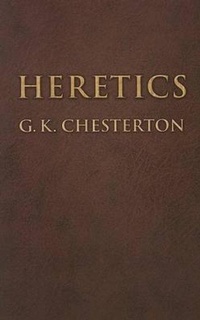
Heretics
Will be published approx. on 28. July 2006
Book
Paperback/Softback
176 pages
978-0-486-44914-2 (ISBN)
Description
The "Prince of Paradox" is at his witty best in this collection of 20 essays and articles. Focusing on "heretics" - those who pride themselves in their superiority to conservative views - Chesterton appraises prominent figures from the literary and art worlds who fall into that category, including Kipling, Shaw, Wells, and Whistler.
More details
Series
Language
English
Place of publication
New York
United States
Product notice
Paperback (trade)
Unsewn / adhesive bound
Dimensions
Height: 216 mm
Width: 141 mm
Thickness: 9 mm
Weight
191 gr
ISBN-13
978-0-486-44914-2 (9780486449142)
Copyright in bibliographic data and cover images is held by Nielsen Book Services Limited or by the publishers or by their respective licensors: all rights reserved.
Schweitzer Classification
Person
Widely known as the "Prince of Paradox," G. K. Chesterton was one of the most influential English writers and thinkers of the 20th century. Chesterton's prodigious talents embraced a wide range of subjects, from philosophy and religion to detective fiction and fantasy. And while his writings are light and whimsical, they are filled with direct and honest truths.
Content
I. Introductory Remarks on the Importance of Orthodoxy
II. On the Negative Spirit
III. On Mr. Rudyard Kipling and Making the World Small
IV. Mr. Bernard Shaw
V. Mr. H. G. Wells and the Giants
VI. Christmas and the Æsthetes
VII. Omar and the Sacred Vine
VIII. The Mildness of the Yellow Press
IX. The Moods of Mr. George Moore
X. On Sandals and Simplicity
XI. Science and the Savages
XII. Paganism and Mr. Lowes Dickinson
XIII. Celts and Celtophiles
XIV. On Certain Modern Writers and the Institution of the Family
XV. On Smart Novelists and the Smart Set
XVI. On Mr. McCabe and a Divine Frivolity
XVII. On the Wit of Whistler
XVIII. The Fallacy of the Young Nation
XIX. Slum Novelists and the Slums
XX. Concluding Remarks on the Importance of Orthodoxy