

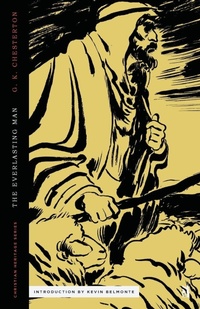
The Everlasting Man
Published on 1. January 2021
Book
Paperback/Softback
316 pages
978-1-952410-76-5 (ISBN)
Description
"In 1920, H.G. Wells wrote a two-volume work which became a best-seller, The Outline of History . . . Why not engage the same subject matter Wells had taken up, but from a perspective fully appreciative of the unique place Christianity held in human history? The result is The Everlasting Man." ~ From Kevin Belmonte's Introduction
In The Everlasting Man, a humorous defense of Christianity which inspired C.S. Lewis, Chesterton shows that once man is reduced to animal, history becomes utterly meaningless.
What truly gives man his dignity is the fact that he is so different from the beasts. What makes Christianity so different is that it tells of the story of the true man, the final man, the everlasting man, who came down in history and transformed it.
"This sketch of the human story began in a cave; the cave which popular science associates with the cave-man and in which practical discovery has really found archaic drawings of animals. The second half of human history, which was like a new creation of the world, also begins in a cave . . . It was here that a homeless couple had crept underground with the cattle when the doors of the crowded caravanserai had been shut in their faces. And it was here beneath the very feet of the passers-by, in a cellar under the very floor of the world, that Jesus Christ was born." ~ From The Everlasting Man
More details
Series
Language
English
Product notice
Paperback (trade)
Unsewn / adhesive bound
Dimensions
Height: 216 mm
Width: 140 mm
Thickness: 18 mm
Weight
400 gr
ISBN-13
978-1-952410-76-5 (9781952410765)
Copyright in bibliographic data and cover images is held by Nielsen Book Services Limited or by the publishers or by their respective licensors: all rights reserved.
Schweitzer Classification
Persons
Born and raised in London, Gilbert Keith Chesterton is well known for his satire and dry wit. In addition to his works of fiction, Chesterton wrote on theology, social criticism, and literature. He is widely considered the father of the modern detective story for his Father Brown series. Throughout his life, Chesterton wrote nearly a hundred books as well as hundreds of poems and short stories. He died in 1936 at the age of 62. His writings have served to shape more than one generation and will continue to do so for many years in the future. The Napoleon of Notting Hill is his first novel.