

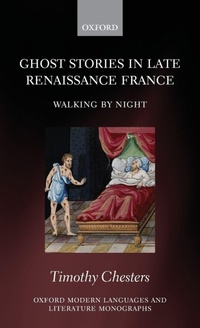
Ghost Stories in Late Renaissance France
Walking by Night
Published on 13. January 2011
Book
Hardback
298 pages
978-0-19-959980-6 (ISBN)
Description
Caught in the grip of savage religious war, fear of sorcery and the devil, and a deepening crisis of epistemological uncertainty, the intellectual climate of late Renaissance France (c. 1550-1610) was one of the most haunted in European history. Although existing studies of this climate have been attentive to the extensive body of writing on witchcraft and demons, they have had little to say of its ghosts. Combining techniques of literary criticism, intellectual history, and the history of the book, this study examines a large and hitherto unexplored corpus of ghost stories in late Renaissance French writing. These are shown to have arisen in a range of contexts far broader than was previously thought: whether in Protestant polemic against the doctrine of purgatory, humanist discussions of friendship, the growing ethnographic consciousness of New World ghost beliefs, or courtroom wrangles over haunted property. Chesters describes how, over the course of this period, we also begin to see emerge characteristics recognisable from modern ghost tales: the setting of the 'haunted house', the eroticised ghost, or the embodied revenant. Taking in prominent literary figures including Rabelais, Ronsard, Montaigne, d'Aubigne, as well as forgotten demonological tracts and sensationalist pamphlets, Ghost Stories in Late Renaissance France sheds new light on the beliefs, fears, and desires of a period on the threshold of modernity. It will be of interest to any scholar or student working in the field of early modern European history, literature or thought.
Reviews / Votes
Among the many merits of this readable, informative, erudite , and stimulating study is that it makes the bold move to create its object, an initiative that will surely enable subsequent scholars to explore the cultural and textual world that Timothy Chesters has opened for us ... This is a rich and useful contribution to our knowledge of late sixteenth- and early seventeenth-century France. * John D. Lyons, French Studies * Chesters's analysis of ghosts walking by night has the same quality of catching their presence in multiple forms, through many voices spread across a rich panorama of texts wonderfully controlled, and with their knotty problems set forth with startling clarity. * Margaret M. McGowan, Times Literary Supplement * Timothy Chesterss ground-breaking contribution to this field focuses on the dominant discursive space for writing on ghosts in the period: prose narrative. This ambitious study implements a truly interdisciplinary approach, weaving together literary criticism, intellectual history, theological debate, and the history of the book ... Chesters writes with both warmth and elegance, making a compelling argument while maintaining an acute sense of critical nuance (light, darkness, and the greys between) throughout. * Jennifer Oliver, Modern Language Review * Chesters has produced a valuable study of interest not only to scholars of early modern literature and history, but also to folklorists looking for historical background on the ghost story. * Anne E. Duggan, French Review * The result is a deftly and wittily argued book that is full of fresh insights. * Stuart Clark, Common Knowledge *More details
Series
Language
English
Place of publication
Oxford
United Kingdom
Target group
College/higher education
Professional and scholarly
Dimensions
Height: 222 mm
Width: 145 mm
Thickness: 21 mm
Weight
554 gr
ISBN-13
978-0-19-959980-6 (9780199599806)
Copyright in bibliographic data and cover images is held by Nielsen Book Services Limited or by the publishers or by their respective licensors: all rights reserved.
Schweitzer Classification
Person
A specialist in early modern French literature and thought, Timothy Chesters was awarded his doctorate at Balliol College, Oxford, in 2005. Since then he has taught in Oxford and Royal Holloway, University of London, where he has been a lecturer in Modern Languages since 2007. Besides his work on ghosts and demonology, his research interests include nineteenth-century attitudes towards the early modern, and the relationship between phenomenology and literature in the work of Maurice Merleau-Ponty and the Geneva School of literary criticism. His latest project is a book on Flaubert and the French Renaissance.
Content
INTRODUCTION; PART ONE: GHOSTS AND RELIGION; PART TWO: GHOSTS BEYOND RELIGION; PART THREE: STORIES; CONCLUSION: 'PLUS JE ME HANTE...'; BIBLIOGRAPHY; INDEX