

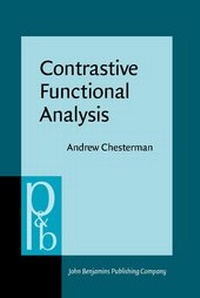
Contrastive Functional Analysis
Published on 15. March 1998
Book
Hardback
230 pages
978-90-272-5060-5 (ISBN)
Description
Why is a raven like a writing-desk? The concept of similarity lies at the heart of this new book on contrastive analysis. Similarity judgements depend partly on properties of the objects being compared, and partly on what the person judging considers to be relevant to the assessment; similarity thus has both objective and subjective aspects. The author shows how contrastive analysis and translation theory make use of the concept in different ways, and explains how it relates to the problematic notions of equivalence and tertium comparationis. The book then develops a meaning-based contrastive methodology, and outlines one theory of semantic structure which can be used in this methodology. The approach is illustrated with four sample studies covering different kinds of phenomena in some European languages. The final part of the book proposes an extension of the theoretical framework to cover contrastive rhetoric: the aim is to suggest a unified approach linking aspects of semantics, pragmatics and rhetoric.
Keywords: similarity, contrastive analysis, functional grammar, semantics, rhetoric, translation.
Keywords: similarity, contrastive analysis, functional grammar, semantics, rhetoric, translation.
More details
Series
Language
English
Place of publication
Amsterdam
Netherlands
Target group
Professional and scholarly
Dimensions
Height: 245 mm
Width: 164 mm
Weight
440 gr
ISBN-13
978-90-272-5060-5 (9789027250605)
Copyright in bibliographic data and cover images is held by Nielsen Book Services Limited or by the publishers or by their respective licensors: all rights reserved.
Schweitzer Classification
Other editions
Additional editions
Andrew Chesterman
Contrastive Functional Analysis
E-Book
03/1998
1st Edition
John Benjamins Publishing Company
€130.99
Available for download
Person
Content
1. Preface; 2. Contrastive; 3. Functional; 4. Analysis; 5. Rhetoric; 6. Closing Comments; 7. References; 8. Author Index; 9. Subject index